HBCU commissioners again urge Congress to back SCORE Act
HBCU leaders say the SCORE Act could shape who stays, who leaves and who can keep up, as 48 schools fight a widening NIL and roster gap.
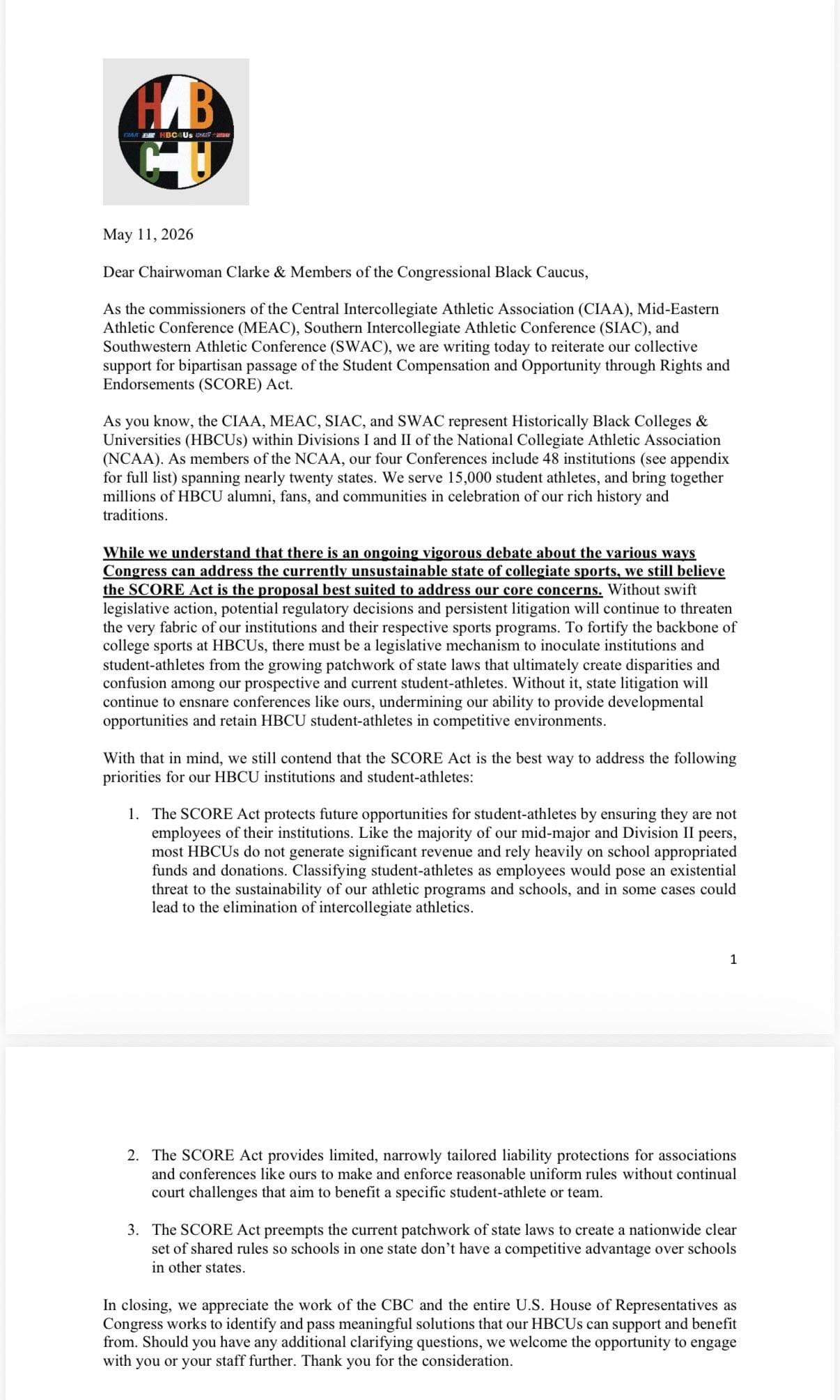
HBCU football’s biggest concern is no longer just signing day. Federal NIL rules and roster protections could decide whether schools can keep returning starters, close resource gaps and stay competitive against programs with far more money, and the leaders of the CIAA, MEAC, SIAC and SWAC are again pressing Congress to act.
In a second letter sent May 11 to Congressional Black Caucus chair Yvette Clarke, commissioners Jacqie McWilliams Parker, Sonja Stills, Dr. Anthony Holloman and Dr. Charles McClelland renewed support for the SCORE Act, the Student Compensation and Opportunity through Rights and Endorsements Act. Their message was plain: HBCU athletic departments need a national framework, not a patchwork of state NIL laws, if they are going to manage recruiting, retention and competition on something closer to level ground.

The four conferences carry real football weight. Together they represent 48 institutions and roughly 15,000 student-athletes across nearly 20 states, a footprint that stretches from Division I into Division II and reaches deep into the FCS ecosystem. For those schools, the issue is not theoretical. The commissioners have argued that if student-athletes are classified as employees, the result would be an existential threat for many HBCU athletic departments already working with smaller budgets and thinner margins than the sport’s biggest brands.
The SCORE Act itself was introduced in the House on July 10, 2025, with language aimed at protecting NIL rights and promoting fair competition in intercollegiate athletics. House action moved it forward later that year, including a 7-4 Rules Committee report on Dec. 1, 2025, and supporters have cast it as the clearest path to consistent NIL standards across college sports. For HBCU leaders, that consistency matters because it affects who can be retained, how teams are built and whether a roster can survive the transfer churn that now hits every level of the sport.
This was the second HBCU conference letter on the bill, following an earlier one in September 2025 that drew criticism from Rep. Terri Sewell, who said the support undercut negotiations. The political fight widened further on May 18, 2026, when the Congressional Black Caucus announced unanimous opposition to the SCORE Act. That response underscored how much is riding on the bill for HBCU athletics: not just policy language in Washington, but the competitive future of programs trying to protect tradition, visibility and the chance to keep pace.
This article was produced by Prism’s automated news system from verified source data, official records, and press releases, then run through automated quality and moderation checks before publishing. The system is built and supervised by the people who set the standards it runs under. Read our full AI policy.
Did this article answer your question?