How FCS football's three signature awards crown stars each season
FCS football’s three big individual awards tell you who owned the season: the offensive centerpiece, the defensive wrecking ball, and the freshman who announced himself early.

Three trophies do a better job than most box scores at explaining who actually mattered in an FCS season. The Walter Payton Award, Buck Buchanan Award and Jerry Rice Award split star power into three clean categories: offense, defense and freshman breakout value. That structure is why they work as a decoder for the subdivision, and why one school producing more than one winner can signal a true program surge.
The three awards, and what each one really measures
The Walter Payton Award is the oldest of the three, first handed out in 1987. It originally recognized the best player in the FCS overall, but its meaning shifted after the Buck Buchanan Award arrived in 1995. From that point on, Payton became the subdivision’s offensive player of the year honor, a cleaner way to isolate the quarterback, running back or all-purpose force driving production.
The Buck Buchanan Award also debuted in 1995, and it exists for a different kind of dominance. It goes to the most outstanding defensive player in the FCS, which means the winner usually looks less like a highlight compiler and more like a game-wrecker who tilts protections, forces bad throws and wrecks drives before they start. The Jerry Rice Award came later, in 2011, and it fills the developmental lane by honoring the most outstanding freshman.
That split matters because it keeps the awards from overlapping too much. One trophy captures established offensive production, one captures defensive impact, and one captures the player who is already changing the shape of a season before he has even had time to age into the level. Together, they give a much sharper read on FCS star power than a generic all-purpose honor ever could.
Why the timing makes the awards feel like pure regular-season judgment
These awards are not postseason trophies dressed up as regular-season honors. Voting is completed before the FCS playoffs begin, and that gives the process a specific edge: the winners are selected on what they did when the entire subdivision was watching the same stretch of games, not on how their teams finished in December.
The Payton Award is chosen by a national panel of more than 150 sports information and media relations directors, broadcasters, writers and other dignitaries. The Jerry Rice Award uses a smaller national panel of more than 40 voters. The Payton and Buchanan winners are revealed at the STATS FCS Awards Banquet and Presentation the night before the championship game, while the Jerry Rice winner is announced after the regular season. That setup keeps each honor tied to the same evaluative window while still giving the award presentation its own stage.
For fans, that means the trophies are best read as a snapshot, not a coronation. A team can make a deep playoff run and still not alter the voting already finished. The regular season is the point, and the awards say who had the most complete body of work before the bracket ever began.
The names on the awards still carry football history
The trophies are also memorable because the names on them are bigger than college football. Walter Payton, Junious Buck Buchanan and Jerry Rice all became NFL legends, but each name brings a different football identity into the FCS conversation.
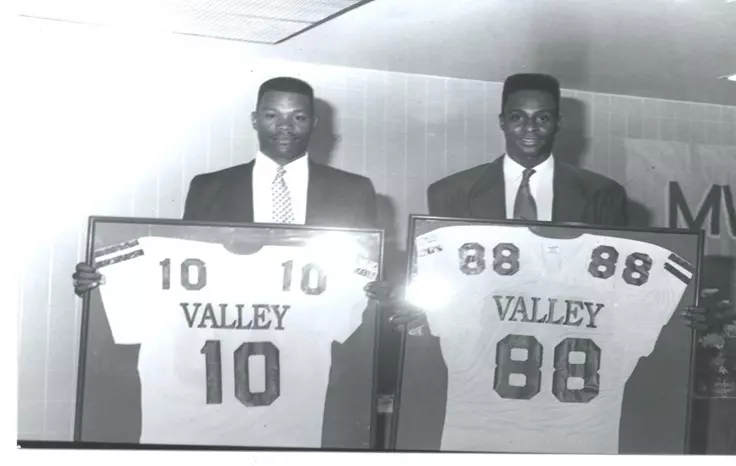
Payton signals the kind of star who can carry an offense with rushing, receiving and all-purpose production. Buchanan stands for the defensive force who can control a line of scrimmage or blow up an opponent’s rhythm from the snap. Rice connects the award to a college-to-pro receiving icon who started at Mississippi Valley State and became one of the defining pass-catchers in football history. That mix gives each honor a built-in reference point, so when an FCS player wins one, the comparison is immediate and understandable.
The legacy also helps casual fans read the awards quickly. A Payton winner is usually the player who makes the offense function. A Buchanan winner is the one opponents have to game-plan around. A Rice winner is the freshman who arrives already looking too advanced for his class.
Recent winners show how the awards map real programs, not just positions
Recent winners make the awards feel less ceremonial and more like a season-by-season record of who actually controlled the subdivision. Youngstown State quarterback Beau Brungard won the 2025 Walter Payton Award, which places him in the offensive spotlight as the FCS’s top player on that side of the ball. Mercer defensive end Andrew Zock took the 2025 Buck Buchanan Award, a reminder that defensive edge players can be just as central to the national conversation as quarterbacks.
Mercer quarterback Braden Atkinson earned the 2025 Jerry Rice Award, and that is the kind of detail that makes the trophy set especially useful. Mercer had a defensive end winning the Buchanan Award and a quarterback winning the Rice Award in the same season, which says something bigger than a pair of individual honors. It suggests a program with impact at both ends of the roster, and that kind of overlap is the sort of legacy stat fans remember when they are trying to separate a good season from a meaningful one.
The 2025 names also show how these awards track different stages of development. Brungard represents proven offensive production. Zock represents full-scale defensive disruption. Atkinson represents the freshman who forced his way into the conversation immediately. Put together, they show why the three awards are more useful as a guide than any single all-FCS label.
How to read FCS star power through these trophies
If you want the quickest read on an FCS season, start with the three winners and work outward from there. The Payton Award tells you which offensive player did the most damage over the regular season. The Buchanan Award tells you which defender made opponents change the way they played. The Rice Award tells you which freshman was too good to ignore.
That is the cleanest map of FCS excellence because it captures three separate truths at once: who carried the ball, who stopped it and who arrived before anybody expected him to. The awards have lasted because they do not blur those jobs together. They isolate them, and in a subdivision built on production and opportunity, that is the sharpest way to tell the story of the season.
This article was produced by Prism’s automated news system from verified source data, official records, and press releases, then run through automated quality and moderation checks before publishing. The system is built and supervised by the people who set the standards it runs under. Read our full AI policy.
Did this article answer your question?