Marshall Faulk hire spotlights growing FCS trend of ex-stars coaching
Southern’s Marshall Faulk hire shows why FCS schools are betting on star power: instant credibility, recruiting juice and a faster path to attention, but also real coaching risk.

Marshall Faulk hire spotlights growing FCS trend of ex-stars coaching
The Bayou Classic win changed the temperature fast
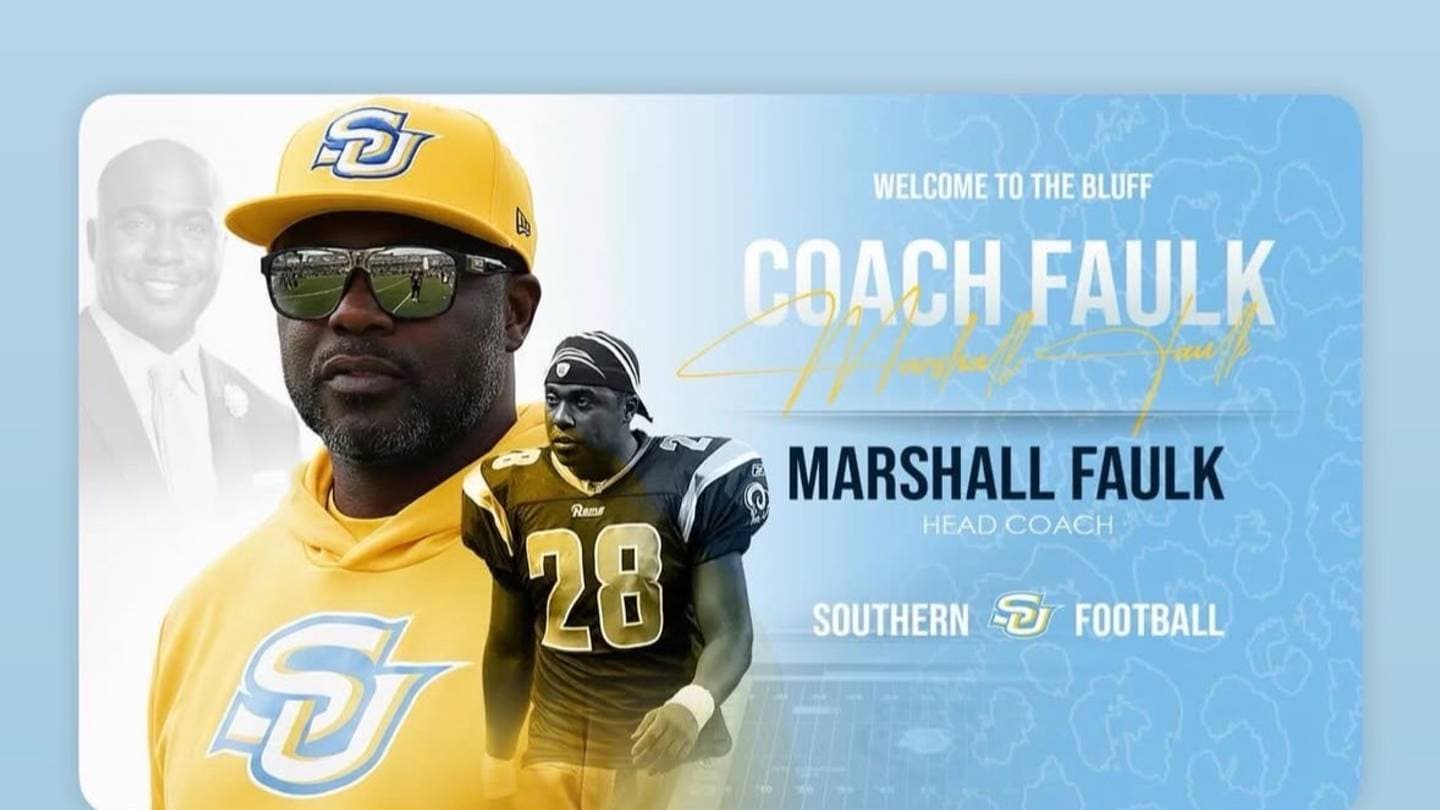
Southern did not just beat Grambling State 28-27 in the Bayou Classic and enjoy the moment. The Jaguars turned that late-November win into a springboard, naming Marshall Faulk, 52, their head coach on November 29, 2025. That sequence matters because it shows how quickly FCS programs can move when they see a chance to grab a recognizable football brand and attach it to the sideline.
Faulk arrives with a Hall of Fame playing résumé and only a brief coaching trail behind it, after serving as an assistant on Deion Sanders’ Colorado staff in 2025. That is the tension at the center of the hire: Southern is not buying a long resume of coordinator stops or rebuilding jobs. It is betting that a legendary player can bring authority, attention and a different kind of energy to Baton Rouge.
What Southern believes it is buying
At the FCS level, a name like Faulk can do more than fill a press conference. It can get recruits to listen longer, donors to lean in faster and players to believe the program is moving somewhere bigger than its current record. That is the currency here: credibility, visibility and momentum.
The upside is obvious. Faulk can walk into a room and command respect before he has even installed a playbook. He knows what elite football looks like, and Southern is clearly hoping that his presence helps translate that standard into a daily culture. But star power is not roster construction, and it does not automatically solve the grind of evaluating transfers, retaining players, building a staff and keeping a program steady from Tuesday practice through Saturday afternoon.
Why the FCS is open to this kind of gamble
The subdivision has become fertile ground for this exact type of hire because the operating reality is different from the Power Four. Many FCS schools cannot spend months waiting for the perfect polished coaching candidate. They need someone who can recruit, motivate and stabilize a roster quickly, even if the coach is still learning the administrative and tactical parts of the job.
That is why Faulk’s hire fits a broader pattern instead of standing as a one-off curiosity. The 2025-26 FCS coaching carousel was unusually active, with Opta Analyst’s tracker counting 25 head-coaching changes entering the 2026 season, two more than the previous cycle. More turnover means more openings, and more openings mean more room for unconventional names to get a real shot.
The NCAA rule change helped widen the doorway
The coaching market also shifted under a new NCAA rule adopted in June 2024. Division I removed some restrictions and allowed any football staff member to provide technical and tactical instruction to student-athletes. That may sound like a bureaucratic tweak, but it matters for former players and nontraditional hires because it makes the staffing model more flexible.
In practical terms, the rule gives schools more room to use people who know football at a high level, even if they are still building the traditional coaching ladder. For someone like Faulk, that is an important on-ramp. He does not need to fit the old mold to be useful, and that is exactly why programs like Southern are willing to take the bet.
The celebrity coach model is not just about the head coach
Faulk’s hire also signals how these jobs ripple beyond one press release. Reports indicated he was putting together a staff that included former NFL figures such as Donald Penn, and later reports said former Southern standout Anthony Balancier would coach defensive backs in 2026. That combination is revealing: the head coach is the headline, but the staff tells you whether the program is trying to build a real infrastructure or just chase buzz.
A staff full of recognizable names can help with recruiting visits and donor conversations, but it still has to function on game day. Position coaches have to teach details, manage personalities and handle the weekly adjustments that decide close FCS games. That is where celebrity hires get tested, because the job is not a highlight reel. It is repetition, accountability and a lot of unglamorous work.
The real risk is that playing greatness does not equal coaching competence
This is the part that gets glossed over when fans hear a famous name. Great players do not always become great teachers, and great teachers do not always become good program managers. Faulk’s case is compelling precisely because he must prove he can do more than inspire.
The questions are concrete. Can he build a roster that survives injuries and attrition? Can he hire and empower assistants who can coach around him, not just beneath him? Can he handle the week-to-week program operation that turns a brand name into wins? Those are the questions that decide whether this is a smart FCS innovation or just the latest headline hire.
The broader FCS backdrop makes the gamble easier to understand
Southern is making this move in a subdivision that is changing around it. North Dakota State’s run of 16 consecutive winning seasons ended with its move to the FBS, while South Dakota State entered 2026 with 14 straight winning seasons above .500, the longest active streak in the subdivision. That tells you two things at once: the top of the FCS is in flux, and the bar for relevance is still high.
When a dominant program moves up and another keeps stacking winning seasons, everyone else has to find an edge somewhere else. For some schools, that edge is development. For others, it is scheme. For Southern, it is clear they see an edge in identity, attention and the possibility that a Hall of Fame player can accelerate a program’s growth faster than a safer, more conventional hire.
Faulk’s move is not proof that celebrity coaching will work everywhere. It is proof that FCS schools increasingly believe the upside is worth the risk, especially when the hire can deliver immediate credibility before the first snap is ever taken.
This article was produced by Prism’s automated news system from verified source data, official records, and press releases, then run through automated quality and moderation checks before publishing. The system is built and supervised by the people who set the standards it runs under. Read our full AI policy.
Did this article answer your question?