McCullough Brings Proven UTPB Staff and System to Gardner-Webb
The OC who engineered UTPB's D2-best 4,622-yard passing attack is installing that system at Gardner-Webb, where three roster questions will define McCullough's first FCS season.

When a passing offense leads all of Division II in yardage and averages 37.1 points per game, the people who built it tend to travel together. Kenneth Hrncir is arriving in Boiling Springs as offensive coordinator and quarterbacks coach, carrying the precise scheme he helped produce at UT Permian Basin into Gardner-Webb's 2026 program alongside head coach Kris McCullough.
McCullough went 28-10 over three seasons at UTPB and guided the Falcons to an 11-3 record and a Division II quarterfinal appearance in 2025, finishing with 37 wins over four total seasons. His full Gardner-Webb coaching staff announcement completes a deliberate transplant: four assistants made the move from West Texas to Boiling Springs, bringing shared terminology, a calibrated work rhythm, and a system that has already been stress-tested at a high level of competition.
The offensive blueprint centers on Hrncir and co-offensive coordinator Brayle Brown, who also coaches tight ends. UTPB's 2025 unit produced 4,622 passing yards, the most in Division II, while Brown's units registered 40.2 points per game in 2024. Together they represent a spacing-and-tempo attack that demands high pass volume, fast ball distribution, and a quarterback with the processing speed to manipulate safeties pre-snap. Hrncir knows the system from the inside: he was UTPB's starting quarterback when he won Lone Star Conference Offensive Player of the Year in 2023, the same season McCullough earned LSC Coach of the Year. As the OC who now teaches what he once ran, Hrncir is positioned to accelerate quarterback development in ways a first-time installer rarely can.
That brings the first immediate question for 2026: who runs this offense? In 2025, transfers Nate Hampton, from Liberty, and Cole Pennington, from Marshall, competed for Gardner-Webb's starting job. Whichever quarterback remains, or arrives through the portal, must demonstrate the downfield processing and rhythm release the system requires. Hampton reportedly excelled during his initial time with the program, but Hrncir's scheme will demand more than physical tools. It requires a quarterback who can work from structure and trigger quickly, and the portal competition for that role will be the most consequential personnel decision of the offseason.
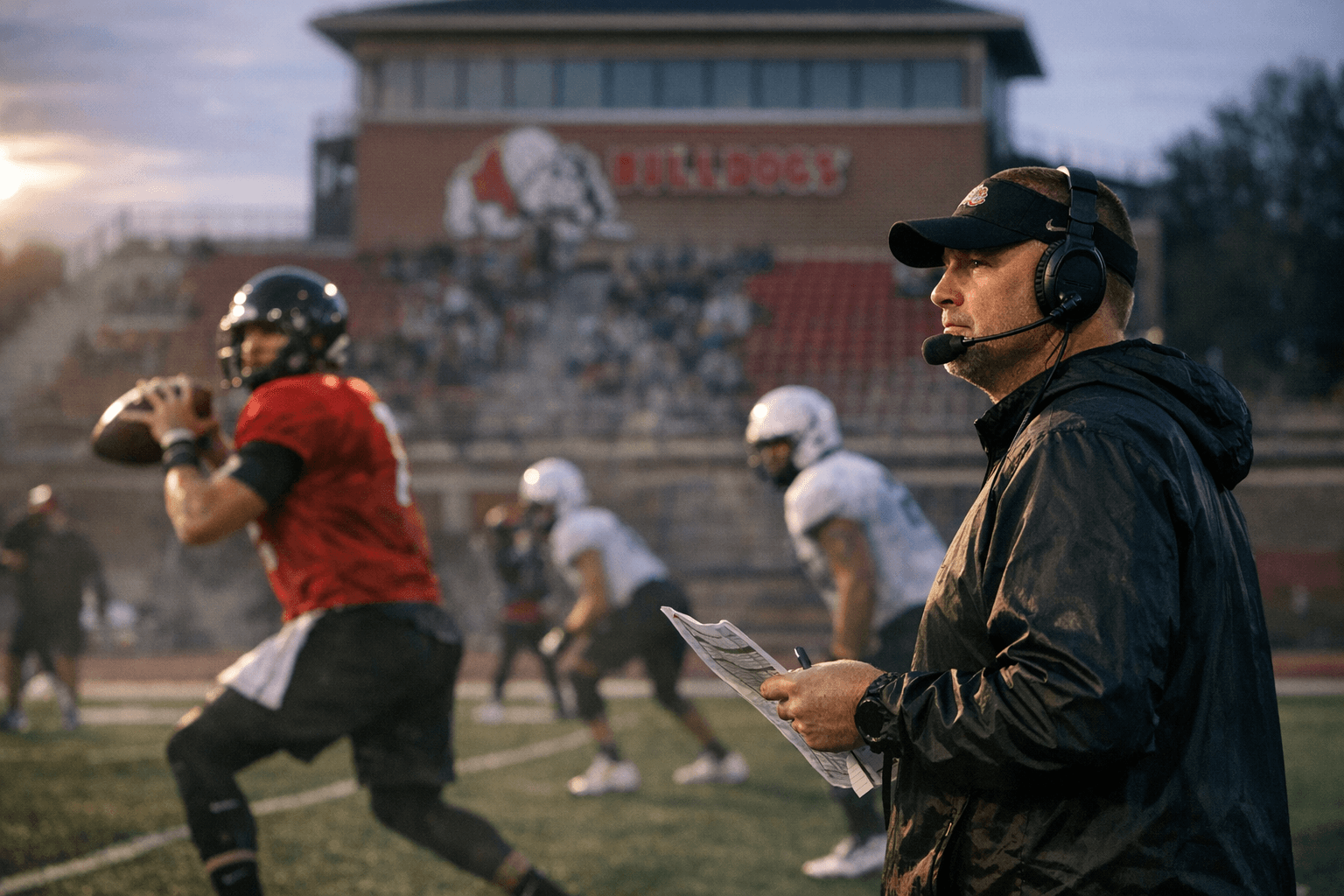
The second question is the offensive line. UTPB's volume passing game was built on protection concepts suited to Division II competition. At the FCS level, defensive fronts are heavier and more varied schematically. A clean 2.5-second pocket is not guaranteed, and the Runnin' Bulldogs' ability to absorb edge pressure while maintaining tempo will determine how cleanly the blueprint translates. Ryver Rodriguez, who joins as running backs coach, will also play a role in how the staff deploys the run game as a complementary constraint on defensive alignments.
On defense, Jacob Shaw takes over as coordinator and linebackers coach, with Devin Gaulden installed as the defensive pass-game coordinator. Their shared vocabulary with McCullough's concepts means installation moves faster, but the third question involves how this unit creates pressure and forces turnovers against FCS offenses. Gaulden's specific assignment targeting the pass game signals a philosophy oriented toward disrupting quarterbacks early in the play clock rather than absorbing yardage and tackling. Whether the personnel already on Gardner-Webb's roster fits a pressure-oriented scheme, or whether the portal must supply the edge, will shape how Shaw's defense looks by September.
McCullough's hire reflects a broader FCS pattern: importing a functional coaching unit from a lower division, bypassing the installation year entirely, and beginning from execution. For Gardner-Webb, the three-question checklist at quarterback, along the offensive line, and at the defensive edge represents the difference between a fast start and a slow one. The infrastructure to compete is in place; what happens in the next 90 days of roster-building will determine how quickly it shows.
This article was produced by Prism’s automated news system from verified source data, official records, and press releases, then run through automated quality and moderation checks before publishing. The system is built and supervised by the people who set the standards it runs under. Read our full AI policy.
Did this article answer your question?