NCAA Explains FCS Conference Realignment Shifts, Moves and Competitive Impacts
North Dakota State's departure to the Mountain West strips the MVFC of its decade-long superpower, reshaping playoff math for every team left behind.

Few departures in FCS history carry the weight of North Dakota State's exit from the subdivision. The Bison collected 10 national championships in a 14-year window from 2011 to 2024, won the Missouri Valley Football Conference title 12 times, and built the most recognizable brand in the subdivision. Their move to the Mountain West as a football-only member in 2026, and the NCAA's updated explainer mapping all of these shifts, is the lens through which every FCS competitive calculation now runs.
The Two Departures That Reshape Everything
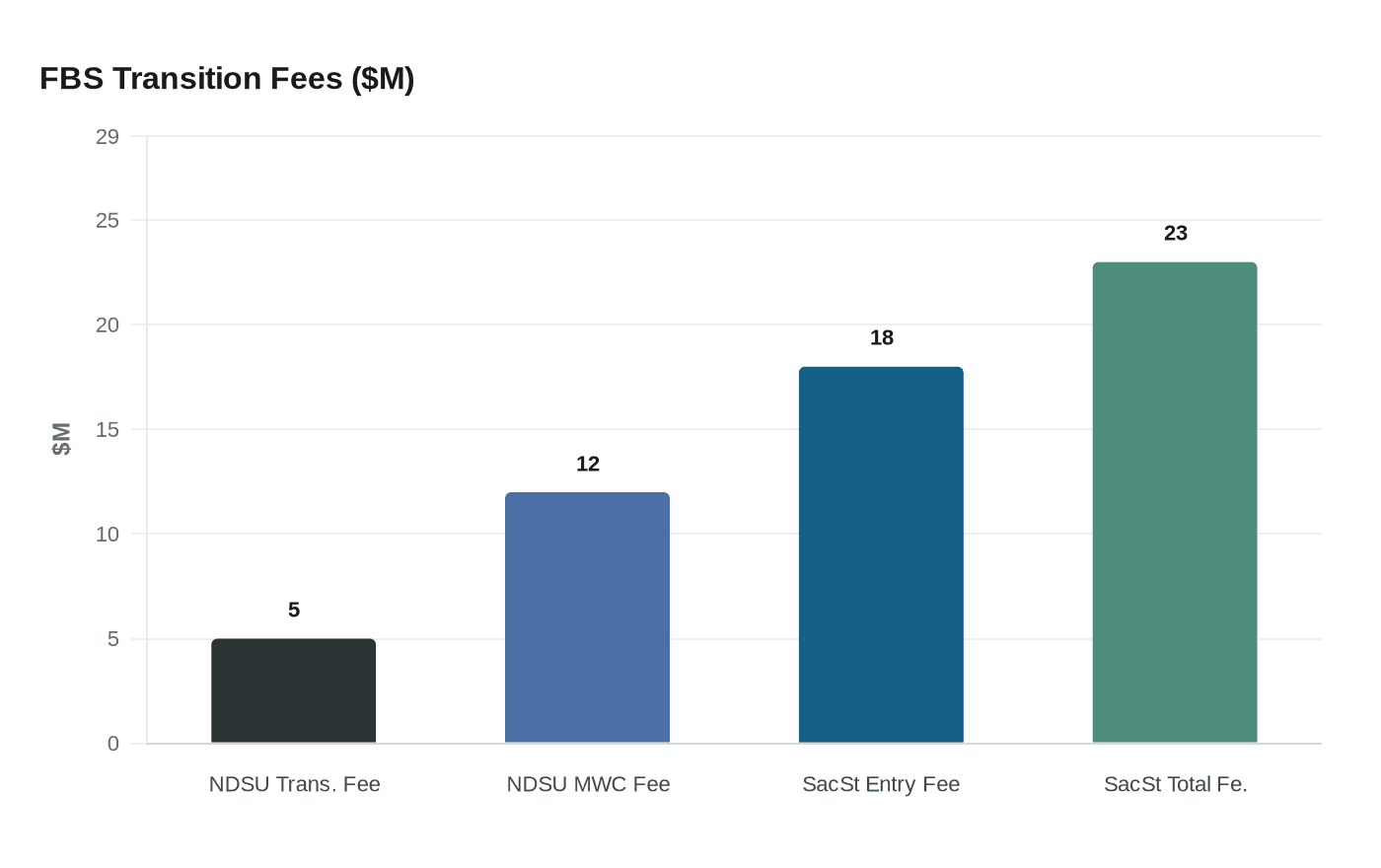
North Dakota State is leaving for the FBS, joining the Mountain West Conference as a football-only member. The financial commitment alone signals how serious this transition is: the FCS-to-FBS transition fee is $5 million, and NDSU will pay the Mountain West more than $12 million to join the league. The Bison will not be immediately competing for bowl games, either. They will be eligible for postseason and CFP competition beginning in 2028. NDSU is petitioning for an exemption to the standard two-year waiting period, pointing to a track record that includes a 9-5 record against FBS opponents since moving to FCS in 2004, including an away win at Iowa in 2016 when the Hawkeyes were ranked No. 13.
The second high-profile departure involves Sacramento State, whose path out of the FCS proved far more turbulent. In April 2025, Sacramento State filed an application and waiver to transition from FCS to FBS as a football independent starting in 2026, but that waiver was denied by the Division I Council, which is made up of FBS administrators. The Hornets do not bring quite the same prestige as the Bison but have found real success at the FCS level, winning the Big Sky Conference three times in the last decade, taking home titles in 2019, 2021 and 2022. The MAC voted to add the Hornets as a football-only member beginning in 2026, and the school will pay about $23 million in total fees, including an $18 million entrance fee. Sacramento State's non-football sports, meanwhile, are moving to the Big West Conference, making the Hornets one of the more prominent examples of the split-affiliation model proliferating across FCS.
The MVFC After NDSU: Winners, Losers, and a Playoff Math Problem
With NDSU's departure, the MVFC will consist of nine members this fall: Illinois State, Indiana State, Murray State, North Dakota, Northern Iowa, South Dakota, South Dakota State, Southern Illinois, and Youngstown State. MVFC members will continue to play an eight-game conference football schedule.
On the surface, South Dakota State inherits the throne. The Jackrabbits have themselves claimed multiple national championships and now enter 2026 without the one program that could consistently challenge them for the conference's autobid. But here is the playoff math problem that FCS selection committee watchers should flag: the committee weighs schedule strength heavily when awarding at-large bids. In 2025, the MVFC dominated the postseason scene with six teams in the bracket. That kind of representation was built, in part, on the back of every MVFC team having NDSU on its resume. Without a Bison game to point to, the collective strength-of-schedule rating for Illinois State, Northern Iowa, Southern Illinois, and Youngstown State drops measurably. A conference that habitually sent six teams to the playoffs could find itself fighting for four or five at-large spots in 2026, even if its teams are just as good. South Dakota State gets a cleaner path to the no. 1 seed in the FCS bracket; the rest of the conference carries less ammunition when pleading their at-large cases to the selection committee.

The Big Sky Adds Two Utah Programs, Loses Its California Anchor
Former Big Sky member Southern Utah will return to the conference, and Utah Tech will join in a move from the WAC and United Athletic Conference for football. The Big Sky will grow to 13 football members with the departure of Sacramento State and the additions of the two Utah schools.
The 2026 Big Sky Conference programs will be: Cal Poly, Eastern Washington, Idaho, Idaho State, Montana, Montana State, Northern Arizona, Northern Colorado, Portland State, UC Davis, Weber State, Southern Utah and Utah Tech. The geographic center of the conference shifts modestly southward with Cedar City (Southern Utah) and St. George (Utah Tech) now on the schedule, replacing Sacramento's Bay Area-adjacent footprint. For programs anchored in Montana, like Montana and Montana State, the new travel loop now extends deeper into Utah while Sacramento drops off the calendar entirely. That is the conference's longest new travel arc, and it runs through two programs that will need to prove they belong against a Big Sky slate that has produced consistent national contenders.
The CAA-to-Patriot League Pipeline Becomes a Pattern
Villanova became the third school to announce that it will leave the CAA for football and join the Patriot League for football in 2026, and the Wildcats will remain in the Big East for all other sports. Villanova and William & Mary depart CAA Football to join the Patriot League in 2026 as football-only members, following Richmond, who made a similar conference jump starting in the 2025 season.
In 2026, the Patriot League will expand to 10 teams: Bucknell, Colgate, Fordham, Georgetown, Holy Cross, Lafayette, Lehigh, Richmond, Villanova, and William & Mary. Three programs, all of them programs with long FCS playoff histories and institutional prestige, have left the CAA in the span of two seasons. The Patriot League now has enough depth to credibly challenge for multiple at-large bids alongside its automatic qualifier, fundamentally altering how the selection committee views that league's representative.
Since 2021, CAA Football has seen significant restructuring. James Madison moved to the FBS ranks in 2021, Hampton and Monmouth joined in 2022, and North Carolina A&T and Campbell became members in 2023. Sacred Heart, located in Fairfield, Connecticut, will become a CAA member in 2026 after being an FCS independent in 2024 and 2025, bringing the league to 13 football-playing members. The CAA continues to expand its geographic footprint while shedding its traditional mid-Atlantic identity, a transformation that will test whether its recruiting pitch and brand travel as far south as Campbell and as far north as Maine.
Football-Only Deals and the Split-Affiliation Trend
The Villanova arrangement is a textbook example of the football-only model that has spread throughout FCS realignment. The Wildcats compete in the Big East for basketball, soccer, and nearly every other sport, but their football program will now operate inside a different conference entirely. Sacramento State does the same in reverse, with football in a MAC that operates at the FBS level while everything else runs through the Big West. The United Athletic Conference is a football-only league for football-playing members of the ASUN and the WAC. These arrangements exist because the financial and competitive incentives for football often do not align with the rest of a school's athletic department, and they create real administrative complexity around scheduling, travel budgets, and the conference loyalties that drive fan bases.
Transition Rules and Postseason Eligibility
Coaches selling recruits on any of these transitioning programs need to understand the postseason eligibility framework the NCAA enforces. Schools making the jump from FCS to FBS serve a two-year period of ineligibility for bowl games and playoff competition. In the earlier wave of transitions, Sam Houston and Jacksonville State began their FBS transition in 2022 and were ineligible for postseason play while remaining in their respective conferences. Similarly, Kennesaw State began its FBS transition in 2023 and was ineligible for postseason play before officially joining the FBS in 2024. NDSU is seeking an exemption from that standard timeline, a request that signals just how unprecedented its profile is as an FCS program entering the FBS era.
Of the 13 FCS conferences, eight will see some movement and realignment in 2026, and when the season gets underway, there will be 127 FCS programs overall. That scope of change, touching two-thirds of all FCS conferences, means that the 2026 season opens with dozens of programs navigating new rivalries, revised travel budgets, renegotiated media deals, and recruiting pitches built around conferences that looked completely different 18 months ago.
The MVFC, stripped of its flagship, now has a genuine wide-open race for the first time since the Obama administration. That is the most consequential single fact of this entire realignment cycle, and every team still standing in Fargo's old division will spend 2026 trying to prove it belongs at the top of the bracket without the Bison around to provide the answer.
This article was produced by Prism’s automated news system from verified source data, official records, and press releases, then run through automated quality and moderation checks before publishing. The system is built and supervised by the people who set the standards it runs under. Read our full AI policy.
Did this article answer your question?