NCAA history shows FCS upset blueprint against FBS powers
The NCAA's upset ledger shows FCS shocks follow a repeatable script: efficient quarterbacks, elite teams and a 63-scholarship ceiling keep the gap bridgeable.
The NCAA’s upset ledger shows FCS wins over FBS powers are not one-off miracles. Since Division I split into I-A and I-AA for the 1978 season, the same pattern has surfaced again and again, from the first landmark ranked shock to six more FCS-over-FBS upsets in 2024.
The history is long enough to be a scouting report
The all-time list reaches back to 1978 and runs through every season of the I-A and, later, FBS era. The biggest markers are easy to remember because they changed how the subdivision was viewed: Cincinnati over No. 20 Penn State in 1983, Appalachian State over No. 5 Michigan in 2007, James Madison over No. 13 Virginia Tech in 2010, Eastern Washington over No. 25 Oregon State in 2013, North Dakota State over No. 13 Iowa in 2016, and Montana over No. 20 Washington in 2021.
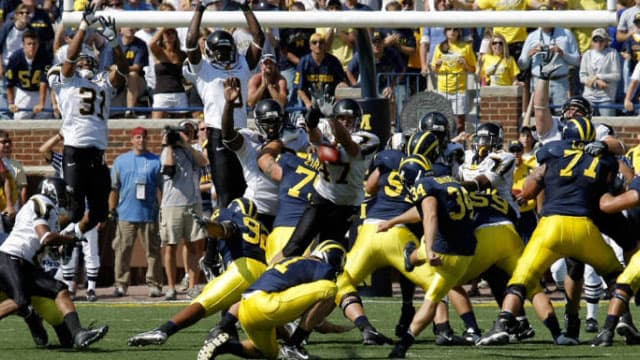
Some of those games became defining scenes because of how they ended. Appalachian State’s 34-32 win in Ann Arbor came down to a blocked field goal in the final minute, the kind of play that turns an upset from a possibility into a permanent part of college football memory. Eastern Kentucky’s 59-57 win over Bowling Green in 2022 went seven overtimes, the second-longest FCS game ever, which is another reminder that the line between a close loss and a program-shaping win can be paper thin.
The real blueprint starts at quarterback
The cleanest edge in the NCAA’s own blueprint article is quarterback efficiency. In five FCS upsets over ranked teams, the starting quarterbacks averaged a 70 percent completion rate, a number that tells you these wins are built on precision, not hope. When the FCS team can stay on schedule, protect the ball and hit efficient throws, the talent gap gets smaller fast.
That passing efficiency matters even more when it comes with dual-threat production. The quarterbacks in those ranked upsets were not just efficient distributors, they also added enough rushing impact to stress the defense in more than one direction. That kind of production forces an FBS opponent to defend the entire field, and it keeps a favorite from simply sitting on the one thing it thinks will decide the game.
The NCAA’s broader takeaway is blunt: the best upset candidates are usually the top-tier FCS teams. That is the subdivision’s sweet spot, the programs most capable of matching execution, discipline and depth for one Saturday, even if the payroll and scholarship structure say they should not be able to.
What to watch before kickoff
The next upset is usually visible before the opening whistle if you know which indicators matter.
- A settled quarterback who can control tempo and complete throws at a high rate, not just a runner who occasionally breaks a big play.
- An offense that can create balance, because one-dimensional teams rarely survive long against a deeper FBS front.
- A defense and special teams group that can turn one hidden-yardage swing into a points swing, the way Appalachian State did in Ann Arbor with the blocked kick.
- A roster that has already spent enough time together to play cleanly under pressure, especially when the game is close enough for one turnover, one fourth-down stop or one long drive to decide it.
That last point is where the prediction work gets useful. The upsets are easiest to spot when an FCS team has veteran pieces in key spots, a quarterback who has already seen a variety of coverages and a scheme that has not changed just because the opponent’s logo is bigger. Continuity matters because the upset favorite is often the team that knows exactly who it is before September ends.
The structure keeps the door open
The reason this keeps happening is structural as much as tactical. In the FCS, the scholarship limit remains 63 equivalencies, while rosters can still carry well over 100 players. The NCAA reaffirmed that 63-equivalency limit in both 2021 and 2022, so the constraint is not an old artifact. It is still part of the competitive math today.
That ceiling does not make the FCS powerless. It makes the margins narrower, which is why elite programs can still bridge the gap against FBS opponents when they are older, cleaner and more organized on a given day. The NCAA keeps treating the number as live because it still shapes roster construction, depth distribution and who can plausibly hang around long enough to make a game uncomfortable.
Why the shocks keep repeating
The list from 1983 through 2024 proves that FCS over FBS is not folklore. Six ranked wins, six more upsets in 2024, a seven-overtime classic in 2022, and a history page that runs all the way back to the 1978 split all point to the same conclusion: the upset formula is repeatable.
When the FCS team has a veteran quarterback, efficient passing, enough rushing balance to stay unpredictable, and the discipline to survive the trenches and special teams, the favorite is suddenly playing a real game instead of a tune-up. That is the blueprint, and it is why the next shock will probably look a lot like the last one.
This article was produced by Prism’s automated news system from verified source data, official records, and press releases, then run through automated quality and moderation checks before publishing. The system is built and supervised by the people who set the standards it runs under. Read our full AI policy.
Did this article answer your question?