North Carolina A&T rebuilding in the trenches under Shawn Gibbs
North Carolina A&T’s spring game looked bigger, deeper and faster, but the real test is whether the Aggies can turn trench gains into wins.
The rebuild is happening up front
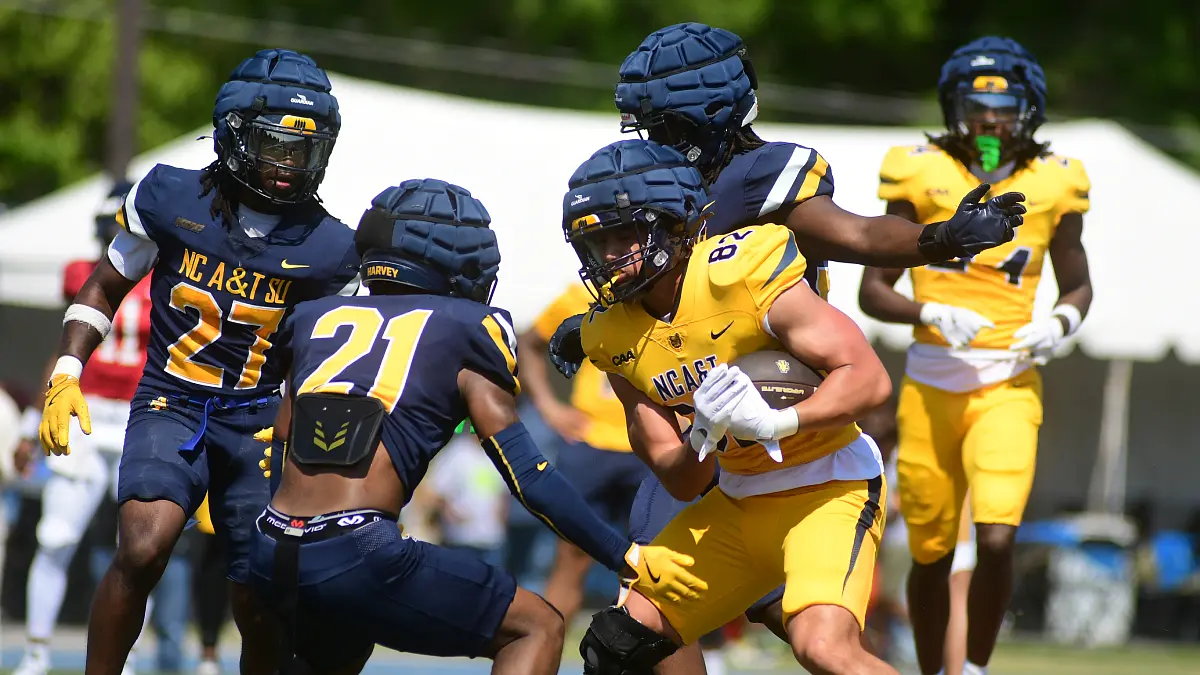
North Carolina A&T’s spring game was never going to be about a scoreboard. The real checkpoint was simpler and much more revealing: did Shawn Gibbs’ second-year plan look like a program that is finally changing shape in the trenches, on the depth chart, and in how fast it operates?
The early signs point to yes, even if the work is far from finished. After a 2-10 season in 2025 and a 2-6 mark in CAA play, A&T spent the spring trying to correct the same physical problems that showed up all fall. The Aggies averaged only 20.5 points per game while allowing 43.58, a gap that explained why size, depth and tempo became the language of the offseason.
What the spring game revealed
The situational scrimmage at Truist Stadium offered a cleaner look at where the rebuild stands. It was the team’s 15th practice of the spring, and the setting mattered: fans were in the building, more were watching on FloCollege, and the session carried the feel of a public progress report rather than a routine practice.
What stood out most was how deliberately A&T used the work. The day mixed situational periods with live reps, which fit Gibbs’ push to sharpen execution instead of merely chasing highlights. The emphasis was on getting in and out of the huddle, handling play calls and understanding situations, the sort of details that often separate a steady offense from one that stalls out on third down and late in games.
That focus fits Gibbs’ broader message. He has been clear that A&T has to master “the little things that win football games,” and the spring session showed that the staff is treating tempo, communication and spacing as part of the rebuild, not as afterthoughts.
The trench emphasis is the clearest change
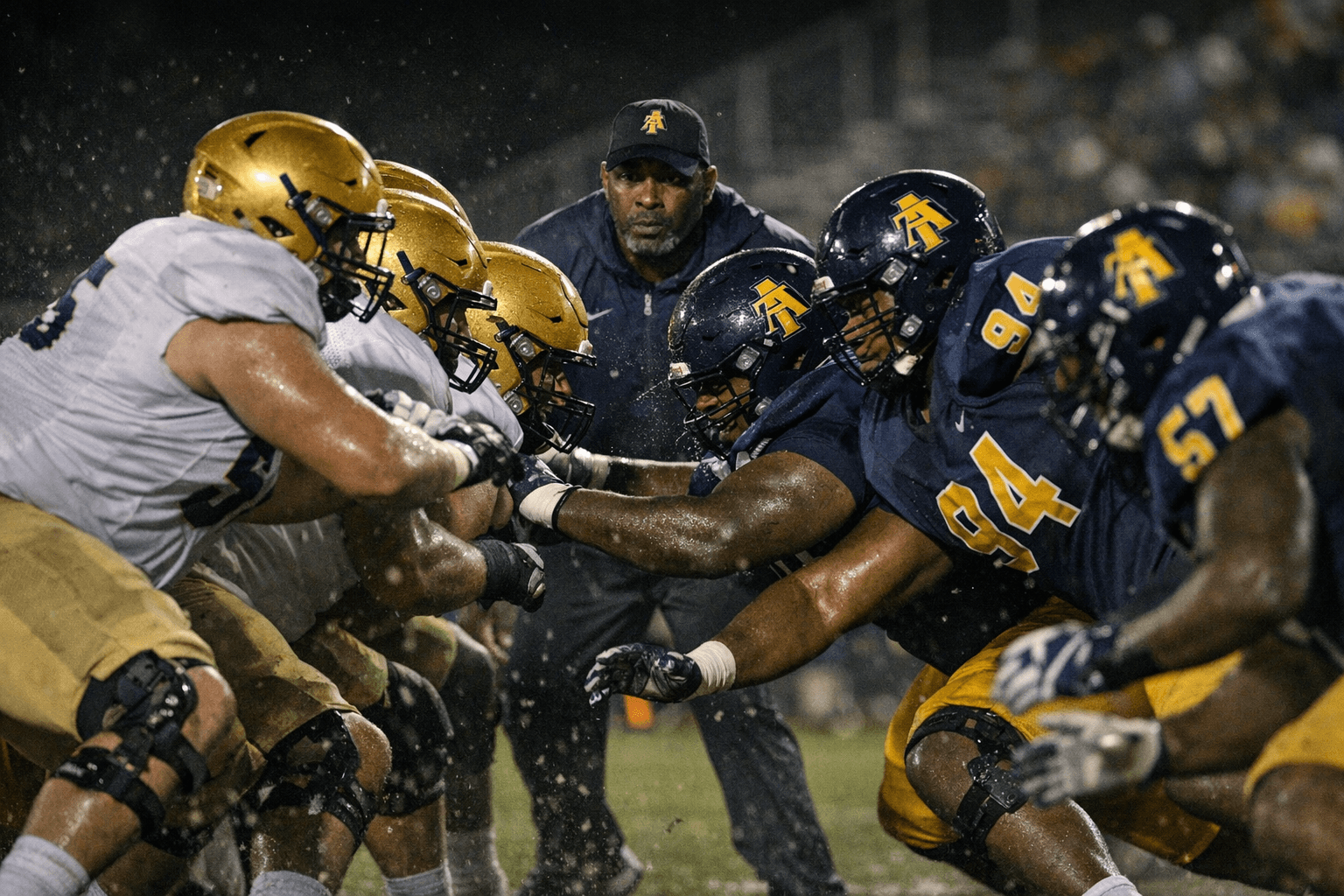
The most visible evidence of the rebuild is on the offensive line. A&T’s front featured a heavy transfer presence and a long list of bodies competing for roles: Elon transfer Ahmarion McLeod, South Carolina State transfer Eli Williams, Coastal Carolina transfer Desmond Jackson, and returning starter Andrew Dorsey. Noah Okoye, Tim Hammonds, Phinnell Marshall and CJ Ragland were also in the mix, giving the line a deeper and more crowded feel than a year ago.
That matters because A&T has long been tied to a physical rushing identity. The current staff is trying to restore that reputation, and the offensive line is where that identity either returns or disappears. Gibbs and his staff are not just looking for starters. They are trying to build a rotation that can hold up over a full CAA schedule, when injuries, fatigue and leverage battles tend to expose thin teams.
The arrival of Donovan Jackson gives that effort added weight. Jackson was hired as offensive line coach on March 17, 2026, replacing Ron Mattes after his retirement following 10 seasons with the Aggies. Jackson came from Arkansas-Pine Bluff after one season there in 2025, and Gibbs has already praised the progress he has seen from the group under the new coach. That is significant because offensive line development usually tells you more about a program’s direction than any spring scrimmage stat line ever could.
Depth is no longer optional
A&T’s offseason roster moves show that this is not a cosmetic rebuild. The Aggies signed 38 new players on Feb. 4, 2026, including 21 high school signees and 17 transfers. The class was heavily rooted in the Southeast, with 16 players from North Carolina, eight from South Carolina and seven from Georgia.
That kind of volume is a clear signal. A team coming off a season like 2025 is not merely adding competition, it is reconstructing its base. The class reflects a staff trying to create not just more talent, but more options. Depth is especially important at A&T because the Aggies already learned the hard way what happens when the roster thins out at key spots.
Quarterback was one of those spots. The 2025 offense dealt with injuries to Kevin White and veteran Alston Hooker, forcing the program to keep searching for stability behind center. That context makes the trench emphasis even more logical, because a stronger line can reduce pressure on the quarterback room and help whichever passer wins the job operate more cleanly.
Gibbs is building around culture as much as bodies
Gibbs’ return to Greensboro was a meaningful homecoming, but his second year is now about proving that the reunion can produce more than familiarity. He came back to North Carolina A&T on Dec. 6, 2024, as the program’s 23rd head coach after spending 11 seasons as an assistant during A&T’s five MEAC title seasons from 2014 through 2019.
That history matters because Gibbs knows what a winning A&T looks like. He was part of a period when the Aggies were standard-bearers in the MEAC, and he is trying to carry enough of that old physical standard into the CAA to make the transition sustainable. The program’s first CAA win under his watch in 2025 was a step, but not a finish line. This spring suggested that the next step is less about slogan-level confidence and more about turning roster size, technique and tempo into repeatable habits.
The broader cultural significance here is real, too. A&T football has always carried weight in Greensboro and across the HBCU landscape because the program’s identity has never been only about wins and losses. It has also been about toughness, visibility and the expectation that the Aggies play with a certain force. Rebuilding in the trenches is not just a football choice. It is a statement that the program still intends to look and play like itself, even in a new conference and after a rough season.
What still has to happen before the progress becomes wins
The spring feel was encouraging, but it also made the remaining work easy to see. Bigger bodies and a deeper line room do not automatically fix a defense that allowed 43.58 points per game in 2025. Better tempo does not matter if the offense cannot stay ahead of the chains. More transfers do not guarantee cohesion, especially on a line that has to learn how to move as one unit.
A&T still has to prove that the new size can absorb the physical punches of CAA football. It has to show that the rotation can survive the grind of the schedule, that the offensive line can protect the quarterback long enough to let the offense breathe, and that the little details Gibbs is stressing can hold up when games tighten in October and November.
But that is what made the spring work worth watching. The Aggies looked like a team trying to rebuild the right way, not a team hoping for a shortcut. The roster is bigger, the line room is deeper, and the operation looks more deliberate. If those traits carry into the fall, A&T has a real chance to climb back toward the kind of football Gibbs helped define before, only this time in a different league and with a clearer emphasis on winning the battle up front.
This article was produced by Prism’s automated news system from verified source data, official records, and press releases, then run through automated quality and moderation checks before publishing. The system is built and supervised by the people who set the standards it runs under. Read our full AI policy.
Did this article answer your question?