SEMO Spring Practice Drill Draws Fierce Backlash Over Player Safety Concerns
Former NFL safety Ryan Clark called SEMO's viral 1-on-3 drill "nonsensical and dangerous" after footage showed defenders diving at a ballcarrier's knees during spring practice.
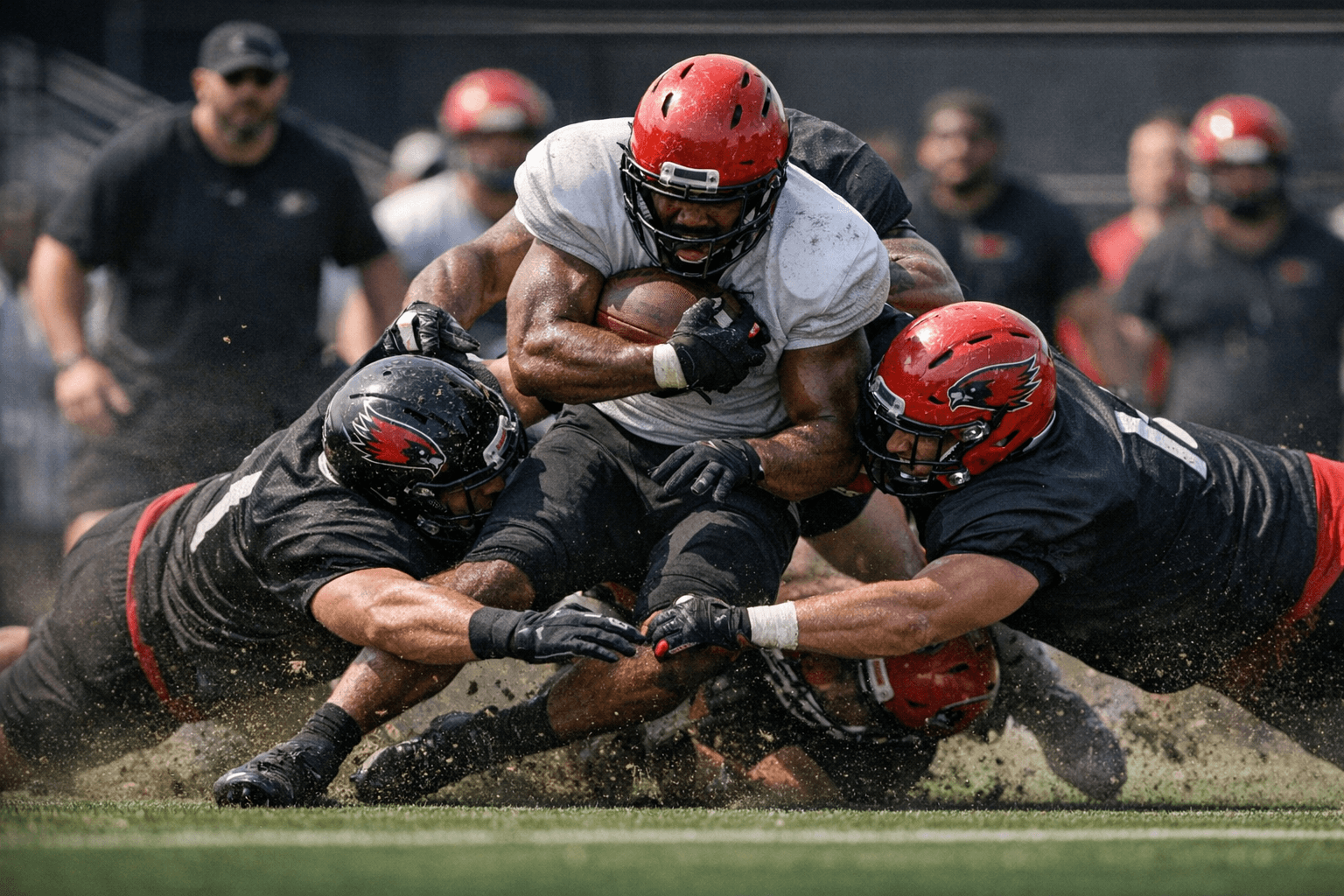
A video clip from Southeast Missouri State's March 30 spring scrimmage detonated across social media within hours of posting, and the reaction from college football's broader community was almost uniform: what head coach Tom Matukewicz called an "identity scrimmage" looked to many observers like an injury factory.
The footage, widely circulated on X by late March 31, shows SEMO's 1-on-3 drill, which closed out the morning session at Houck Field in Cape Girardeau. In it, multiple defenders drive toward a lone ballcarrier's lower body without blockers or protective structure between them, in a sequence that critics immediately compared to the long-banned Oklahoma drill. Former NFL safety Ryan Clark put the reaction bluntly: "This has to be A.I. Can't be real. I refuse to believe a coach would do this. It's nonsensical and dangerous."
Clark was far from alone. The College Transfer Portal account on X, which first amplified the clip to a wide audience, labeled it "complete stupidity" and argued it was "exactly how players end up getting hurt for no reason." The post spread to sports aggregators and national outlets within 24 hours, touching off the kind of scrutiny that usually bypasses FCS programs entirely.
Matukewicz, in his 13th year leading the Redhawks, defended the session in remarks to local reporters. SEMO brought in 28 mid-season transfers this past winter with 23 more arriving in the summer window, leaving the roster carrying 50 new players and five new coaches heading into spring. "We need to make sure we understand who we are as a program," Matukewicz said. "When you wear our jersey, when you put on our helmet, there's a standard, and about what that standard looks like." The explanation framed the drill as a threshold-setting exercise for a roster in transition, part of a 15-practice spring schedule that runs through the Rowdy Bowl III game on April 18.
Not every player on the roster objected. Starting running back Brandon Epton Jr. defended the drill publicly, writing that "it's football.. and this exact situation happens in every single football game." The counter-argument, from critics who reviewed the footage, is that repetitive high-impact contact isolated from normal blocking structures disproportionately exposes knees and ankles to the kind of catastrophic torque that game situations, with their varied angles and speeds, do not replicate predictably.
The backlash gained another dimension when former SEMO punter Adam Heston's name surfaced in coverage. His college career ended after a player careened into his right leg during a SEMO practice, shattering his tibia and fibula in a compound fracture, an incident that had been reported at the time but found a new and larger audience as the drill video circulated. The historical callback sharpened the argument that high-contact practice work at SEMO carries documented consequences, not hypothetical ones.
The lone prominent voice defending the drill's design came from coach Jason Brown, known from the Last Chance U documentary, who argued the physicality had merit. The scientific and medical consensus that emerged across expert commentary ran the opposite direction: the current best-practice model for college and professional football favors progressive-exposure contact periods, technique-based tackling progressions, and strict medical oversight, rather than repetitive open-field collisions.
The Redhawks finished 4-8 in 2025. Whether Matukewicz adjusts the drill before the remaining spring sessions, and whether the Ohio Valley Conference or SEMO's athletic department issues any formal guidance, will determine whether this controversy closes with the spring game or carries into fall camp.
This article was produced by Prism’s automated news system from verified source data, official records, and press releases, then run through automated quality and moderation checks before publishing. The system is built and supervised by the people who set the standards it runs under. Read our full AI policy.
Did this article answer your question?