South Dakota looks to stay among FCS elite under Matt Vitzthum
South Dakota is not rebuilding, it is being measured. Matt Vitzthum inherits a playoff team with enough continuity and transfer punch to chase the top of the FCS.
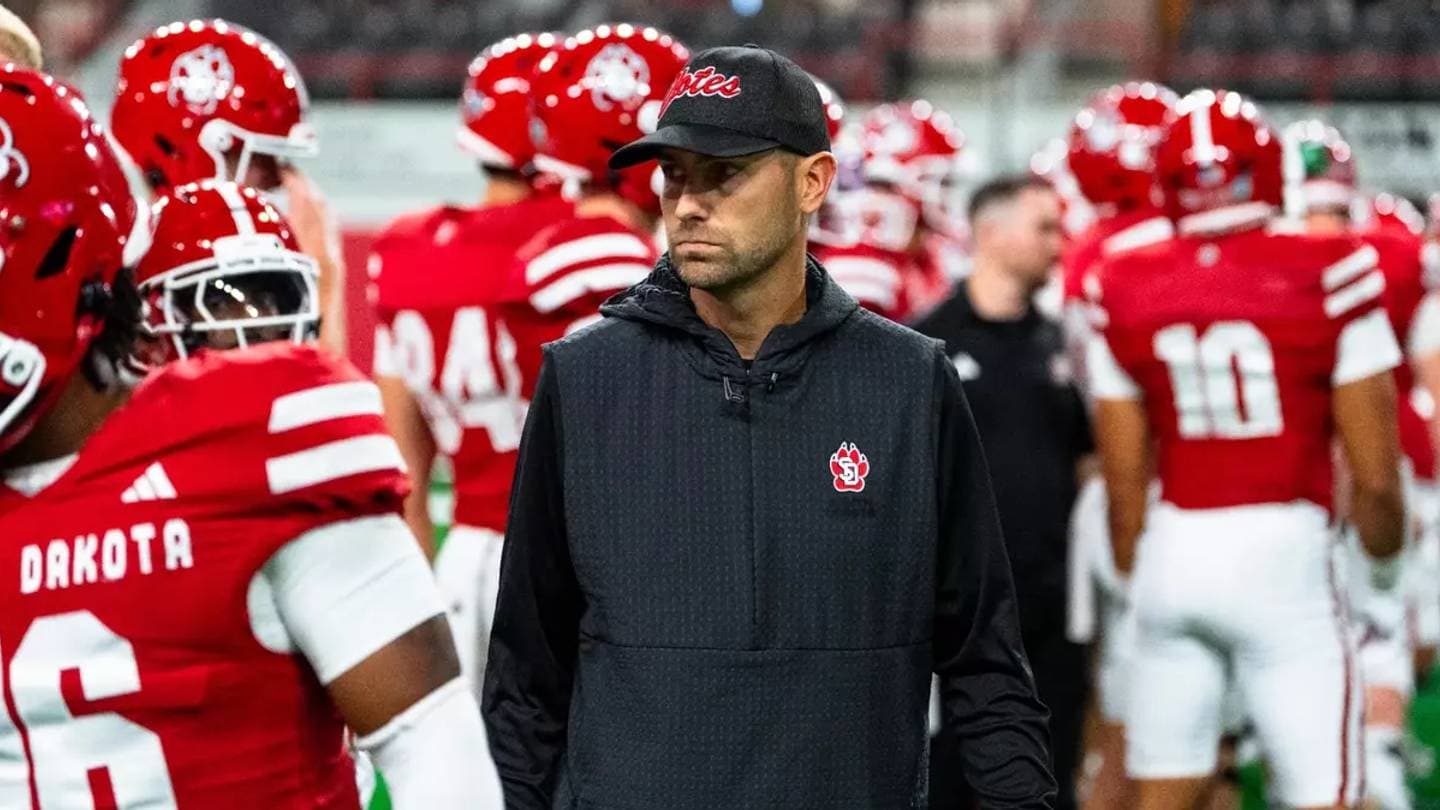
South Dakota enters 2026 with something more dangerous than optimism: proof. The Coyotes finished 10-5 overall and 6-2 in the Missouri Valley Football Conference, took second in the deepest league in FCS football, and won playoff games over Drake and Mercer. Now the question is not whether Vermillion has a good program. It is whether Matt Vitzthum can turn a strong playoff team into a true title threat in Year 1.
The standard in Vermillion has already been raised
South Dakota is coming off a season that put it squarely in the national conversation, not on the fringe of it. The Coyotes’ 2025 run included a second-place finish behind North Dakota State in the MVFC standings, a 10-5 overall record, and a pair of postseason wins that confirmed they could survive beyond the opening round. That matters because the Valley is where FCS contenders get separated from teams that only look dangerous in August.
The bigger story is that this is not a program trying to claw its way back from collapse. South Dakota reached the FCS semifinals in 2024, then followed with another playoff trip in 2025. That kind of consistency creates a higher bar for the next coach, especially when the bar was already set by a staff that had been building something real in Vermillion.
Vitzthum inherits continuity, not chaos
That is why Matt Vitzthum’s promotion is so important. South Dakota named him the 32nd head coach in program history on February 6-7, 2026, after he joined the staff in February 2024 as wide receivers coach and moved up to co-offensive coordinator in December 2024. This is not a clean-slate hire from outside the program’s identity. It is a handoff from inside the building, and that should matter when the margins in the MVFC are this thin.
The coaching tree behind him also explains why expectations stayed high. Bob Nielson stepped down on January 16, 2025 after nine seasons and 50 wins at South Dakota, and the university pointed to the program’s first share of an MVFC title and three playoff appearances in the previous four seasons. Travis Johansen then became head coach the same day after serving six seasons as defensive coordinator, following the program’s first FCS semifinal appearance in 2024. In other words, South Dakota is not resetting its culture. It is trying to preserve a rise that already had momentum.
That continuity is the first pressure point of the season. If the new-look staff can keep the same competitive edge while sharpening a roster that has changed around it, South Dakota can stay among the league’s heavyweights. If the transition slows the offense or dulls the identity, the Coyotes slide from title-chasing territory back into the crowded middle of the playoff picture.
The offense already proved it can withstand turbulence
South Dakota’s 2025 offense gave the program a foundation worth trusting. The Coyotes scored 407 points and averaged 27.13 points per game, while rushing for 3,081 yards as a team. That is not the profile of a team that needs to reinvent itself from scratch. It is the profile of a team that knows how to move the ball even when the pieces keep changing.
That resilience becomes more impressive when you remember how much turnover the offense absorbed. South Dakota lost most of its starting offensive line to the portal, its best pass catchers to graduation, and then its projected top two running backs to injury almost immediately. Yet the offense stabilized anyway, which is part of why Vitzthum’s promotion makes sense. He already knew the system, the personnel, and the players who chose to stay through the transition.
Aidan Bouman was central to that stability. His 9,278 career passing yards stand as the program record, and his 695 completions helped him become the first Yote with 9,000 career passing yards. When a quarterback leaves behind numbers like that, the next offense is not just replacing a player. It is replacing a standard of production and command that helped push South Dakota into national relevance.
The roster still has enough muscle to make a run
The return of Charles Pierre Jr. and Keyondray Jones-Logan gives South Dakota something every contender needs: backfield upside that did not fully show in 2025 because of injuries. Both running backs were limited last season, but both were All-MVFC players in 2024. That combination, past production and unfinished business, is exactly the kind of ingredient that can matter in November when playoff seeding starts to matter more than style points.
The transfer class is just as telling. South Dakota added Kevin Dodard from Lafayette, John Starman from Brown, Kael Kolarik from Iowa, Neeo Avery from Maryland, Jackson Proctor from Northern Illinois, Jake Utley from UTEP, Asher Tomaszewski from Kansas State, Sam Same from Iowa State, Bryce Cohoon from Kansas, Josh Grant from Washburn, Tyler Sapit from Bemidji State, and Isaiah Wray from Concordia-St. Paul. That is a deep and wide-ranging portal haul, the kind that signals targeted roster construction rather than panic shopping.
Neeo Avery’s arrival is especially notable because the official signing release from January 23, 2026 highlighted him among the incoming transfer group. The broader message is clear: South Dakota is not waiting for internal development alone. It is layering portal help onto a playoff-caliber core, which is exactly how top FCS programs protect themselves from regression.
The season-opening test arrives immediately
The first big measuring stick is already on the calendar. South Dakota announced that its 2026 opener will be against Central Connecticut State on August 29, 2026, the first meeting between the programs. It is not just a clean starting point for the schedule. It is an early inspection of how quickly Vitzthum’s version of the Coyotes can look like the same dangerous outfit that has been punishing Valley opponents for the last two years.
The university also announced that five of its six home games will kick off at 1 p.m. at the DakotaDome, which only adds to the sense that the season will move fast once it begins. For a team trying to prove it belongs in the FCS elite, every early game matters, because the margin for error is smaller when the standard is no longer making the bracket but threatening to run through it.
The real question is how high this ceiling goes
South Dakota’s immediate benchmark is obvious: stay in the MVFC top tier and keep the playoff path alive. The harder, more interesting question is whether the Coyotes can close the gap on North Dakota State and turn a strong postseason team into a legitimate championship threat. The 2025 record says they are close. The coaching continuity says they are built to stay close. The roster movement says they are not satisfied with merely staying in the conversation.
That is why this season feels like a contender test. If Vitzthum’s first team keeps the offense efficient, gets Pierre and Jones-Logan back on track, and survives the Valley gauntlet, South Dakota will look less like a nice story and more like a program that has permanently inserted itself into the FCS hierarchy.
This article was produced by Prism’s automated news system from verified source data, official records, and press releases, then run through automated quality and moderation checks before publishing. The system is built and supervised by the people who set the standards it runs under. Read our full AI policy.
Did this article answer your question?