Fliteboard battery guide weighs weight, range and ride feel
The real Flitecell decision is feel, not just runtime: lighter batteries sharpen the board, heavier packs buy distance, and the wrong fit changes everything.

The tradeoff that decides the board
Fliteboard’s battery guide is really a handling guide in disguise. Yes, the three Flitecell packs are defined by range, but the bigger story is how much weight you are willing to carry for every extra minute on the water. A lighter battery gives you a quicker, more reactive board; a heavier one buys time, distance and less charge anxiety, but you feel that mass every time you lift, carry and carve.
That is why Flitecell matters so much to the platform. Fliteboard treats the battery as a core part of the ride, not a removable accessory, and the company builds the packs around premium 21700 cells, a titanium housing and phase change materials for thermal management, safety and longevity. It is performance hardware built for water, with proprietary safety touches like a sight glass and a magnetic on-off switch. In plain English: this is one of the few eFoil choices where the battery changes the personality of the board as much as the foil does.
Nano: the lightest, sharpest setup
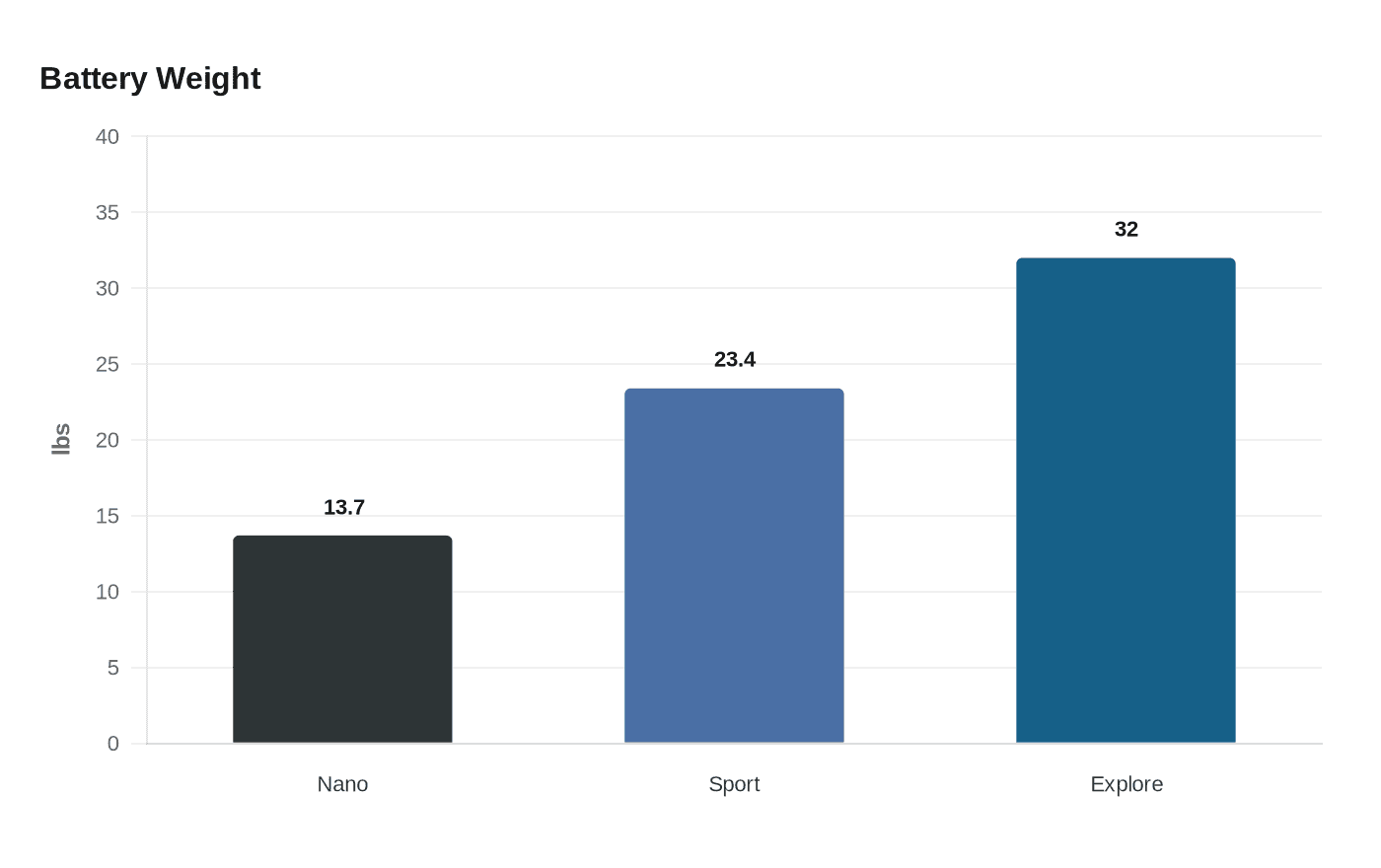
Flitecell Nano is the cleanest answer if you care most about responsiveness. It weighs 13.7 lbs, or 6.2 kg, carries 16.8 Ah and 806 Wh, and delivers up to 45 minutes of foil time. Fliteboard calls it the world’s lightest lithium-ion eFoil battery, and the placement closer to the mast is meant to keep swing weight down, which matters more than casual buyers usually think.
That lower mass is the reason Nano makes sense for a first-time owner who wants the board to feel as easy and nimble as possible, or for a lighter rider who values quick transitions over marathon sessions. Simon Axmann, Fliteboard’s battery engineer, is clear about the tradeoff: he likes the lightest setup when he wants a lively board, even if it means giving up range. Nano is the battery for short, punchy sessions where the goal is to feel every bit of the board’s response underfoot.
Sport: the middle ground that does real work
Sport is the battery Fliteboard leans on for the broadest set of riders, and the market has voted with its feet: it is the company’s most popular choice. At 23.4 lbs, or 10.6 kg, with 30 Ah and 1.6 kWh, it sits right in the middle between agility and endurance, and its foil time stretches to around 1.5 hours.
That middle lane is why Sport is the smartest buy for a lot of riders, especially if your sessions start at the beach and end somewhere else. Axmann says he often uses Sport in the surf when he enters from one beach and rides a couple of miles around the corner to the break. That is the key use case: enough battery to travel with purpose, but not so much weight that the board loses its edge. If Nano is the sharpest scalpel and Explore is the long-haul tool, Sport is the one that handles the messy middle of real-world riding.
Explore: the battery that buys time
Explore is for riders who want to stop thinking about the clock. It is Fliteboard’s largest eFoil battery, and it comes in at 32 lbs, or 14.5 kg, with 40 Ah and 2.1 kWh. The payoff is up to 2.5 hours of foil time, which changes the whole session dynamic. Instead of checking the remaining charge after every run, you can focus on distance, conditions and who you are riding with.
That makes Explore the right call for a maximum-range cruiser, a heavier rider who wants more reserve, or anyone planning longer routes, repeated laps or shared sessions with friends and family. Fliteboard’s own framing is blunt: go further for longer. This is the pack for riders who value time on water over the crispest possible handling, and who are willing to carry extra weight to get it.

Why the hardware matters as much as the numbers
The specs are only half the story. Fliteboard’s use of premium 21700 cells, the same cell format used in high-power applications such as hypercars, is a signal that these batteries are built around performance headroom. The titanium housing and PCM thermal management are doing quiet work in the background, helping the system stay stable, safe and durable in a marine environment.
That matters because battery choice is not just about runtime on a chart. A heavier pack changes how the board lifts, how it swings in your hand, how quickly it turns and how much effort it takes to keep the ride alive. The battery is part of the board’s balance sheet, and on a foil board that balance is everything.
Compatibility is part of the buying decision
This is where buyers need to slow down and check the fit before they click purchase. Fliteboard says Sport and Explore are compatible with all Series, while Explore is not compatible with Flite AIR or Ultra L2. The company also says full-size Flitecells are not compatible with Flite AIR and AIR PRO.
That compatibility detail is the parking-lot problem every foil owner wants to avoid: the battery can look perfect on paper and still be the wrong fit for the board in your garage. If you already own a Fliteboard, the platform matters as much as the pack. If you are starting fresh, it is worth choosing the battery and the board together, because the wrong pairing can erase the advantage you thought you were buying.
Price and what you are really paying for
Fliteboard’s current U.S. pricing puts Nano at $2,310, Sport at $2,860 and Explore at $3,960, before shipping and tax. The spread is steep, but so is the spread in what you get: 45 minutes at one end, 1.5 hours in the middle and 2.5 hours at the top.
- Choose Nano if your priority is the lightest, most responsive board and you ride in shorter bursts.
- Choose Sport if you want the best all-around mix of range, surf usability and board feel.
- Choose Explore if your sessions are long, your routes are bigger and you want the least battery anxiety.
The cleanest read on Flitecell is this: the best battery is not the biggest one, it is the one that matches how you actually ride. On Fliteboard, weight is not just weight. It is steering feel, lift, swing, confidence and the length of the session all rolled into one decision.
This article was produced by Prism’s automated news system from verified source data, official records, and press releases, then run through automated quality and moderation checks before publishing. The system is built and supervised by the people who set the standards it runs under. Read our full AI policy.
Did this article answer your question?