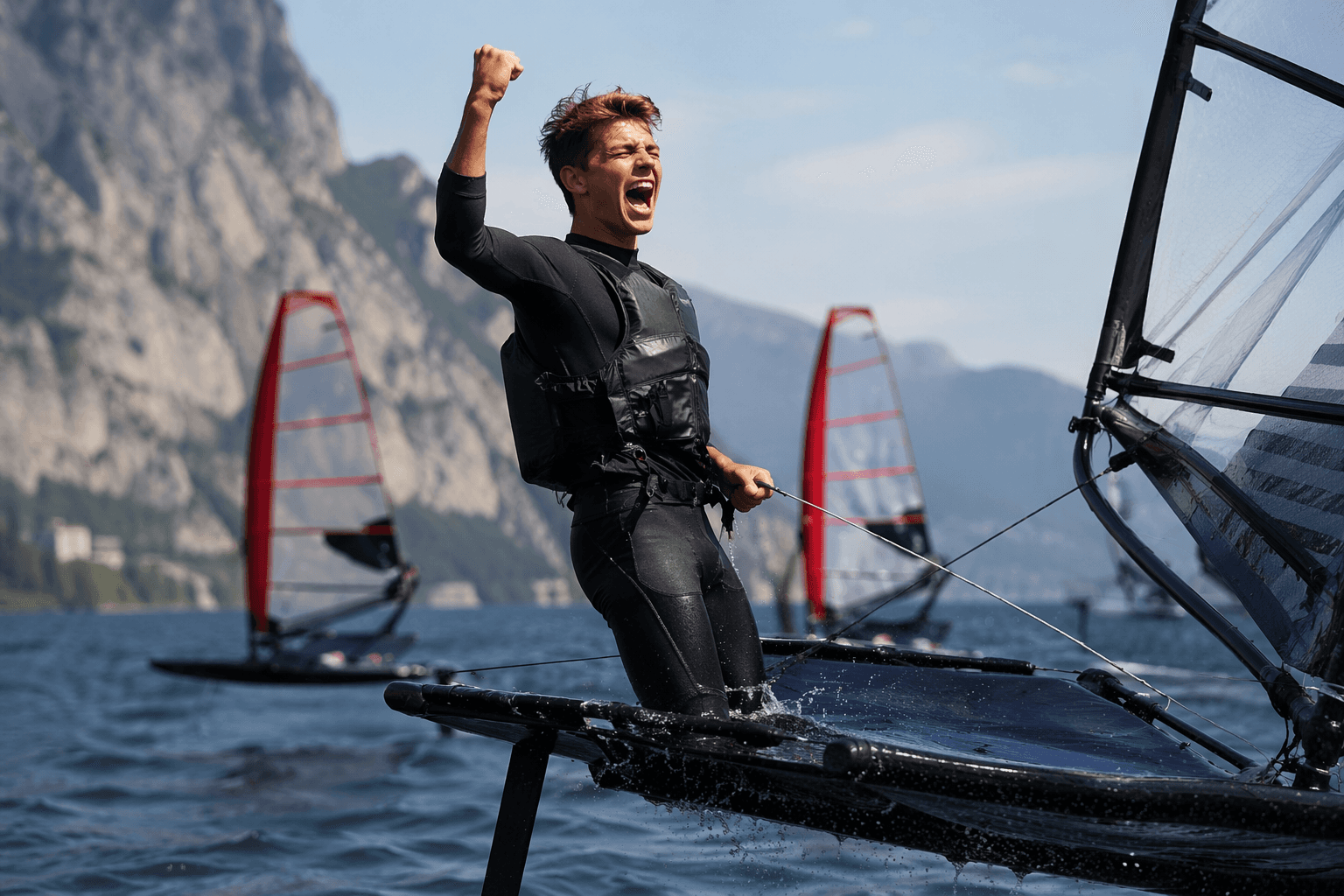
Glyde guide maps Fliteboard lineup from beginners to expert riders
Fliteboard’s lineup can feel crowded, but Glyde turns it into a clean buying path from first rides to race-day speed. The right board comes down to stability, runtime, portability and price.

How the lineup is meant to be read
Fliteboard’s 2026 lineup works less like a shelf of unrelated products and more like a progression map. Glyde Watersports says the current Flite Series 6 family spans nine board models, and Fliteboard itself groups the range into beginner, intermediate, advanced and beginner-to-advanced tiers, with names that include ICON, PRO, ULTRA L3, AIR, Flitescooter, RACE x Mercury Racing and Marc Newson.
That structure matters because eFoil shopping gets expensive fast when a board is chosen for the wrong reason. The smart question is not which model looks fastest on paper, but which one solves the ride you actually want: the calmest learning curve, the easiest family session, the lightest performance setup, or the most direct path to top speed. Fliteboard’s own configurator reinforces that logic by treating boards, wings, propulsion systems and batteries as pieces of one ecosystem, not one-and-done purchases.
For first-time eFoilers, low friction wins
If your priority is to get flying without spending the first week fighting the gear, Flitescooter is the clearest entry point. Fliteboard says complete beginners can learn to eFoil in minutes, and it positions the board as especially well suited to yachts, resorts, docks and families. That is the lowest-barrier version of the sport, built for riders who want confidence and quick success before they think about sharper handling or higher speeds.
The tradeoff is obvious: Flitescooter is about ease, not chasing the most aggressive performance ceiling. That makes it the right answer for people who value stability and approachability over a board that demands more technique from the first run. In buyer terms, it is the step-on-and-go option.
The middle ground is where most buyers should look first
For riders who want one board that can grow with them, ICON is the most practical center of the lineup. Fliteboard calls it its most versatile model, and says it starts at $10,999, is built for riders up to 265 pounds, and can be customized as the rider improves. The company also describes ICON as the best all-rounder for any level of experience and riding style.
That is why ICON makes sense for buyers who do not want to box themselves into a narrow use case. It offers a cleaner answer to the classic first-big-buy question: do you want a board that feels stable enough to learn on, but still useful once your balance and control improve? ICON is built for that middle lane. The upside is longevity inside the same ecosystem; the downside is that it will not be the most specialized tool for pure speed or the lightest race-minded build.
AIR sits close to that same practical lane, but Glyde frames it as a more accessible, more budget-conscious route into the sport. For riders who want a do-everything board without immediately paying for the most advanced performance tier, AIR is the natural place to compare against ICON. If Flitescooter is the easiest entry and ICON is the most adaptable all-rounder, AIR is the board that keeps the purchase simpler and more restrained.
For families, resorts and shared-use setups, the use case matters more than the spec sheet
A lot of eFoil buyers are not shopping for a personal toy. They are trying to serve a houseboat, a resort dock, a yacht program or a family that needs a board multiple people can use without a steep learning curve. That is where Flitescooter’s positioning is especially strong, because Fliteboard specifically calls out yachts, resorts, docks and families as ideal settings.
The logic is straightforward: in shared environments, the winning board is the one that gets more people riding sooner, with fewer setup headaches and less intimidation. A board that is easy to explain and easy to step onto often matters more than a board with the sharpest edge in a performance test. For operators and families, convenience is not a luxury, it is the product.

Performance riders need to decide how much specialization they really want
Once the goal shifts from easy cruising to more aggressive riding, Fliteboard’s performance families become much more specific. Fliteboard labels PRO as intermediate-to-advanced, while ULTRA L3 is aimed at advanced riders and is the company’s lightest production eFoil. The guide also notes ULTRA L2 and L3 as the lightest options, and frames PRO as the focused performance choice.
That splits the performance market into two camps. If you want nimble handling and a board that feels closer to a precision instrument than a floating platform, PRO and ULTRA are the boards to inspect. If you want the most refined edge of the lineup, ULTRA L3 is the one built around reduced weight. In this part of the range, the tradeoff is less about beginner stability and more about how much responsiveness and lightness you want to pay for.
Then there is RACE x Mercury Racing, the board for riders who care most about speed. Fliteboard says it is intermediate-to-advanced, calls it the world’s fastest Fliteboard, and says the setup draws on Mercury Racing propulsion expertise with a longer, narrower carbon silhouette designed for flat-water speed and efficiency. That design language tells you exactly what it is chasing: less compromise, more straight-line pace.
The smartest way to think about runtime, speed and range
The most useful part of Fliteboard’s system is that it lets you tune the ride before you buy into a dead-end. The company says battery choice and wing size affect ride time, speed and distance, and its ride calculator is built from real-world rider data and is accurate within 10% in most situations. That gives buyers something most premium sports products do not: a practical way to model the ride before they commit.

This is where the modular setup becomes a real financial advantage. Because the ecosystem is configurable across boards, wings, propulsion systems and batteries, a rider can move through the lineup without throwing away every previous purchase. The result is a path that rewards progression instead of punishing it.
Why Fliteboard’s lineup has become this deep
The company’s story helps explain why the range has grown into such a detailed ladder. Fliteboard says the idea began with founder David Trewern in 2016, after years of prototype work and early experimentation with battery and motor technology. Since then, the brand has built a record that goes beyond product launches, including the first official international eFoiling race, the Flite Cup, in 2021, which Tom Court won in Portugal.
Fliteboard also says Tom Court and Glyn Ovens became the first people to ride the giant waves of Nazaré on a Fliteboard in January 2022. Add in the company’s 10 patents and 4 registered designs, plus the Series 6 refinements such as recessed handles, refined latches, a cleaner lid profile, new colors and the renaming of the original Fliteboard as ICON, and the lineup starts to look less like product clutter and more like a mature sports platform.
That is the real value of the Glyde guide. It translates a costly, technical product family into a simple buying road map: learn fast with Flitescooter, grow into AIR or ICON, push harder with PRO or ULTRA, and chase pure pace with RACE x Mercury Racing. In a market where the wrong choice can be expensive, that kind of clarity is worth as much as any extra horsepower.
This article was produced by Prism’s automated news system from verified source data, official records, and press releases, then run through automated quality and moderation checks before publishing. The system is built and supervised by the people who set the standards it runs under. Read our full AI policy.
Did this article answer your question?