Hydrofoiling prices in 2026, what first-time riders really pay
First-time foil riders can start near $1,500, but lessons, safety gear, and compatibility upgrades quickly change the real bill. The real jump comes with carbon and eFoils.

The real starting line
The cheapest way into foil surfing is not the foil itself. It is the pathway: a stable beginner package, a few lessons, and enough protective gear to avoid turning a first session into a repair bill. That is why the 2026 market makes more sense when you treat it as a progression sport, not a single purchase. BoardCo calls wake foiling “the fastest growing sport on the water,” and the gear mix now stretches from basic complete packages to high-end electric systems with very different ownership costs.
That spread matters because buyers are not choosing just a board. They are choosing a discipline, a material set, and an upgrade path. A rider who wants a soft landing and predictable lift will buy differently from someone chasing a surf-style carve, a wing setup, or a battery-powered eFoil with premium electronics. The market has split into tiers, and the price jumps happen when performance, weight, battery tech, and compatibility start to matter more than simple entry.
Entry tier: get on the water without overbuying
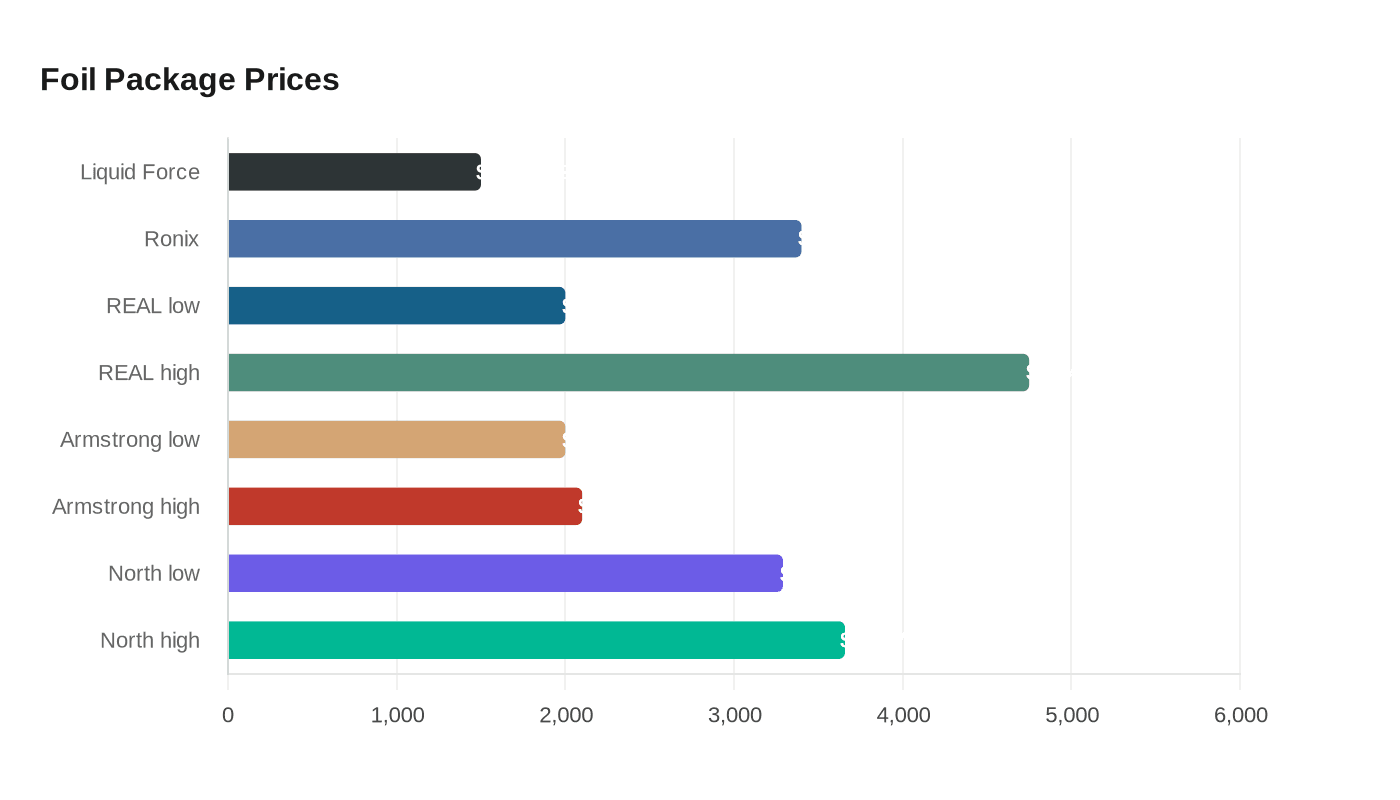
For first-time riders, the cleanest entry point is the complete beginner package. BoardCo’s 2026 wake-foil lineup shows that clearly: the Liquid Force Launch / Launch Alloy 1200 Fuselock Wake Foil Package 2026 is listed at $1,499.99, while the Ronix Blackbird / Velo High Aspect Wake Foil Package 2026 sits at $3,399.99. That is a wide gap, but it reflects more than branding. The lower-priced package is built to get riders foiling without demanding premium materials or race-level hardware on day one.
REAL Watersports shows the same pattern across broader foiling categories, with complete packages ranging from about $1,999.99 to $4,749.92. Its complete-foiling format is designed to remove guesswork: board, foil, and the key components are matched to work together. That is a major hidden value for beginners, because a mismatched setup can cost more in the parking lot later when you realize the mast, fuselage, wing, or board choice does not fit the way you planned to ride.
Naish’s Wingsurfer Package fits this same lower-price entry lane. It is marketed as a beginner package and includes an 1840 HA foil set, stabilizer, fuselage, a 5.0m wing, a mast, and a board choice. That kind of bundle is exactly where first-time riders save money, because it gives you a usable system instead of a shopping cart full of separate parts. The tradeoff is that you are buying into a defined path, not the most aggressive performance ceiling.
Committed progression: where the spend starts to change performance
The next tier is for riders who know they will keep going. This is where the market shifts from “just get up and ride” to “make the setup lighter, cleaner, and more adaptable.” Hydrofoiling.org’s breakdown of the sport makes that point in a broader way by splitting hydrofoiling into seven disciplines, including surf foiling, kite foiling, wing foiling, SUP foiling, pumping, and electric eFoils. There is no single foil price in 2026. There is only a price shaped by the discipline you choose and how serious you are about performance.
This is also the tier where materials start to matter. Carbon fiber components are faster, lighter, and more performance-focused, but they cost significantly more than aluminum and can be more fragile. That is the classic committed-rider tradeoff: if you want a better feel and less swing weight, you pay for it. If you want durability and a lower entry bill, aluminum and other more affordable parts can make much more sense while you are still learning.
REAL Watersports shows how progression pricing works in wing and surf packages too. An Armstrong S1 Alloy SURF Foil Package is listed around $1,999.99 to $2,099.99, while a North 2025 Nova Complete Wing Package sits around $3,290.00 to $3,657.50. That difference is not random. It reflects how quickly riders move from a stable alloy starter to more refined wing and surf systems that ask more of the rider but also reward cleaner technique and stronger commitment.
This is where modular systems become a real financial advantage. AXIS Foils emphasizes complete foil kits and modularity restrictions, which is a reminder that compatibility is not a small detail. If your mast, wings, fuselage, or board do not play nicely together, the “upgrade” becomes a replacement cycle. The smart money is on systems that let you swap wings or masts as your skills grow, instead of forcing a full reset every time you improve.
Premium: where electronics, batteries, and status pricing take over
At the top end, the bill changes because you are no longer just buying hydrofoil hardware. You are buying battery tech, controllers, and an integrated electronics stack. Lift Foils makes that clear with its 2026 LIFT5 eFoil platform, which uses a wireless drop-in battery system and a 2026 Gen5 Full Range Battery rated for up to 90 minutes of ride time. Lift says that battery is 23% lighter than the 2025 model, and that kind of weight reduction is not cosmetic. On the water, it changes handling, transport, and how tiring the board feels when you are setting up or carrying it.
Fliteboard’s 2026 lineup tells a similar premium story. Its range includes beginner, intermediate, and premium models such as AIR, Flitescooter, RACE x Mercury Racing, and Marc Newson lines. That range shows how the category has matured: one brand can now serve the first-timer, the ambitious intermediate rider, and the buyer who wants a high-status, high-performance platform. The price premium is not only about speed. It is about system design, electronics, design language, and the confidence that comes with a fully integrated product.
The biggest spending jump in this tier is Foil Drive. REAL Watersports lists Foil Drive hybrid electric packages around $7,992.98 to $11,805.08 depending on configuration. That is a very different purchase from a standard foil setup, and it should be treated that way. Once you move into hybrid electric support, you are paying for a more complex system with more capability, but also more cost, more parts, and more reasons to pay attention to compatibility.
The hidden costs that change the real total
The sticker price is only the first number. The other costs are the ones that change whether your setup feels like a smart purchase or a trap. Safety gear is the most obvious add-on: helmets, impact vests, and related protective kit are part of the real cost of getting started. Maintenance items and small consumables also pile up, especially if you are learning and replacing dinged parts, worn hardware, or upgraded pieces as you go.
Lessons matter too. A rider who spends a little more on coaching often avoids the much bigger cost of buying the wrong board, the wrong foil, or the wrong mast length. In a sport where balance, lift, and takeoff timing are tied to equipment choice, a lesson can save you from a bad first buy that looks cheap on paper but ends up expensive after the first upgrade.
That is the real 2026 buyer reality-check. Entry-level foil surfing can begin around the low-$1,000s, committed setups push into the $2,000 to $4,500 range, and electric systems can jump far beyond that. The money changes performance most clearly when you buy lighter materials, better battery systems, or a modular setup that keeps pace with your skills. It mostly changes status when you pay for premium branding without a matching need.
This article was produced by Prism’s automated news system from verified source data, official records, and press releases, then run through automated quality and moderation checks before publishing. The system is built and supervised by the people who set the standards it runs under. Read our full AI policy.
Did this article answer your question?