PWR-Foil turns Palma boat show trip into Mallorca eFoil adventure
PWR-Foil’s Mallorca trip is less showroom gloss than logistics test: ferrying boards, batteries, and riders to Palma proves where eFoil travel really works.

Boat show as a real-world test
PWR-Foil did not treat the Palma International Boat Show as a simple booth stop. It used the April 29 to May 2, 2026 event at Moll Vell in Palma de Mallorca as the start of an eFoil expedition that moved from Canet-en-Roussillon to Barcelona, then by ferry to Mallorca, and finally onto the island’s roads and coves.
That matters because Palma is not just another marina stop. The show is widely regarded as the opening signal of the Mediterranean yachting season, and the 2026 edition reportedly brought more than 300 boats and 270 onshore exhibitors into one of the region’s highest-visibility maritime stages. With the 5,000 m² Superyacht New Build Hub and its 21 premium berths added in 2025, the event has become a place where hardware, travel, and lifestyle marketing collide.
For a foiling brand, that makes Palma useful for more than exposure. It becomes a stress test for the whole trip: how the gear moves, how the batteries travel, how much effort it takes to get from a city dock to water that is actually worth riding, and whether the experience still feels practical once the promotional polish is stripped away.
The ferry leg is the difference between a demo and a destination ride
The most important detail in this Mallorca story is not the boat show itself but the route to get there. PWR-Foil crossed from southern France to Barcelona, then took the ferry to Palma de Mallorca, turning the journey into a transport problem as much as a riding trip.
That ferry leg is what makes the trip work for foilers. Barcelona-to-Mallorca services typically run about 6 to 7.5 hours depending on operator and route, and the main carriers on the corridor, Baleària, Grandi Navi Veloci, and Trasmed, allow passengers to bring cars, motorbikes, bicycles, and luggage. In plain terms, that means you can move foiling gear to Mallorca without flying, which is a major practical advantage for riders who care about batteries, boards, and the realities of packing.
For the sport, this is a bigger story than it first appears. eFoiling often gets sold as instant freedom, but the real question is whether the setup can survive the trip before the ride. A ferry-friendly route changes the math: it turns Mallorca from a postcard destination into a place where you can actually bring your own board, your own battery, and enough kit to ride hard for several days instead of depending on a one-off rental handoff.
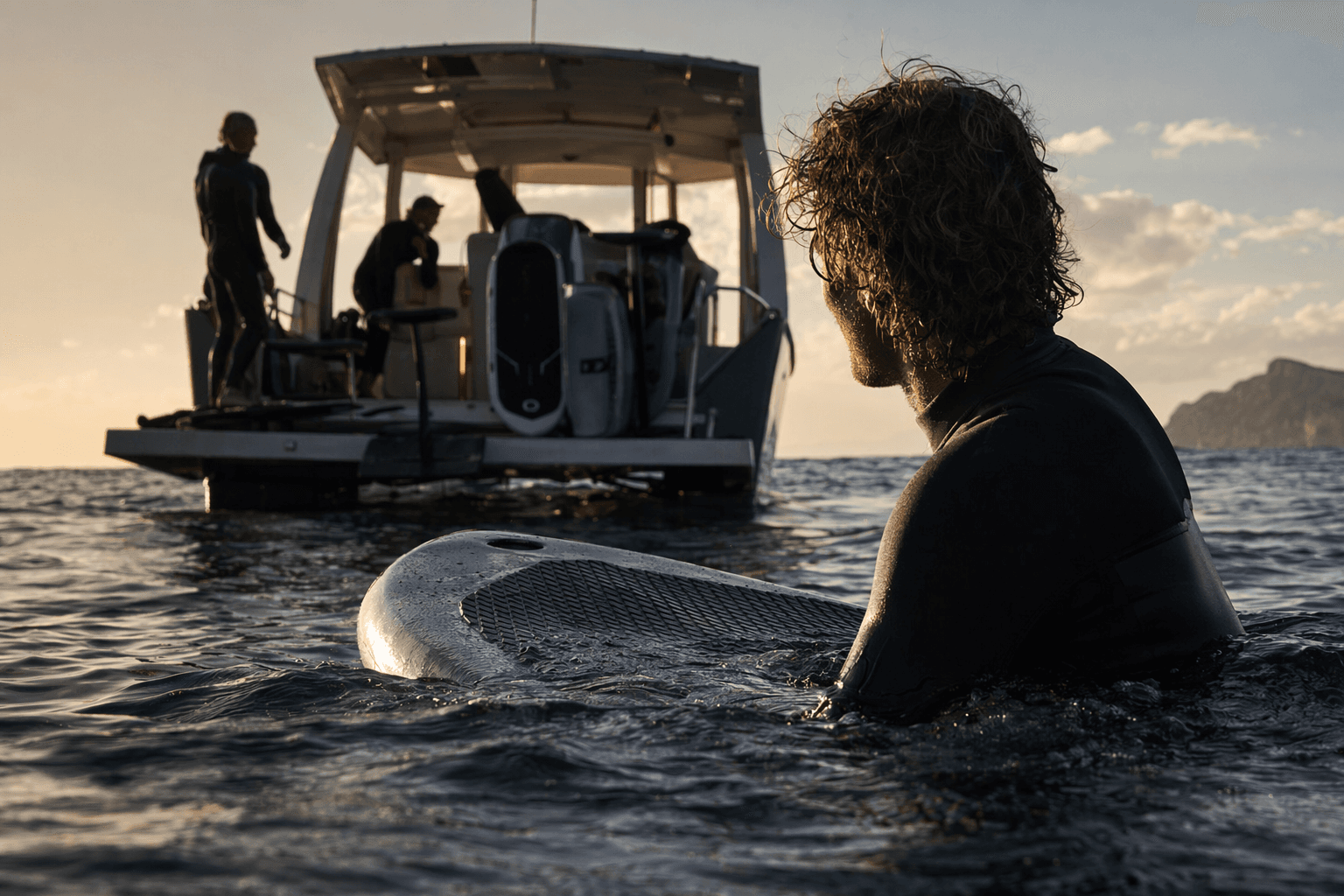
What PWR-Foil is selling is not just speed, but portability
PWR-Foil has built its identity around French engineering, saying its eFoils are designed, developed, and assembled in France with 100% French engineering. Outside coverage traces the company’s origins to 2016 in Canet-en-Roussillon, and the REVO range was described as the result of seven years of expertise and field feedback. That background matters here because Mallorca is an unforgiving place to fake practicality.
The company’s current product information gives the REVO Classic battery at 25 Ah, 1620 Wh, 64.8 V, and 10 kg, with up to 90 minutes of flight time plus a 20-minute reserve under controlled conditions. Other coverage cites a top speed of up to 60 km/h and autonomy of up to 2 hours. Those numbers are not just brochure filler on a trip like this. They tell you what kind of day the board is built for, how much charging discipline you need, and whether the rider can treat the trip as a sequence of sessions or only as a short demo.
For readers focused on real-world use, the key takeaway is simple:
- Battery mass and handling matter as much as headline speed.
- Flight time changes how remote a cove can be.
- A 6 to 7.5 hour ferry ride is easier to justify when the whole trip is built around multiple water sessions, not a single launch.
That is the kind of utility story a glossy launch video rarely explains. The boat show gives the brand visibility, but the island trip gives it credibility.
Mallorca rewards the rider who thinks like a traveler
The route from Barcelona to Mallorca, and then across the island from mountain roads to more isolated coves, is exactly why this story lands as a destination test rather than a travel diary. Mallorca is not just a backdrop for water sports content. It is a place where access, road time, and launch logistics all shape the session before the board even touches the sea.
That is where the practical value for the foil community sits. If you are deciding whether to bring or rent an eFoil in Mallorca, the real lesson is not whether the island looks good on camera. It is whether the trip lets you move gear efficiently, reach water without turning the day into a freight exercise, and switch between packed event energy at Moll Vell and quieter water away from the show floor.
PWR-Foil’s setup shows why expedition-style foiling is growing. The sport is increasingly about more than performance per minute on the water. It is about compatibility with travel, how a board fits into a ferry schedule, whether a battery and board can be moved as part of a normal trip, and whether the ride still feels worthwhile once you leave the marina and head for less predictable water.
Why this trip matters beyond Mallorca
The larger Mediterranean context is what gives the story weight. Palma International Boat Show sits inside a region where yachting season, marine trade, and watersports culture overlap, and PWR-Foil used that overlap to frame eFoiling as a transportable adventure sport rather than a static demo product. The brand’s French origins, its REVO development story, and its hardware specs all support that message.
What this Mallorca trip really proves is that the future of eFoiling is not only about faster boards or cleaner branding. It is about whether the sport can move with the rider, survive the transit, and make sense as part of a multi-day plan. In that sense, Palma was never just the destination. It was the checkpoint that showed how an eFoil trip actually works once the gear leaves the beach.
Know something we missed? Have a correction or additional information?
Submit a Tip