Afterblows reshape scoring in Historical European Martial Arts bouts
A first hit in HEMA is not the whole story. Afterblows and doubles make clean timing, structure, and exit discipline matter more than raw speed.

A longsword exchange can look decisive and still leave the score unsettled. One fighter lands first, the blade lands back in a countering tempo, and HEMA Ireland’s rules can turn that into a weighted exchange instead of a simple point for the opener. That is the real impact of afterblows: they punish reckless entries, reward survival after contact, and force the fencer to finish the action with control, not just reach first.
How the scoring changes the fight
HEMA Ireland’s official ruleset caps a bout at 9 exchanges, 3 minutes, or 20 points, whichever comes first. It also allows the last exchange to push a score as high as 24, because a deep-target action can add 5 points on top of a 19-point total. That matters because the bout is not decided only by who starts fastest; it is decided by who can score while denying a meaningful reply.
Under those rules, a clean hit to a deep target is worth 5 points, while a shallow-target touch is worth 3. But double hits and afterblows are not treated as automatic wins for first contact. Instead, they are fully weighted so the scoring system asks a harder question: did the attacker land and stay safe, or did the exchange leave both fencers exposed?
That structure changes winning behavior immediately. A fighter who rushes in for a single touch without protecting the line may give away the value of the exchange if the opponent answers inside the permitted afterblow window. In practice, the faster hit does not always win because the score also measures what happened next.
What an afterblow actually is in the bout
Dublin HEMA Club defines an afterblow as the immediate next blade action with no pause in between. HEMA Ireland gives the defender one afterblow action within one-step range. Those two descriptions point to the same competitive idea: the counter must be part of the same tempo, not a late reaction after the original action has clearly ended.
That tempo requirement keeps the mechanic from becoming a random back-and-forth of delayed taps. It ties the reply to the original exchange, which means the initial attacker has to plan beyond the first touch. The cleanest scoring sequence is not just a landed strike, but a landed strike that leaves no opening for an immediate, valid answer.

HEMA Ireland adds another layer with thrust priority. If a thrust goes through the bind, the afterblow can be lowered to shallow-target value. That gives the fencer who enters with a well-placed thrust a tactical edge, but only if the line, timing, and structure are good enough to support it. The message is simple: the attack has to do more than arrive first, it has to arrive in a way that survives the counter.
Why the rules reward structure, not haste
The quality rules make that philosophy concrete. HEMA Ireland requires a cut or slice to travel at least 45 cm with proper edge alignment, and it requires a thrust to make the bend of the blade visibly apparent in order to count as valid. These standards are there to separate real offensive mechanics from grazing contact, and they also push fighters toward controlled, committed actions.
That matters in a system with afterblows because the exchange is judged as a sequence, not as a single flash of steel. A fighter who lunges out of structure may hit first, but if the reply lands in the legal window, the exchange no longer looks like a pure success. The rule set effectively teaches a survival principle: strike with enough form that you can leave, recover, or close the line before the opponent answers.
This is also why afterblow systems have become such a distinctive part of modern HEMA competition. They exist to discourage “stop at first touch” behavior, the kind that can produce suicidal fencing when the only goal is reaching the opponent before being hit. In this format, the safest path often scores better than the bravest one.
How the historical sources fit the modern rule set
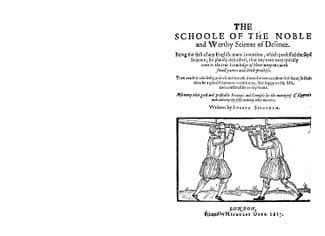
The modern scoring logic does not come from nowhere. Wiktenauer, the HEMA research project that began in 2009, organizes primary source material for the discipline and notes that well over 150 distinct manuscripts and hundreds more printed works survive. That body of material gives modern fencing communities a broad textual base, even if no tournament rule set is a perfect copy of any one period source.
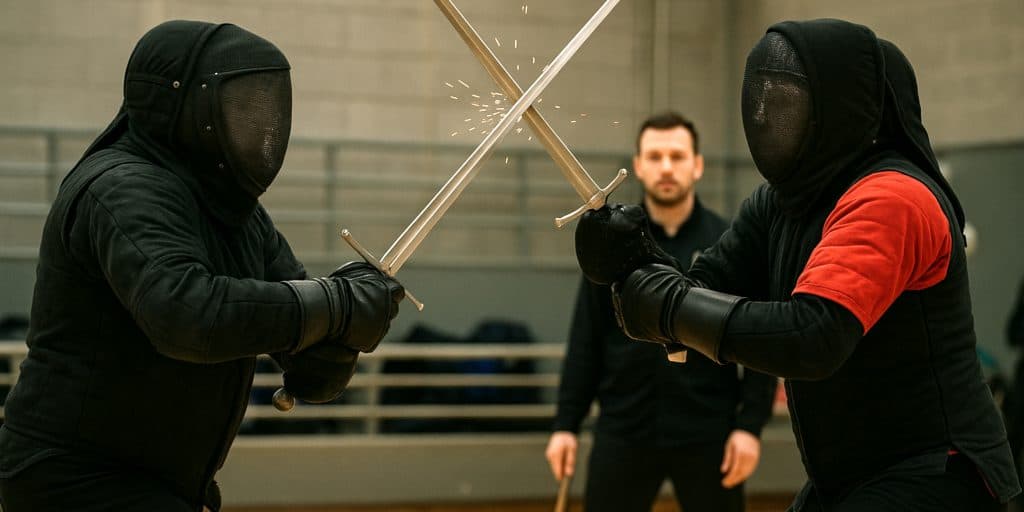
The historical language of Vor and Nach, before and after, sits close to the logic behind afterblows. Johannes Liechtenauer’s tradition emphasizes acting before the opponent can fully answer and avoiding the disadvantage of being caught in the after. Wiktenauer also describes duplieren as a “doubling” response that immediately cuts to the other side after a parry, which shows that the idea of an immediate response was already embedded in European fencing thought.
The same broad continuity appears in Italian material. Wiktenauer describes Antonio Manciolino’s Opera Nova, printed in 1531, as possibly the earliest printed Italian fencing treatise. That does not mean today’s afterblow rules are historically exact replicas, but it does show that European fencing traditions long treated timing, response, and initiative as inseparable parts of the fight.
Where these rules live in the modern scene
HEMA Ireland is not just a rules page. It describes itself as a registered Irish federation that supports research, communication, technical instruction, and safety standards across member clubs in the Republic of Ireland and Northern Ireland. That makes its ruleset part of a larger ecosystem, not an isolated tournament quirk.
Its events page gives the clearest competitive context: the Irish Historical Fencing League is a series of three elimination-format open longsword tournaments hosted by clubs around the island. That is the kind of format where afterblows matter because every exchange can swing an elimination bout, and a fighter cannot afford to treat the first landed cut as the end of the problem.
For spectators, that makes HEMA scoring more readable once the logic clicks. A faster hit can still lose the exchange if the attacker overcommits and absorbs an answer. A slower, cleaner action can win because it arrives with better structure, better timing, and a better exit. In that sense, afterblows do more than alter scoring. They reshape the entire definition of what a winning exchange looks like.
This article was produced by Prism’s automated news system from verified source data, official records, and press releases, then run through automated quality and moderation checks before publishing. The system is built and supervised by the people who set the standards it runs under. Read our full AI policy.
Did this article answer your question?