Swetnam’s 1617 fencing manual blends combat and gentlemanly conduct
Swetnam’s 1617 manual teaches blade work and gentlemanly self-command in equal measure, making quarrels, restraint, and reputation as important as technique.
Joseph Swetnam’s *The Schoole of the Noble and Worthy Science of Defence* is one of the most revealing HEMA texts of the early 17th century because it refuses to separate fighting from behavior. It is built around weapons instruction, but it also spends real space on murder, drunkenness, quarrels, fear, fury, and the right way to answer a challenge, which makes it a practical fencing book and a snapshot of how an armed gentleman was expected to carry himself.
A manual that sells itself as English
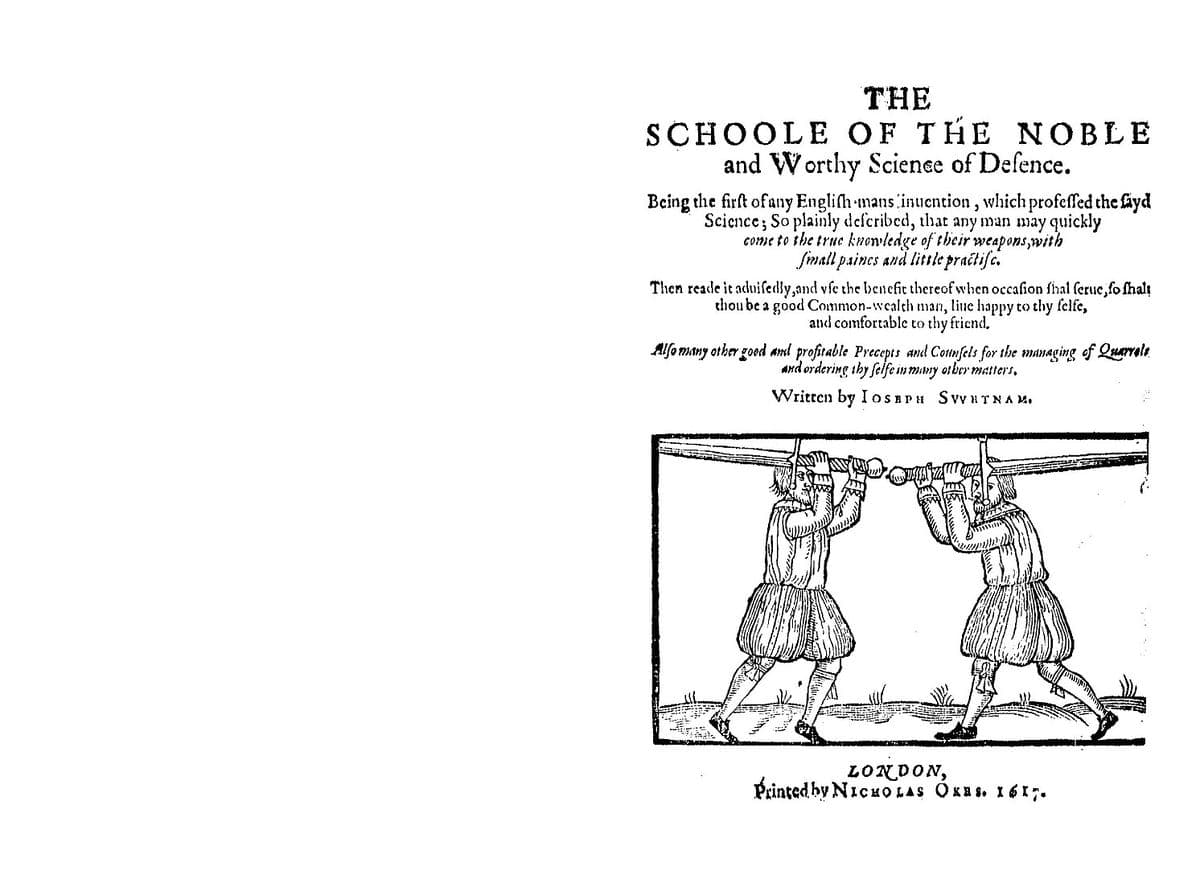
Swetnam frames the book as a native breakthrough. Its title page claims it is “the first of any Englishman’s invention” to profess the science of defence, and that a reader can quickly come to “the true knowledge” of the weapons with “small pains and little practice.” That pitch matters because it tells you how Swetnam wanted the book read: not as imported theory, but as an English system meant to be direct, usable, and socially authoritative. The single surviving edition was printed in London in 1617 by Nicholas Okes, runs to 198 pages, and was dedicated to Charles, Prince of Wales.
What the book actually teaches
The weapon syllabus is broad enough to reward close study. Wiktenauer’s contents list rapier and dagger, sword and dagger, backsword, single rapier, short sword, and staff, which gives the text a wider practical range than a narrow dueling primer. It also organizes the material in a way that moves from general instruction into specific play, then into questions and answers, and finally into a long staff section presented in dialogue between master and scholar. That structure suggests a teaching method as much as a combat method: learn the principles, then apply them under different weapons and conversational drills.

Where Swetnam becomes more than a move list
For modern HEMA practice, the most useful part of Swetnam is not only the list of weapons but the way he links technical work to decision-making. He includes a chapter on “the cause of quarrels” and how to prepare to answer a challenge, a chapter on how “fear and fury are both enemies to true valour,” and a chapter that praises skill while urging men to forbear “idle quarrels.” In other words, the manual treats violence as something shaped by temperament, reputation, and escalation, not just by blade mechanics. That is precisely why it remains valuable in the salle: it teaches you to read the tactical problem and the social problem at the same time.
Usable martial insight, and what to question
Swetnam’s text is best read in two columns, one for practice and one for period attitude. The practical side is clear enough in the book’s weapon coverage, its opening advice on entering practice, and its seven principal rules of true defence, which give modern readers a scaffold for drills and interpretation. The period attitude is just as visible in the moral language of murder, cowardice, drunkenness, and valour, which reflects early modern anxieties about status and self-command more than neutral combat science.
A useful way to approach the book is to separate what can train your fencing from what reveals the culture around fencing:
- Keep the structure of the syllabus, from broad principles to weapon-specific work.
- Keep the staff dialogue, which shows a teaching style built on exchange rather than mere prescription.
- Keep the seven principal rules as a signpost for how Swetnam organized defense.
- Question the book’s moral labels, especially where fear, fury, drunkenness, or cowardice are used to sort people into virtue and vice.
- Read the quarrel material as social history, because it shows how closely weapon use was tied to honor, escalation, and public behavior.
Why this matters for HEMA now
Swetnam is especially useful because he exposes a central truth about early modern combat culture: the fence was never just a place to learn blows. It was also a place to rehearse restraint, status, and the management of conflict before steel was drawn. The book’s focus on quarrels, the preparation for challenges, and the battle against fear and fury shows an early 17th-century world where violence was imagined as something that had to be justified, controlled, and folded into gentlemanly conduct.
That is why Swetnam still reads sharply today. The techniques matter, but the larger lesson is even sharper: in 1617, knowing how to fight was inseparable from knowing when to hold back, how to present yourself, and how to avoid turning skill into shame. For HEMA, that makes the manual less a relic than a field guide to the social life of the blade.
This article was produced by Prism’s automated news system from verified source data, official records, and press releases, then run through automated quality and moderation checks before publishing. The system is built and supervised by the people who set the standards it runs under. Read our full AI policy.
Did this article answer your question?