How armor changed the logic of HEMA fencing
Armor turns HEMA into a different game: cuts matter less, half-swording and grappling matter more, and modern clubs need strict safety gear.

Plate armor in western Europe began to rise in the 13th century and advanced through the 14th. In harnischfechten, armor changes the target map, the timing, and the winning conditions, making armored fencing feel less like unarmored longsword and more like a separate combat system. The School of Arms and Armour defines it as fighting built around combat in armor.
Weapons changed with it. Mail remained dominant well into the 14th century, but improved crossbows could pierce shields and mail armor, and articulated plate began to appear for limbs and hands. Once the armor could blunt or redirect the obvious line of attack, fencing stopped being a contest of clean cuts and became a search for weak points, leverage, and control.
Cuts give way to pressure, half-swording, and the clinch
Once a fighter is inside harness, the usual answers stop working the same way. Armor restricts mobility, vision, breathing, and balance, so distance management and tempo take on a different meaning than they do in unarmored HEMA. The practical effect is simple: a strong cut that would end an exchange in an open jacket bout may become a setup in armor, while a thrust to an opening, a hand attack, or a wrestling entry can become the real decision point.
Armored fencing traditions emphasize half-swording, grappling, and strikes aimed at gaps in the harness. Late medieval swords included some deliberately stiff and sharply pointed blades to pierce armor, which matches the tactical logic of armored play: control the weapon close to the blade, slide to openings, and use the point where the armor is thinnest or absent. In practice, that means the sword is not only a cutting tool. It becomes a lever, a probe, and a short spear at different moments in the same exchange.
The manuscripts show this was not a side street of the tradition
Armor work is not a marginal curiosity hidden in one or two odd texts. Wiktenauer’s Armored Fencing category links material to Fiore dei Liberi, Hans Talhoffer, Paulus Hector Mair, and the Liechtenauer tradition, which puts harnischfechten inside the mainstream of late medieval martial writing. Wiktenauer lists well over 150 distinct manuscripts and hundreds more printed works in the broader European treatise tradition.
His MS Chart.A.558 is dated to or after 1448 and is among the earliest Talhoffer manuscripts, MS Thott.290.2º is dated to 1459, and Cod.icon. 394a is dated to 1467 and is his final work. Armored and judicial fighting concepts appear across decades of manuscript production rather than in a single isolated text.
Gladiatoria manuscripts begin with spears and small shields called ecranches, then move to swords, then daggers on foot and on the ground. Late medieval combat literature treated armor and close fighting as a continuum, not a single isolated weapon problem.
Liechtenauer’s system is bigger than longsword
Johannes Liechtenauer’s system was a holistic late medieval combat tradition that includes longsword, wrestling, dagger, langes messer, polearms, and mounted and armored combat. Harnischfechten stays in that context. Armored fencing does not sit apart from the rest of the curriculum like a specialty class bolted onto the side. It is one expression of a broader combat ecology in which striking, grappling, armored footwork, and weapon transitions all belong to the same world.
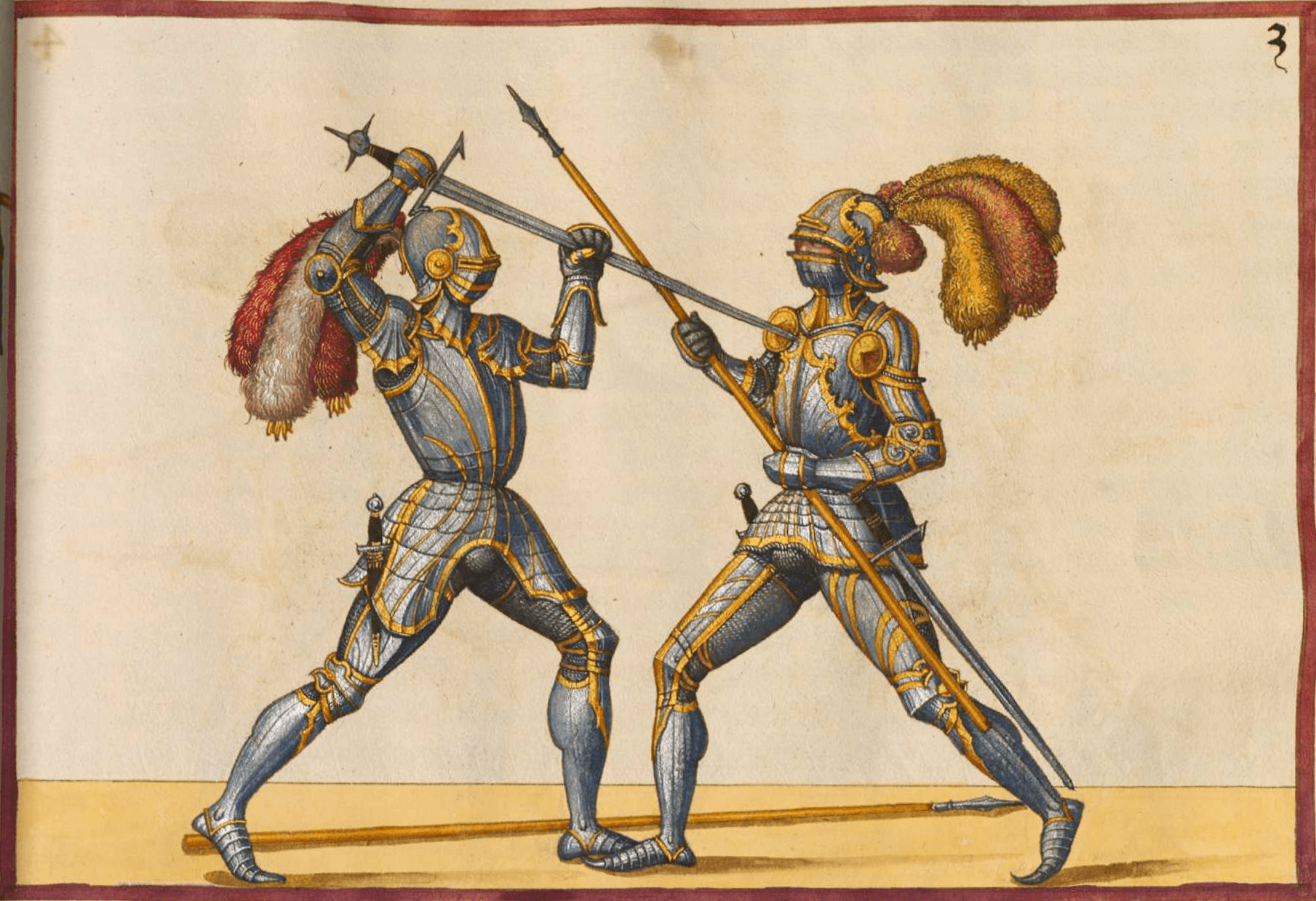
That broader view explains why armor changes decision-making so dramatically. If your training system already expects wrestling entries, weapon retention, and transitions between tools, armor does not merely protect the body. It shifts which of those tools matters most at any given range. In open fencing, the cut can dominate the exchange. In harness, the clinch, the point, the pommel, and the gap often decide it.
Modern clubs cannot copy the past without changing the rules
The historical logic is only half the story. The HEMA Alliance frames club policy around enforceable physical and social safety frameworks, which is exactly what armored fencing needs if it is going to be practiced by living people instead of imagined as museum theater. Modern participants cannot simply reproduce medieval conditions and call that fidelity. They need gear standards, clear conduct rules, and a format that can survive repeated contact.
The Met’s tournament rules make the goal explicit: reproduce historically accurate fighting in historically accurate armor while keeping it safe for modern participants. The more faithfully the gear changes the mechanics of the fight, the more carefully the club has to manage force, target area, and acceptable thrusting or grappling behavior.
A live club example shows what armored HEMA looks like now
Rocket City HEMA in Huntsville, Alabama gives the clearest contemporary example of how this plays out on the floor. The club explicitly focuses on armor and trains armored combat alongside longsword, rapier, dagger, and ringen. Its Ye’H.A.W. armored weekend mixes armored and unarmored fencing, group scenarios, pikes, crossbows, and limited full-harness play, which is a practical reminder that modern armored events are often ecosystems rather than single-weapon brackets.
Community media around Ye’H.A.W. puts the scale in numbers. A description of the 2023 event lists nearly 70 combatants on the field at once. A separate video description of the 2022 gathering lists nearly 40 combatants in various states of protection, from early 15th-century harness to modern HEMA protective gear.
The historical precedent for armored foot combat is already there
This modern appetite for harness has a medieval precedent. Tournament foot combat was a weaponed form of close combat that resembled professional wrestling, which is exactly the sort of environment where grappling, balance breaking, and weapon control become decisive. Tournament armor for the Scharfrennen remained popular at the court of the prince-electors of Saxony long after it had faded elsewhere in Europe, with Dresden among the places where that court culture anchored the style.
This article was produced by Prism’s automated news system from verified source data, official records, and press releases, then run through automated quality and moderation checks before publishing. The system is built and supervised by the people who set the standards it runs under. Read our full AI policy.
Did this article answer your question?