Joachim Meyer bridges medieval German fencing and early modern HEMA
Meyer links Liechtenauer-era fencing to early modern HEMA through a broad treatise, public Fechtschulen, and a book still used across weapons.

Joachim Meyer is the figure HEMA keeps returning to when the question is not just what to study, but what can still be used. Born in Basel around 1537 and established in Strasbourg by 4 June 1560, he sat at the crossroads of manuscript fencing, public competition, and the practical needs of a working master. His surviving work spans enough weapons, audiences, and formats to make him the clearest bridge between medieval German fencing and the early modern game that clubs still build around today.
The Strasbourg years made Meyer more than a text on a page
Meyer’s Strasbourg record is unusually concrete for a fencing author of his era. By 4 June 1560 he had married Appolonia Ruhlman and been granted the rank of master cutler, a status that placed him inside the city’s craft hierarchy rather than at its edge. In 1561, the City Council of Strasbourg granted his petition to hold a Fechtschule, which ties him directly to public fencing culture and not only to private instruction or manuscript copying.
That matters for modern HEMA because Meyer was not writing as a detached compiler. By 1570 he was serving as treasurer of the Strasbourg smiths’ guild, the Schmidzunft, which marks him as a man with standing, responsibility, and access to the civic networks that made fencing visible. The result is a rare combination in one person: craftsman, instructor, public demonstrator, and author.
What survives is broad enough to cover a whole training calendar
Meyer’s surviving material is valued because it does not trap readers inside a single weapon or a single social layer. The 1570 printed treatise, along with the 1560s manuscripts, covers longsword, dusack, rapier, dagger, polearms, and armored fencing. That breadth is why clubs can use Meyer as a source for multiple tracks of training without jumping from one author to another every time the weapon changes.
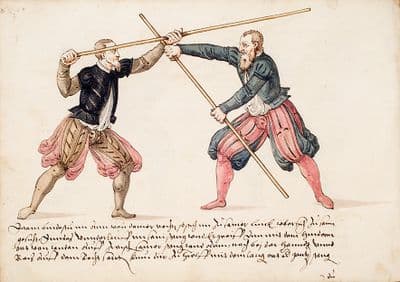
Modern descriptions organize the 1570 book into five parts across 379 pages: longsword, dusack, rapier, dagger and wrestling, and staff or polearms. Those sections give a clear map of why Meyer still lands in so many HEMA syllabi. A club working on tournament longsword can find material there, but so can a group interested in dusack, rapier with secondary weapons, or the staff and halberd work that sits closer to battlefield and militia concerns.
The modern illustrated reference edition is especially useful because it reproduces all 69 of Tobias Stimmer’s prints. That visual density gives practitioners more than isolated technique descriptions; it gives them a full instructional environment, one where image, sequence, and presentation all matter at once.
Meyer connects the old Liechtenauer world to newer fencing habits
Meyer is often described as the last major figure in the Liechtenauer tradition, but his work is not a simple replay of older material. His writings absorb contemporary influences, including Italian rapier fencing, which turns him into a witness to transition rather than a guardian of a sealed past. That is one reason his books remain so practical for a sport that constantly negotiates between reconstruction and live competitive use.
He also stands out because he wrote for both laymen and beginners. That choice opens the door wider than many specialist fencing texts, and it explains why Meyer travels so well across clubs, seminars, and tournament prep. A source aimed at newcomers but rooted in a sophisticated martial tradition gives modern teachers room to scale the material without losing historical structure.
- Longsword practitioners get a strong base for dynamic fencing and structured play.
- Dusack fencers get a compact weapon system that trains timing and cutting action.
- Rapier students get an early modern crossover point, including work with secondary weapons.
- Staff and polearm students get access to broader weapon logic, not just dueling patterns.
- Beginners get material that was never written only for insiders.
For HEMA, that makes Meyer unusually adaptable:
The rediscovery of the 1561 manuscript changed the story
A major shift in Meyer scholarship came with the rediscovery of a 1561 manuscript in the Bavarian National Museum in Munich. That manuscript changed how scholars understand the composition of the 1570 treatise, because it showed that the printed work was not simply a neat final product appearing out of nowhere. Instead, the print sits inside a longer process of drafting, revising, and organizing material across the 1560s.
That matters in practical terms because it helps explain why Meyer feels so usable. The book is not only a monument of preservation; it is a working text whose structure reflects instruction, adaptation, and reorganization. For readers trying to understand how a fencing tradition moves from manuscript culture into printed form, Meyer is one of the clearest examples available.

The book had a long afterlife, and practitioners kept returning to it
Meyer’s reach did not stop with his death in 1571. The Metropolitan Museum notes that his manual appeared in four editions between 1570 and 1660, which gives the text an unusually long print life. Modern editions also describe his works as having been copied by other authors for more than 100 years after his death, a sign that his material remained useful well beyond the first generation of readers.
The 1600 Augsburg edition is another hard marker of that persistence. After Meyer died, his widow, Appolonia Ruhlman, reportedly sold the original woodcuts to pay a 300-crown debt connected to the book’s production, a reminder that even foundational martial texts had a financial backstory. The surviving copies, later editions, and the marks left by readers show a book that stayed in circulation because people kept finding something in it worth reusing.
That is the real reason Meyer still anchors so much HEMA discussion. He gives the sport one author who can connect the manuscript age to the printed age, public fencing to private study, and the late medieval German inheritance to the early modern weapon mix. For anyone deciding what to study now, that combination is hard to beat because it offers history that still trains well.
This article was produced by Prism’s automated news system from verified source data, official records, and press releases, then run through automated quality and moderation checks before publishing. The system is built and supervised by the people who set the standards it runs under. Read our full AI policy.
Did this article answer your question?