Roßfechten, medieval mounted combat from the saddle and in armor
Roßfechten is HEMA’s hardest branch to stage: horses, armor, safety rules, and judging from the saddle keep it rare and prized.

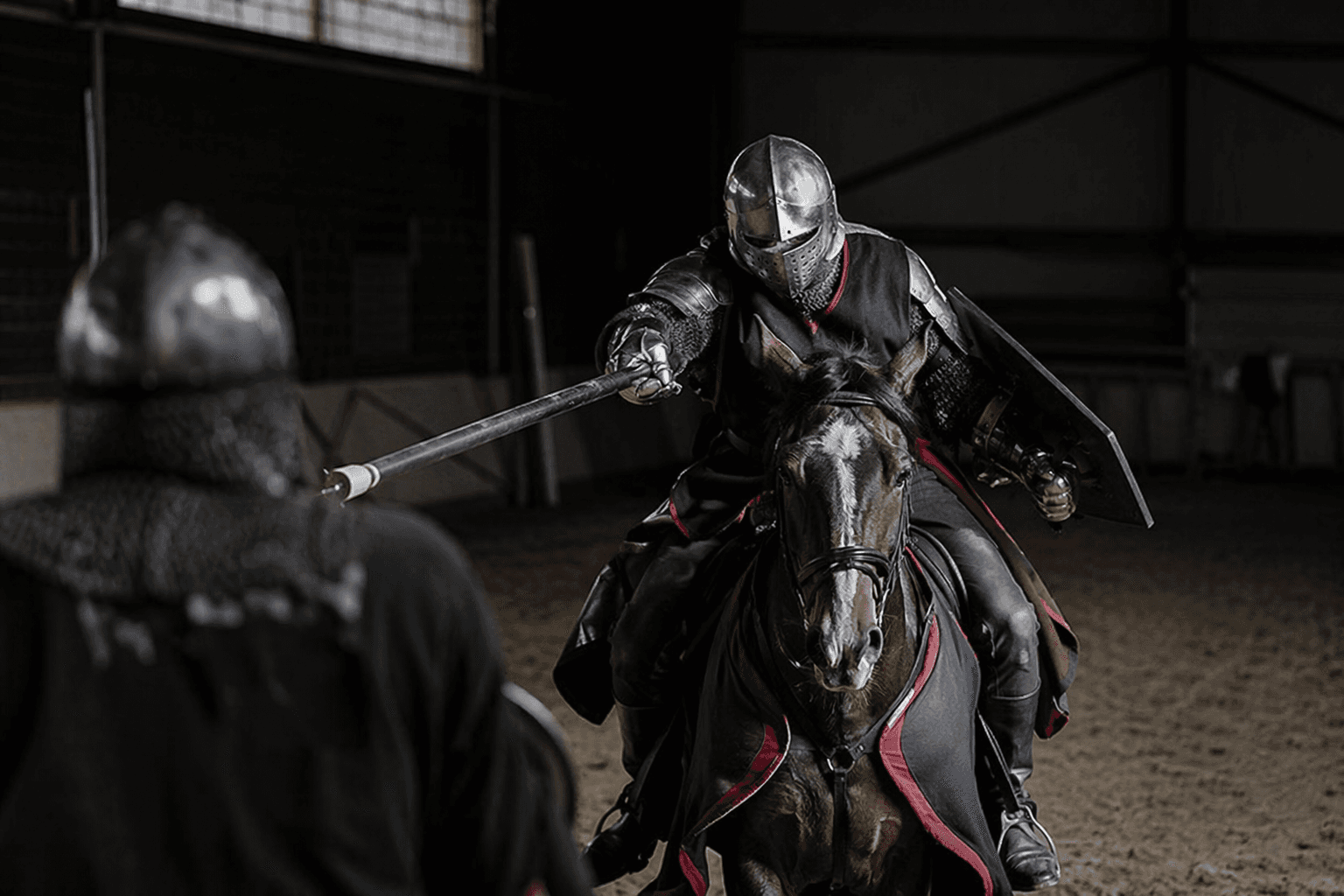
A rider in armor has to control distance, balance, reins, timing, and a live animal while still delivering a clean strike or lance hit. That demand makes Roßfechten one of the rarest and most prestigious formats in modern HEMA.
Why Roßfechten stays rare
Roßfechten is demanding in a way that foot combat simply is not. HEMA Canberra’s familiar triptych of Blossfechten, Harnischfechten, and Rossfechten, unarmored fighting, armored fighting, and mounted fighting, makes clear that mounted combat is its own technical field, not foot fencing with extra drama. The horse changes everything. The fighter has to stay seated, keep the animal moving on line, manage the reins, and still make precise weapon work possible while the target is also moving under a second will.
That is also why the discipline is still niche. Mounted combat is a smaller, less-emphasized branch of the art than ground-based sword fighting, and the surviving source material is comparatively limited. In practice, that means fewer clubs can train it regularly, fewer facilities can host it, and fewer people can gather the horses, armor, and staff needed to do it safely.
From battlefield necessity to tournament culture
Mounted fighting mattered because cavalry mattered. Effective mounted troops could decide a battle, which is why the saddle became a place for real martial technique, not just pageantry. TOTA’s overview of HEMA also shows how wide the field was: mounted combat appears in battlefield use, duels, jousting, and sport, and some traditions even include fighting other riders, using the horse as a weapon, or wrestling from horseback.
The weapon list is broader than many readers expect. From the saddle, historical fighters used lances, swords, spears, maces, and hammers. The lance usually dominates modern imagination, but the historical record shows a much larger system, one built for impact, retention of balance, and the ability to transition when the first strike did not end the exchange.
Fiore dei Liberi and the clearest source window
For modern reconstruction, Fiore Furlan dei Liberi da Premariacco gives the sharpest view into the art. The J. Paul Getty Museum dates his Getty manuscript, Ms. Ludwig XV 13, to about 1410, and the manuscript instructions include mounted combat in all its variations. In Wiktenauer, Fior di Battaglia is an Italian fencing manual dedicated to Niccolò III, Marquis d’Este, and the surviving copy is a parchment manuscript in the Getty Museum.
The imagery is unusually vivid. The Getty’s collection entry includes charging horses and armored knights, while the Public Domain Review covers mounted lance work, sword-on-horse plays, grappling from the saddle, and spear-versus-cavalry material. Fiore’s mounted section also ties the lance to broader martial theory; Wiktenauer transcribes the lance verse as a weapon used in battle “on horse and on foot.”
The armor and tournament side of the story
Mounted combat did not live only in war. The Metropolitan Museum of Art traces horse armor through a longer European cycle, revived in the 12th century after disappearing with the fall of Rome, then flourishing again in the Renaissance before becoming obsolete in the early 1600s. Horse armor, rider armor, and tournament armor formed one ecosystem, and the art of fighting from the saddle developed inside it.
The Met’s tournament definitions separate several mounted forms. A tilt was a horseback joust between two opponents armed with lances and separated by a lengthwise barrier. A tourney could involve two mounted groups armed with blunted lances and swords, with armor combining field and tournament components.
What modern reconstruction has to solve
The biggest obstacle in modern HEMA is that mounted combat is not just technically hard, it is logistically hard. Horses have to be available, trained, and handled by people who understand both horsemanship and martial risk. Safety protocol has to cover the animal, the rider, the weapon, the footing, and the space between them, which makes every exchange more complicated than a foot-fight in a ring or on a strip.
That complexity also makes judging harder. A mounted bout has to account for the rider’s line, the horse’s movement, the lance’s angle, contact quality, control after impact, and whether the exchange was safe enough to continue.
How riders trained, and why that matters now
Mounted combat was never improvised. ARMA identifies the quintain as a historical tool for training mounted lance combat, a simple but revealing detail because it shows how riders built accuracy and timing before facing a live opponent. The same martial culture appears across Fiore’s manual, which moves systematically through wrestling, dagger, spear, longsword, armored combat, and mounted work.
An armorer in ARMA’s interview says very few people do unchoreographed mounted combat and that historical knights may have spent more time training horses and riding than swordsmanship.
This article was produced by Prism’s automated news system from verified source data, official records, and press releases, then run through automated quality and moderation checks before publishing. The system is built and supervised by the people who set the standards it runs under. Read our full AI policy.
Did this article answer your question?