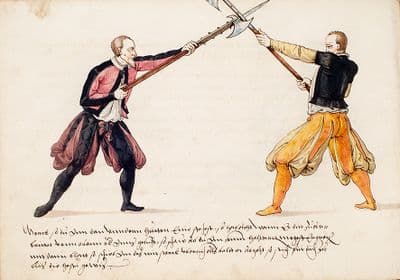
Why HEMA has so many names, and what they mean
HEMA’s many names are a map of the sport itself: historical fencing, Renaissance martial arts, and HEMA each signal different weapons, rules, and club culture.

ARMA, the Association for Renaissance Martial Arts, has been online since 1996, and it still describes the discipline as “Historical Fencing and Medieval & Renaissance Combat Skills.” The label on the flyer often reveals the training culture inside the room, the sources behind the class, and the kind of event fit the club is chasing.
What the names are really pointing to
That wording puts two things front and center: the weapons work itself and the historical periods that produced the manuals, techniques, and systems practitioners study. It is a good example of how one name can emphasize both method and context without collapsing the sport into a single weapon class.
The HEMA Alliance uses a wider frame for Historical European Martial Arts: the study and practice of historical European fighting techniques. The organization also provides club-finder and new-student resources.
Liverpool HEMA spells out the acronym as “Historical European Martial Arts.” Its explainer page treats the term as an academic and technical study of historical fencing, and the page includes a 2017 training photo.
Historical fencing, Renaissance martial arts, and HEMA each tell a different story
If a club calls itself a historical fencing group, expect the pitch to lean hard into the mechanics of combat. That phrase usually highlights blades, distance, timing, the bind, footwork, and how one weapon controls another. It suggests a room where interpretation is tested through drilling and sparring, with the weapon system itself as the main lens.
“Martial arts of Renaissance Europe” or “Renaissance martial arts” pushes the historical frame forward. That wording reminds you that the source material comes from real periods, real schools, and real social settings, not fantasy or modern sport invented from scratch. It can also signal that the club wants readers to notice continuity across manuscripts, court culture, and battlefield context, not just the exchange of hits in the ring.
HEMA is the broadest label and the one most likely to be used when a club wants to be inclusive across weapons and formats. The term works well for a community that contains longsword, rapier, sword-and-buckler, sidesword, sabre, singlestick, wrestling, dagger work, and armored fencing. In practice, that breadth helps explain why the same person might train in one weapon on Tuesday, enter a mixed-weapon tournament on Saturday, and spend Sunday reading a manual in a different source tradition.
Why the broad umbrella became necessary
Bold City Longsword places HEMA in the modern reconstruction of martial arts in Europe from around 1300 to 1800. That range covers medieval systems, Renaissance treatises, and the later material that many clubs still teach and test.
In a 2015 Atlanta report, WABE used Historical European Martial Arts as a term encompassing any number of fighting styles rooted in the chivalric combat of Medieval and Renaissance Europe. The sport is not one style, one weapon, or one competition format, but a family of related practices built from surviving sources and modern interpretation.
Multiple terms survive at once. A club focused on source scholarship may prefer “historical fencing.” A club that wants to signal breadth, accessibility, and tournament compatibility may favor “HEMA.” A group that wants the public to understand the period and cultural background may reach for “Renaissance martial arts.”
How to read a club page, class listing, or tournament ad
The quickest way to decode the label is to look at what the club emphasizes alongside it.
- “Historical fencing” usually means technical weapon work, testable interpretations, and an emphasis on timing, measure, and the bind.
- “Renaissance martial arts” usually means a stronger historical frame, with more attention to the period, the manuscript tradition, and the culture that produced the fighting systems.
- “HEMA” usually means breadth: multiple weapons, multiple rulesets, and a community wide enough to include both study and competition.
A newcomer looking for a structured entry point may find the HEMA Alliance’s club-finder and new-student resources more helpful, because the umbrella term signals a wider network of clubs and teaching styles. Someone who wants a sharper technical focus may feel more at home in a group that brands itself as historical fencing. A tournament flyer using HEMA may be flagging mixed weapons or a broader competitive field, while a more specific label can suggest a narrower ruleset or a source-centered event.
The research culture behind the labels
Wiktenauer is a community-driven library of books and manuscripts tied to the field. The naming debate is also a research debate: the sport draws its legitimacy from surviving texts, and the terms clubs use often point to which texts and traditions they value. A club that talks about manuscripts, translated sources, and reconstruction is giving you a very different promise from a club that sells only sparring volume.
ARMA’s presence online since 1996 places it in the early modern revival period for HEMA, when the field was still defining its public vocabulary. Even as HEMA became the dominant umbrella term, older phrases stayed in use for clubs that wanted to emphasize method, sources, and scope.
This article was produced by Prism’s automated news system from verified source data, official records, and press releases, then run through automated quality and moderation checks before publishing. The system is built and supervised by the people who set the standards it runs under. Read our full AI policy.
Did this article answer your question?