12-Week Offseason Plan Targets Indiana High School Guard Development
Indiana guards who complete this 12-week audit arrive at tryouts shooting 45%+ from three and turning it over less — with data to prove it.
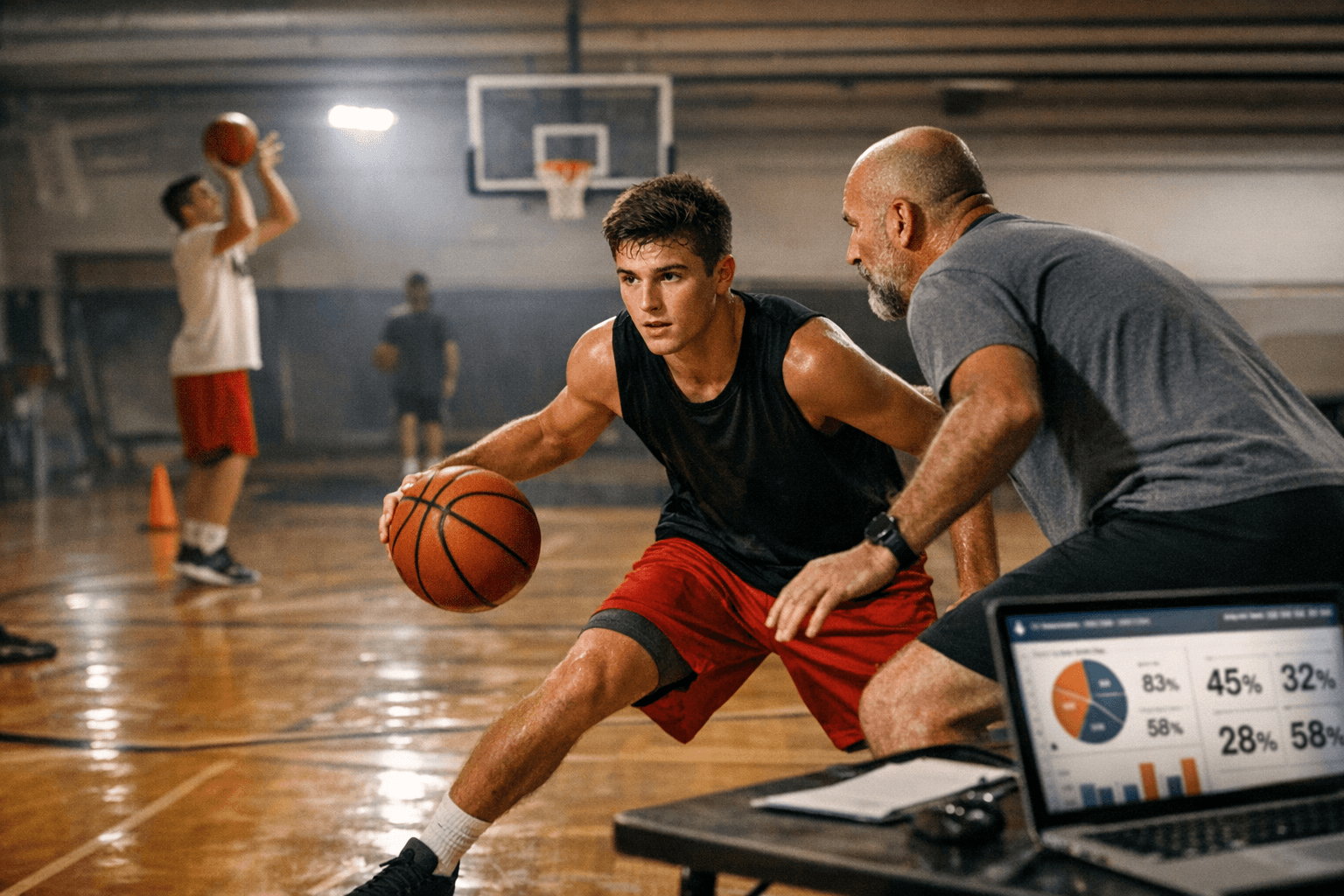
Guards in Indiana get cut or kept based on a narrow margin. A step-back three that rattles in versus one that rattles out. A pick-and-roll read that produces an assist versus a charge. The difference between those outcomes is almost never talent; it's structured repetition. This 12-week offseason program is built as a measurable guard audit, phase by phase, with weekly targets that coaches can verify and players can track themselves.
Before Week 1 begins, every player should record four baseline numbers: free throw percentage over 50 attempts, catch-and-shoot makes out of 25 attempts from five spots, off-dribble field goal percentage on 20 pull-up attempts, and turnover rate per 10 possessions in a controlled 3-on-3 scrimmage. These four numbers are the foundation of the audit. Every number collected during Weeks 4, 8, and 12 gets measured against them.
Phase 1: Foundation and Mechanics (Weeks 1-3)
The first three weeks are non-negotiable for any guard who wants the later phases to produce real results. The primary target is 250 makes per day, broken across five distinct segments: form shooting from close range, catch-and-shoot repetitions, pull-up midrange, step-back threes, and game-speed threes. That structure matters because each segment isolates a different mechanical demand, and guards who skip straight to game-speed work before locking in their form carry bad habits into every phase that follows.
Ball-handling in Phase 1 runs parallel to shooting. Two-ball stationary dribbling for three minutes, two-ball zig-zag sets for five rounds, and a strong-hand/weak-hand push-pull series that runs 10 minutes daily. These are not warm-up drills; they are the primary skill targets for the week. Spot-up shooting progression covers five spots at five shots per spot across five rounds, and form-focused one-hand makes from four to six feet account for 100 attempts in each session.
Strength and conditioning in Weeks 1-3 stays intentional: two sessions per week focused on hip and core stability along with linear acceleration work. The goal is building a base without heavy bulking, protecting joints and keeping movement patterns clean.
Week 1-3 Targets: Catch-and-shoot: 14+ makes out of 25. FT%: establish baseline (50 attempts). Off-dribble FG%: establish baseline (20 attempts). Turnover rate: establish baseline (3-on-3, 10 possessions).
Phase 2: Creation and Finishing (Weeks 4-6)
Phase 2 shifts the focus from mechanics to pressure. Guards need to create for themselves and others against resistance, and this phase introduces the tools to do it. Change-of-pace combinations are the core skill target: hesitation plus rip-through, step-back plus sprint recovery, all executed against cone and pad defenders that simulate live resistance. The goal is not just completing the move but finishing it correctly, which means floaters from six to eight feet and two-foot finishes under the rim when contact is initiated.
Pick-and-roll reads become a structured daily component. Three-on-three pick-and-roll sets emphasize getting to the elbow and reading three distinct coverages: drop, switch, and trap. Getting the read right is tracked, not just the make. Progressive contact finishing runs static two-minute sets where the guard must finish 10 contested layups from varied angles, building the mental durability that late-game situations in postseason play require.
Film work enters the program here. Weekly sessions of 20 to 30 minutes analyzing shot selection and decision-making are not optional in Phase 2. Without film review, guards repeat the same poor reads even as their physical tools improve.
Week 4-6 Targets: Catch-and-shoot: 16+ makes out of 25. FT%: 78%+. Off-dribble FG%: 36%+. Turnover rate: reduce to 2.5 per 10 possessions.
Phase 3: Competitive Play and IQ (Weeks 7-9)
The skills built in Phases 1 and 2 only translate to games if guards have practiced making decisions at game speed with consequences attached. Phase 3 puts them in that environment every day. Three-on-three and five-on-five scrimmages run with modified scoring: assists earn bonus points and turnovers count double. That structure forces guards to weigh the risk/reward of every possession rather than default to isolation habits.
Situational drills cover three specific scenarios: late-clock pull-up reads, inbound pressure responses, and transition decision-making (identifying when to attack the rim versus kick to the corner three). These aren't hypothetical; they're the exact situations that decide games in sectional and regional rounds across Indiana.
Conditioning in Phase 3 moves to repeat-sprint protocols and five-on-zero circuits that replicate actual game stoppage patterns. Conditioning that mimics real game rhythm prepares guards for the physical demands of postseason play far more effectively than straight-line distance running. Film sessions in this phase shift to opponent scouting and self-analysis, pushing basketball IQ development beyond individual skill.
Week 7-9 Targets: Catch-and-shoot: 18+ makes out of 25. FT%: 82%+. Off-dribble FG%: 40%+. Turnover rate: reduce to 2.0 per 10 possessions.
Phase 4: Preseason Sharpen and Individual Reporting (Weeks 10-12)
The final phase is about measuring what the previous nine weeks built. Shooting targets are now specific: 45% or better from three on structured sets, and 85% or better on free throws in practice settings. Defensive drills with rotations and closeouts enter as primary skill targets. Simulated game nights serve as the formal audit checkpoint.
Every player finishes Phase 4 with a written player report that includes projected points and assists per game, shooting percentages from structured sets, identified strengths to exploit in early-season play, areas requiring continued polish, and a four-week in-season maintenance plan. That document is what transforms this from a summer program into an accountable development system.
Week 10-12 Final Targets: Catch-and-shoot: 20+ makes out of 25. FT%: 85%+. Off-dribble FG%: 43%+. Turnover rate: at or below 1.5 per 10 possessions.
Weekly Reporting Template
Use this format every Sunday to keep players and coaches aligned:
- Player name / position (lead guard or combo guard)
- Week number and phase
- Daily makes logged (target: 250/day)
- Catch-and-shoot: makes out of 25 attempts
- Free throws: makes out of 50 attempts (record as %)
- Off-dribble FG%: makes out of 20 pull-up attempts
- Turnover rate: turnovers per 10 possessions in scrimmage
- Film session completed (Yes/No) + one decision to correct
- Recovery notes (sleep hours, mobility work completed)
Programs adopting this at the team level should standardize an offseason test combining shooting, shuttle, and vertical measurements so each incoming guard's progress benchmarks against prior-year players. That year-to-year data is what separates a one-off summer workout from an institutional development system.
Coaching Notes on Individualization
Lead guards and combo guards are not the same player, and this program accounts for that. Reps should be individualized based on role: a lead guard needs more volume on pick-and-roll reads and transition decisions; a combo guard needs more work on off-ball catch-and-shoot mechanics and finishing off screens. Daily attempt counts and make percentages must be tracked, not estimated. Recovery is not optional: nutrition, sleep quality, and daily mobility work determine how much of each session's volume actually converts to retained skill.
The program is also intentionally portable. It compresses into a six-week intensive or stretches across summer camp windows without losing its developmental logic. What it cannot lose is the measurement structure. Guards who complete all 12 weeks with clean data behind them arrive at Indiana high school tryouts with something most of their competition doesn't carry: proof.
This article was produced by Prism’s automated news system from verified source data, official records, and press releases, then run through automated quality and moderation checks before publishing. The system is built and supervised by the people who set the standards it runs under. Read our full AI policy.
Did this article answer your question?