Evergreen coaching primer: How to structure an effective high-school all-star / showcase practice (for Indiana coaches and event directors)
Indiana's all-star ecosystem gives elite players one shot to impress college scouts; here's the 90-minute practice blueprint that maximizes every rep.
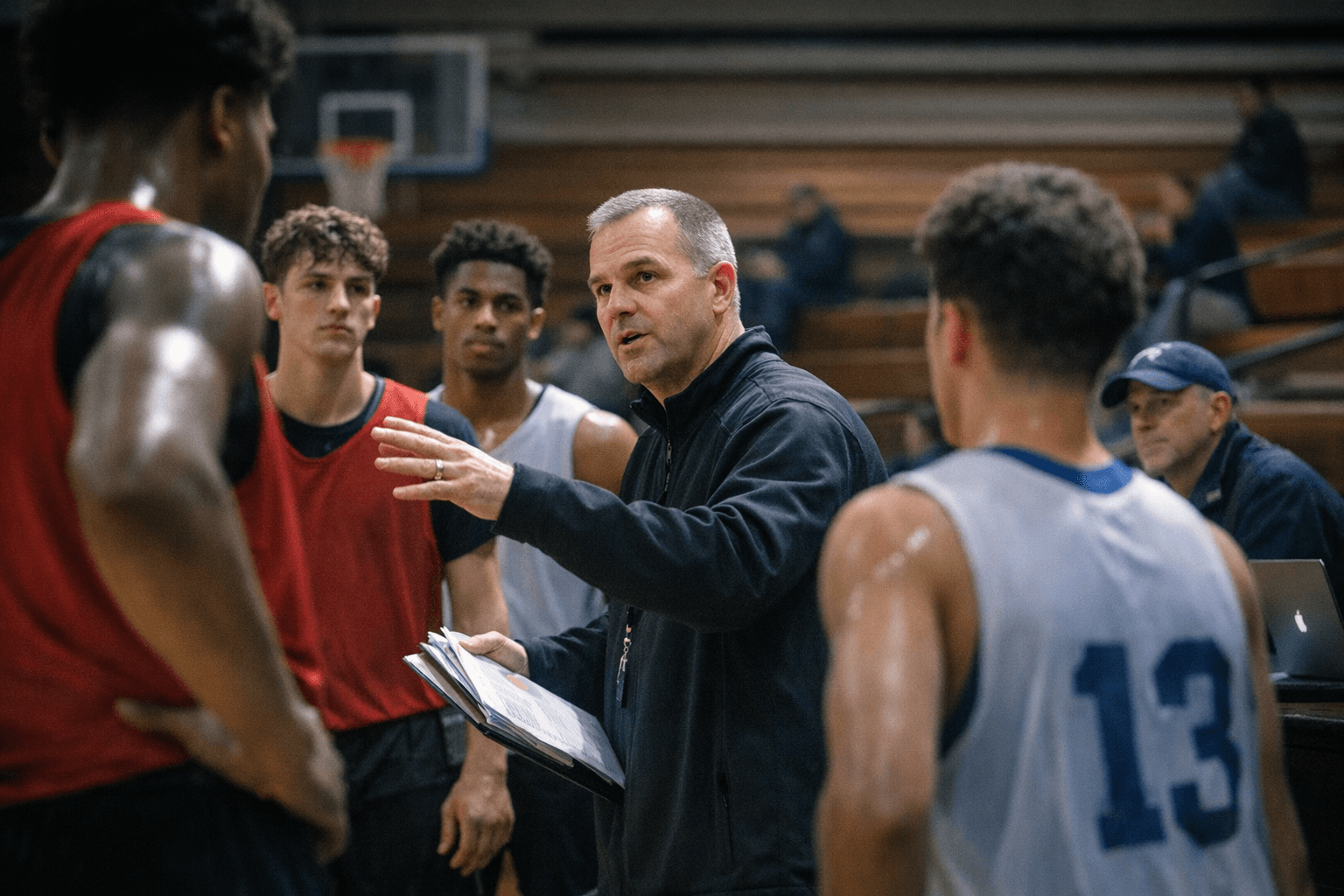
Every summer, a handful of Indiana's best high school basketball players walk into a gym knowing that what happens in the next 90 minutes could define where they play in college. The Indiana All-Stars, Junior All-Stars, and Futures Games are not ordinary practices. They are compressed, high-visibility auditions where college coaches, media, and selectors watch dozens of prospects in a single session. Unlike a full season of film, an all-star showcase gives evaluators a narrow window and a short sample. For coaches and event directors running these sessions, that reality demands a structure that is deliberate, replicable, and built around player performance rather than event spectacle.
Why "winging it" costs players recruitment opportunities
The hardest truth about Indiana's all-star ecosystem is that a disorganized practice reflects on the players, not just the organizers. When rotations are unclear, when walk-throughs run long, or when scrimmage minutes are distributed unevenly, college coaches leave with incomplete evaluations. Selectors attending the Indiana All-Stars or a regional Futures event are making mental notes from the moment players step on the floor. A well-structured 90-minute session ensures every prospect gets a fair, comparable showcase; a chaotic one creates gaps that hurt players who needed those reps most.
Pre-practice logistics: The groundwork that makes 90 minutes work
No practice runs cleanly without preparation completed before the first player arrives. For all-star and showcase events, that means distributing a communication packet, either by email or a single printed sheet, that confirms arrival time, parking instructions, warm-up expectations, team assignments, and an exact minute-by-minute schedule. Strong events also include a short behavioral expectations paragraph covering sportsmanship and sideline conduct, plus a direct contact number for the event director. Players and families who arrive informed are players who arrive ready to compete.
Medical infrastructure is non-negotiable. Every showcase must have accessible medical release forms, emergency contacts, and ACL and concussion baseline documentation on file. A certified athletic trainer or EMT must be on-site; for larger events involving the full Indiana All-Stars or Futures field, two certified medical staffers is the standard. The presence of medical coverage also signals professionalism to college coaches who attend these events routinely and notice when it is missing.
Coaches must convene 30 to 45 minutes before players arrive. That meeting covers rosters, substitution rotations, and the primary objective of the session, whether the emphasis is evaluation, development, or competition. Critically, coaches must agree in advance on a guaranteed minimum of playing time for every participant, with six minutes in any live scrimmage serving as a reasonable floor. Protecting that minimum is not just about fairness; it protects the event's reputation with the players and families who trusted it with a recruit's most visible summer moment.
The 90-minute script: Five non-negotiable segments
Segment 1: Arrival and dynamic warm-up (Minutes 0-12)
The warm-up is not downtime. Scouts who arrive early begin evaluating movement quality, lateral quickness, and athleticism from the first drill. A low-load, consistent warm-up protocol including banded activation, dynamic lunges, and ten short acceleration sprints of 10 to 20 yards gives evaluators an identical baseline to compare across players. Keeping the warm-up standardized is deliberate: when every player runs the same protocol, differences in explosion, coordination, and body control become visible against a common frame.
Segment 2: Position-based skill stations (Minutes 12-32)
Three rotating stations, each running six to seven minutes, expose evaluators to the skills that college programs prioritize most. The first station focuses on shooting and finishing; the second on playmaking and pick-and-roll reads; the third on defensive footwork and closeout mechanics. Keeping stations competitive, through make-it-take-it shooting contests or 2-on-2 finishing challenges, creates the game-like decision pressure that separates shooters from scorers and defenders who communicate from those who drift. This is where selectors for the Indiana All-Stars and Junior All-Stars can observe the decision-making speed and defensive communication that matter far more than highlight plays.
Segment 3: Team concepts and limited-scheme walk-through (Minutes 32-42)
All-star rosters have minimal practice time together, which means complexity kills the event. Introduce no more than two or three offensive sets and one or two defensive coverages that will appear in the scrimmage. Emphasize spacing, quick reads, and simple inbound plays. The goal of this segment is not system execution; it is to give players a shared vocabulary so that scrimmage play does not collapse into isolation basketball. For college evaluators, watching a prospect navigate a simple ball-screen read correctly tells them far more about basketball IQ than a contested pull-up taken without a teammate in sight.
Segment 4: Controlled scrimmage windows (Minutes 42-82)
Forty minutes of live play, broken into 6 to 8 minute quarters or 8 to 10 minute running-clock halves with frequent substitutions, forms the evaluative core of the session. Running both 3-on-3 and 5-on-5 segments in quick succession gives passers and scorers multiple opportunities in different spatial contexts, which matters for selectors who want to see how a prospect reads space under different defensive alignments. Contact intensity should be managed and kept below a full competitive game standard to protect player health across a full summer of showcases.
The rotation plan must be communicated to each player at halftime, spelling out exactly which segment they will play next. That transparency eliminates sideline anxiety and keeps players mentally ready rather than watching the clock. Late-game and special-situation execution, including sideline out-of-bounds plays and press-break reads, should appear in the final 10 minutes of this segment so evaluators can observe composure under time pressure, the quality that most directly predicts college readiness.
Segment 5: Cool-down and media access (Minutes 82-90)
A supervised cool-down reduces soft-tissue injury risk and transitions players out of competitive intensity. It also creates a controlled environment for brief media interviews, which benefit the event's visibility and give players low-stakes experience speaking to press. Events that manage this window professionally, rather than letting players scatter immediately after scrimmages, reinforce the quality signal that college coaches carry back with them.
What evaluators are actually collecting
Coaches running these sessions should be gathering standard metrics throughout: shots made, turnovers, assists, defensive stops, and short video clips of each athlete's possessions. These data points accelerate recruitment conversations that happen after the event and give coaches specific evidence to offer college programs rather than anecdotal impressions. Events that deliver this level of documentation build long-term credibility with evaluators who attend Indiana showcases year after year.
Professionalism in conduct matters as much as production on the floor. Events that enforce sportsmanship standards and limit sideline trash talk are consistently better received by college programs, whose coaches make note of character as readily as they note crossover speed.
Post-event follow-through
Within 48 hours of the showcase, every participating athlete and their high school coach should receive a short recap including minutes played, key statistics, and a highlight clip. That follow-through accelerates recruitment timelines by giving college programs a ready-made reference point instead of relying on scattered notes from a single viewing. A debrief with coaches and medical staff to capture operational lessons and update the event packet completes the cycle and makes each successive Indiana showcase sharper than the last.
A single well-run practice session, repeatable and athlete-centered, is the most powerful recruitment infrastructure a host school or event director can build. In a state with Indiana's basketball heritage, getting that 90 minutes right is not just good event management; it is what keeps the pipeline flowing from gyms across the state directly to college rosters.
This article was produced by Prism’s automated news system from verified source data, official records, and press releases, then run through automated quality and moderation checks before publishing. The system is built and supervised by the people who set the standards it runs under. Read our full AI policy.
Did this article answer your question?