One-Page Scouting Template Helps Indiana Coaches Prepare for Sectionals
Indiana sectional brackets give coaches as few as 48 hours between games; this reproducible one-page scouting template turns limited film into a focused game plan tonight.

The bracket drops, and suddenly a program has 48 hours to prepare for an opponent it may have seen once, on a grainy gym livestream, from a camera angle that cuts off half the floor. That is the standard condition of Indiana sectional basketball: compressed timelines, limited film, and a roster of volunteer scouts doing their best with smartphone notes and a YouTube link. The teams that advance most consistently are not always the most talented; they are the ones that gather the right information fastest and convert it into a focused game plan before tip-off.
This template is designed to do exactly that. Compact enough to fit on one page and structured to prioritize what actually moves the needle at the IHSAA level, it gives coaches a repeatable framework and volunteers a defined job.
Team Identity: Three Lines That Set the Game Plan
Every scouting sheet starts with a three-line summary that anchors the entire coaching staff's understanding of who they are facing. The first line covers offensive style: is this a spread pick-and-roll team, a motion/pass-and-cut system, or an isolation-heavy attack built around a single scorer? The second line names the defensive base, whether man-to-man, 2-3 zone, matchup zone, or a box-and-one. The third line pins down tempo. Teams running more than 70 possessions per game reward your transition offense; teams in the 55-to-70 range play moderately; anything below 55 possessions is a deliberate, half-court-heavy opponent where every shot attempt carries extra weight.
Getting these three lines right in the first viewing changes how a coach structures the rest of game prep. A slow-tempo zone team requires a different practice emphasis than an up-tempo man defense program, and that distinction alone is worth 10 minutes of preparation time.
Key Personnel: Four Players, One Sentence Each
List the top four players and fill in five attributes for each: height and length, primary role, scoring habits (left or right hand, pull-up three-pointer, catch-and-shoot, transition finisher), foul tendency, and late-clock usage. That last point matters more in high school than at any other level. Indiana sectional games are routinely decided in the final two minutes, and knowing that a team's primary scorer prefers to curl off a pin-down with 8 seconds on the shot clock gives defenders a specific cue rather than a vague instruction to "guard their best player."
Add one defensive note per player: who do they switch onto, can they guard the post, and are they prone to reaching or over-helping? Keep it to one sentence. A scout who writes a paragraph has already lost the coach's attention at halftime.
Set Plays and Situational Tendencies
Four categories cover the situations that most frequently decide close games:
1. Late-clock plays: what does this team run with 10 to 5 seconds left on the shot clock? An isolation for a specific number, a sideline baseline inbound, or a drag screen for a guard? Naming the action and the jersey number gives defenders a script.
2. Turnover patterns: is this team press-susceptible, or do they protect the ball well but foul late at an above-average rate? Those two profiles demand completely different fourth-quarter strategies.
3. Free-throw rate: a program that draws fouls at a high rate relies on interior contact to generate points, which signals a need for disciplined help defense rather than aggressive trapping.
4. Transition vulnerability: teams that rebound poorly give up early transition points at a rate that compounds across 32 minutes. If an opponent ranks at the bottom of their conference in defensive rebound percentage, pushing pace off made baskets is not a gamble; it is a calculated advantage.
Statistical Quick Hits: Five Numbers That Tell the Story
When advanced data is available, prioritize opponent field-goal percentage near the rim, three-point attempt rate, offensive rebound percentage, and assist-to-turnover ratio. Programs with a high assist-to-turnover ratio tend to punish passive defenses; those with a low ratio are more isolation-dependent and turn the ball over under pressure.
For programs in smaller communities where tracking data is limited, substitute league rank for points allowed per game and points scored per game. Rank is often more informative than raw totals because it contextualizes schedule strength without requiring any proprietary software.
A Sectional Matchup in Practice: Tagging ATOs, Ball-Screen Coverage, and Late-Game Tendencies
Consider how this template functions in a representative Indiana sectional semifinal: a moderate-tempo opponent running roughly 62 possessions per game, attacking out of spread pick-and-roll sets, with a man-to-man base that collapses into a 2-3 zone when protecting a lead. Their leading scorer, a 6-foot-2 wing at number 3, favors a pull-up three from the right wing off a ball-screen and consistently runs an isolation after timeouts (ATOs) on the right side of the floor in the fourth quarter.
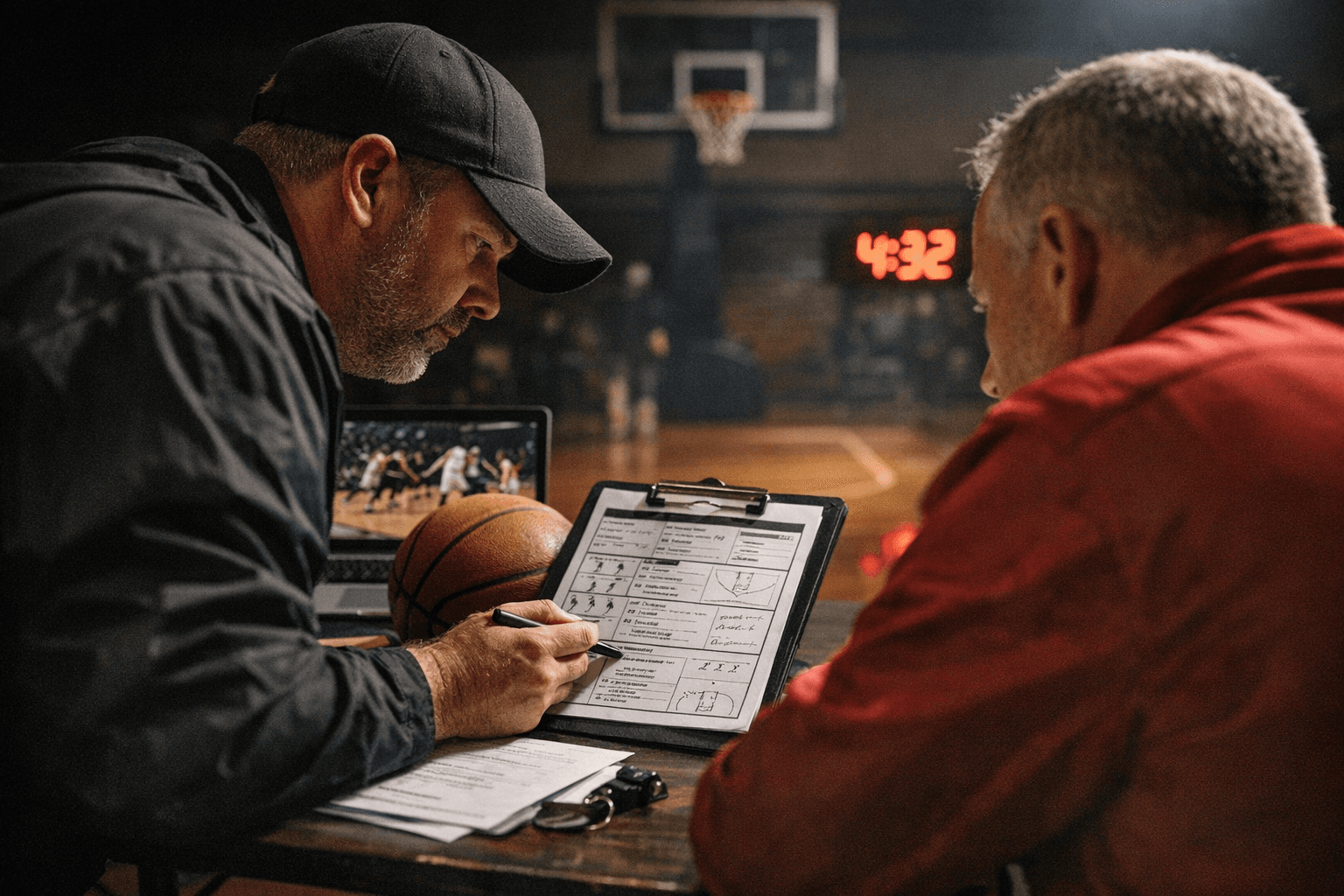
On the scouting sheet, that single pattern becomes the entire ATO defensive assignment: shade number 3 left, deny the wing catch, and communicate the screen before it arrives. The ball-screen coverage note reads "hedge hard, recover to shooter" for number 3 and "drop" for the team's weaker ball-handler at the top. Two sentences. One page. No confusion during a baseline huddle with 30 seconds on the clock.
That specificity, applied consistently across each of the four situation categories, is what separates a scouting sheet from a scouting report. The sheet travels to the bench; the report stays in the office.
Video and Data Collection Workflow
A single assistant tagging possessions live on a smartphone notes app can generate the foundation for this template in one game. The tagging categories are intentionally simple: made field goal, missed field goal, turnover type, and foul. Aggregated across a full game, these tags produce the percentages that feed the statistical section without requiring a full analytics staff.
For programs in areas with limited infrastructure, the priority is video capture of two specific moments: set plays and the possessions immediately following offensive rebounds. At the high-school level, those two situations are disproportionately decisive, particularly in games where both teams are similarly talented. A second viewing of those clips in the 24 hours before tip-off reveals tendencies that no box score captures.
Halftime Adjustments: Micro-Changes, Not Overhauls
The template earns its greatest value in the locker room at halftime. The instruction is deliberate: two defensive adjustments, two offensive adjustments, no scheme overhauls in the third quarter. Coaches who attempt wholesale changes at intermission typically compound confusion rather than solve problems.
Effective halftime changes at the sectional level look like this: switching to a zone for a four-to-six-minute stretch in the third quarter to disrupt a team's rhythm, calling one fewer isolation in the half-court to prevent the defense from loading up on a single action, or tightening spacing near the free-throw driving lane to shrink the opponent's best path to the rim. These are micro-changes, and they are more reliably executed under tournament pressure than anything requiring new terminology.
The One-Page Game Plan Checklist
At the bottom of every scouting sheet, the game plan checklist runs in four items. Print it, fold it, and keep it on the bench.
- Limit number 3 to catch-and-shoot only; force left hand; box out on every missed three-pointer.
- Communicate ball-screen coverage before the screen arrives; hedge the ball-handler, recover to the shooter.
Defense:
- Attack closeouts early; their wing defenders are slow to recover after showing on screens.
- Run quick two-on-ones off made baskets to exploit transition defense that ranks among the conference's worst in rebound percentage.
Offense:
Substitution plan: preserve your primary defender and best rebounder for the fourth quarter; use bench minutes in the second and early third quarter when the game remains within a margin that allows rotation experimentation.
Hoosier sectional basketball is ultimately decided by execution, rebounding, and turnovers, and a compact scouting sheet aligns coaching focus precisely on those three areas. Over a full season, collected into a single opponent binder, these one-page sheets become the most useful offseason study tool a returning roster and coaching staff can take into next year's bracket.
This article was produced by Prism’s automated news system from verified source data, official records, and press releases, then run through automated quality and moderation checks before publishing. The system is built and supervised by the people who set the standards it runs under. Read our full AI policy.
Did this article answer your question?