Hoosier Dome era helped define Indiana high school basketball
The Hoosier Dome turned Indiana’s finals into a statewide event, and Bedford North Lawrence’s 63-60 win over Concord before 41,046 fans became the era’s defining image.
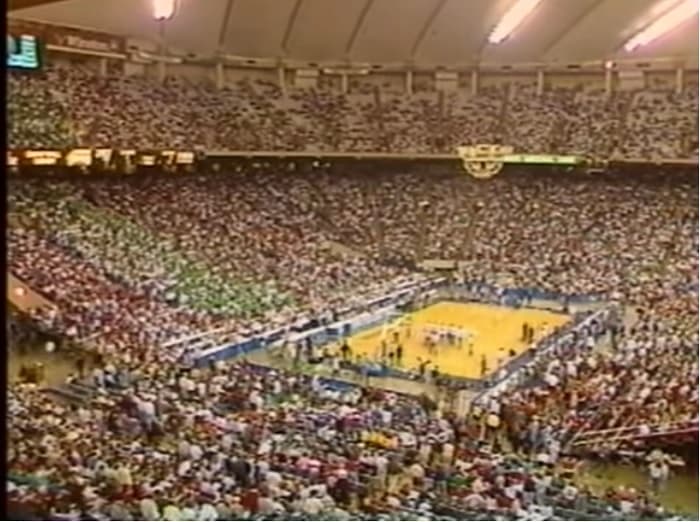
The Hoosier Dome did more than house a championship game. It gave Indiana high school basketball a scale big enough to turn one March weekend into a statewide identity test, and the 1990 boys finals delivered the number that still frames the era: 41,046 inside the building for a national-record high school crowd. Bedford North Lawrence’s 63-60 win over Concord, sealed by Damon Bailey’s late burst, became the cleanest snapshot of what that decade meant.
The number that made the dome the benchmark
The move to the Hoosier Dome came in 1990 after 60 consecutive sellouts, and the first championship there instantly felt different from the gym-centered finals that came before it. UPI’s March 24, 1990 coverage noted that the Indiana high school boys basketball final four had sold out for 62 straight years and drew 431 national media members, proof that the event had outgrown a local audience. The attendance figure, 41,046, has become the hard number attached to Hoosier Hysteria because it captured both the demand and the scale.
That crowd mattered because it changed the emotional math of the tournament. A game that might once have belonged to one town or one section of the state suddenly belonged to everyone, with the noise, the pageantry and the sheer size of the setting making the finals feel like a civic occasion. In the Hoosier Dome, the championship was no longer just the end of a bracket. It was the stage where Indiana measured itself.
Damon Bailey’s finish made the scene unforgettable
The 1990 title game gave that atmosphere a signature finish. Bedford North Lawrence beat Concord 63-60 in the 80th annual Indiana High School Athletic Association boys basketball state finals tournament, and the IHSAA’s championship description says Bailey scored the last 11 points for Bedford North Lawrence. He also helped erase a 58-52 deficit in the final 2 1/2 minutes, the kind of closing run that turns a great game into a remembered one.
That sequence is one reason the Hoosier Dome era still carries weight. Big venues can swallow emotion if the game does not match the setting, but Bailey’s finish did the opposite. It used the size of the moment to magnify the player, and in a single game a regional star became part of the state’s permanent basketball memory.
Why whole communities treated March like a road trip
The Hoosier Dome years worked because Indiana basketball was never only about the players on the floor. The final weekend pulled in families, alumni, students and towns that traveled together, then carried the games with them everywhere else, from television and radio to school hallways, offices and dinner tables. That shared experience made the finals feel bigger than a championship and more like a reunion of the state’s basketball culture.
The event also reflected how deeply Indiana tied basketball to identity. The state did not simply celebrate the sport as entertainment. It marketed it, lived it and used it to explain itself, which is why a finals weekend could become a common reference point across communities that otherwise had little in common. When the same games could be watched, discussed and replayed across the state, the championship became a shared language.
From Assembly Hall to the dome, Indiana built the stage
The Hoosier Dome era sits inside a much longer tournament history. The IHSAA’s boys basketball state tournament began in 1911 at Assembly Hall on the Indiana University campus in Bloomington, and the 1990 championship was the 80th annual finals tournament. That timeline shows how far Indiana had already gone by the time the state moved its showcase into a dome in Indianapolis.
The significance of the Hoosier Dome decade is not that it replaced tradition. It stretched tradition to a larger canvas. The old single-bracket feel still mattered, but the new setting gave the finals a big-event presentation that fit the state’s obsession with the sport and the larger crowds that came with it. That is the standard the modern game keeps chasing: not just strong teams and good players, but a weekend that feels like the whole state has arrived.
Indiana high school basketball still carries that expectation because the Hoosier Dome years proved what happens when the final weekend becomes a true statewide gathering. The record crowd, the media attention, the traveling communities and Bailey’s 11-point finish created a benchmark that still defines Hoosier Hysteria whenever March comes back around.
This article was produced by Prism’s automated news system from verified source data, official records, and press releases, then run through automated quality and moderation checks before publishing. The system is built and supervised by the people who set the standards it runs under. Read our full AI policy.
Did this article answer your question?