Almaqam stuns in Tattersalls Gold Cup as Walker lands first Irish win
Almaqam’s two-length Gold Cup shock gave Ed Walker his first Irish winner and jolted the middle-distance pecking order. Minnie Hauk’s fifth was forgiven.
Almaqam changes the summer script
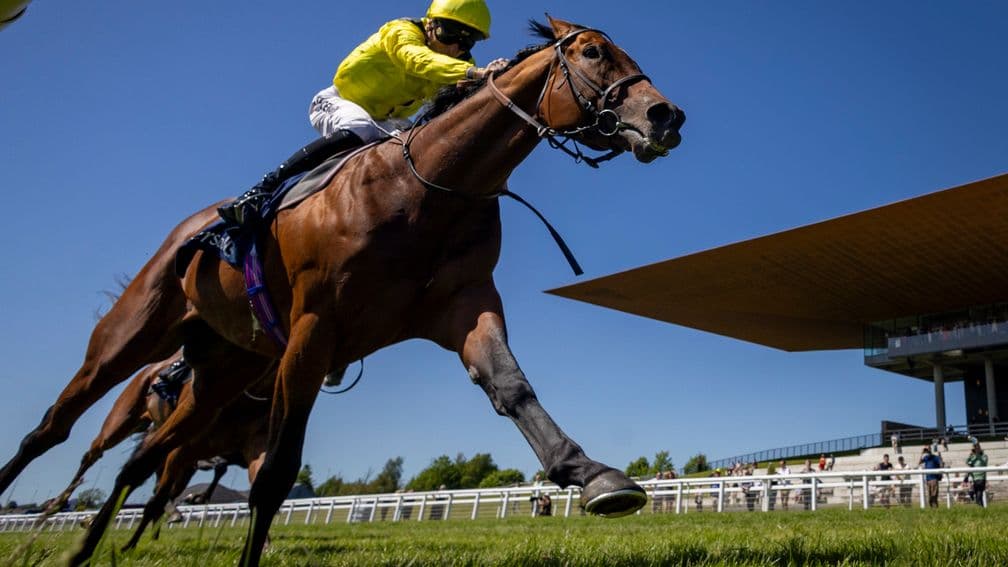
Almaqam did more than win the Tattersalls Gold Cup at the Curragh. He snapped up a €294,500 first prize, beat Bay City Roller by two lengths, and announced himself as a genuine new force in Europe’s middle-distance division. For Ed Walker and Kieran Shoemark, the Group 1 breakthrough was a landmark moment, and for the summer campaign it was a reset button.
The race was run over 1m2½f on 24 May 2026 at the Curragh in County Kildare, in a seven-runner field that never quite looked straightforward on paper and became even more compressed once Royal Rhyme was declared a non-runner because the ground was unsuitable. Almaqam went off at 13/2, Bay City Roller at 15/2, Saddadd at 18/5 and Minnie Hauk at 4/6 favourite, yet the market favourite finished only fifth. That contrast between expectation and execution is what made the result feel so meaningful: this was not a soft Group 1, it was a proper pecking-order race, and Almaqam came out on top.
For Walker, the win carried extra weight because it was his first in Ireland. He said the horse had been handled patiently and that connections would be bolder this year, with the Prince of Wales’s Stakes at Royal Ascot now a possible next target. That is the kind of shift that matters in a season like this: a horse that was being nursed into top-company relevance is suddenly being talked about as a Royal Ascot player in a division already stacked with established names.
The bloodline story got louder for Lope De Vega
The breeding angle is as important as the sporting one here. Racing Post Bloodstock noted that Almaqam’s victory was the 27th individual Group or Grade 1 winner for Lope De Vega, and that changes how the stallion’s momentum looks going into the rest of the year. When a son of a proven sire lands a race of this scale, it is never just one result; it becomes part of a sales-ring argument, a covering-season argument, and a wider narrative about which lines are still producing elite depth.
That is why this Gold Cup felt like a stock-market day for bloodlines. Almaqam did not simply join the list of Group 1 winners, he strengthened the profile of a sire already trusted for class and versatility. In practical terms, the win tells breeders and buyers that the Lope De Vega line remains live in a division where quality over 10 furlongs can turn into commercial value very quickly.
It also underlined the Curragh’s place in the calendar. The race was framed by The Curragh as one of the premier middle-distance contests in the world, and the Irish Guineas weekend gave that claim real weight. Tattersalls’ sponsored-races schedule placed the Gold Cup alongside the Tattersalls Irish 1,000 Guineas on the same 24 May weekend, which is exactly why a result like Almaqam’s reverberates beyond the track: this is a stage built for reputation-making performances.
Minnie Hauk’s defeat does not rewrite her season
If Almaqam was the new stock rising fastest, Minnie Hauk was the marquee mare whose defeat came with an important asterisk. She finished fifth, but Aidan O’Brien’s post-race reaction made clear that the performance should not be overread. He told punters to “put a line through” the run and argued that the way the race unfolded did last year’s Prix de l’Arc de Triomphe runner-up no favours.
That matters because in a race like this, the shape of the contest can distort the formbook. Minnie Hauk was the 4/6 favourite, so the eye is naturally drawn to the fifth-place finish, but O’Brien’s view was that the pace and tactical setup compromised her chance to show her true level. In pecking-order terms, the result slows the hype but does not dent the broader profile: she remains a high-end mare with major targets ahead, and this was treated as a runnable excuse rather than a warning light.
For the breeding narrative, that distinction is crucial. Top-level mares can absorb one off day if the excuses are credible and the long-term class remains obvious. Minnie Hauk’s reputation is not built on a single Gold Cup run, and the reaction from Ballydoyle suggested that her value lies in the bigger campaign still to come. In a weekend built around elite bloodstock, her defeat was more about context than collapse.
The finish tells us where the division stands
Bay City Roller’s second and Saddadd’s third added useful shape to the result. Neither horse was flattered by the finish, because Almaqam won decisively enough to make the margin feel authoritative, but both runners also confirmed that this was a serious Group 1 middle-distance test rather than a race that fell apart around the winner.
That is what changes the pecking order for the summer. Bay City Roller’s 15/2 chance and Saddadd’s 18/5 profile suggested a competitive, open race behind the favourite, and the final placings now give the division a clearer hierarchy: Almaqam has moved into the conversation as a disruptive force, Minnie Hauk keeps her top-level standing despite defeat, and the chasing pair have every reason to remain in the mix without claiming first call on the division.
The bigger picture is simple. The Curragh billed the weekend as a showcase for some of Europe’s most coveted races, and the Tattersalls Gold Cup lived up to that billing by producing form with consequences. Walker has his Irish breakthrough, Shoemark has a Group 1 headline ride on his card, Lope De Vega has another elite runner on his record, and the summer middle-distance map just got a lot more interesting.
This article was produced by Prism’s automated news system from verified source data, official records, and press releases, then run through automated quality and moderation checks before publishing. The system is built and supervised by the people who set the standards it runs under. Read our full AI policy.
Did this article answer your question?