Mohammad Alkhairat builds horse racing’s future through mentorship
Mohammad Alkhairat’s rise shows how racing can still renew itself: a 20-year-old bloodstock worker, a mentor in Ben Henley, and three horses headed to Robbie Medina.
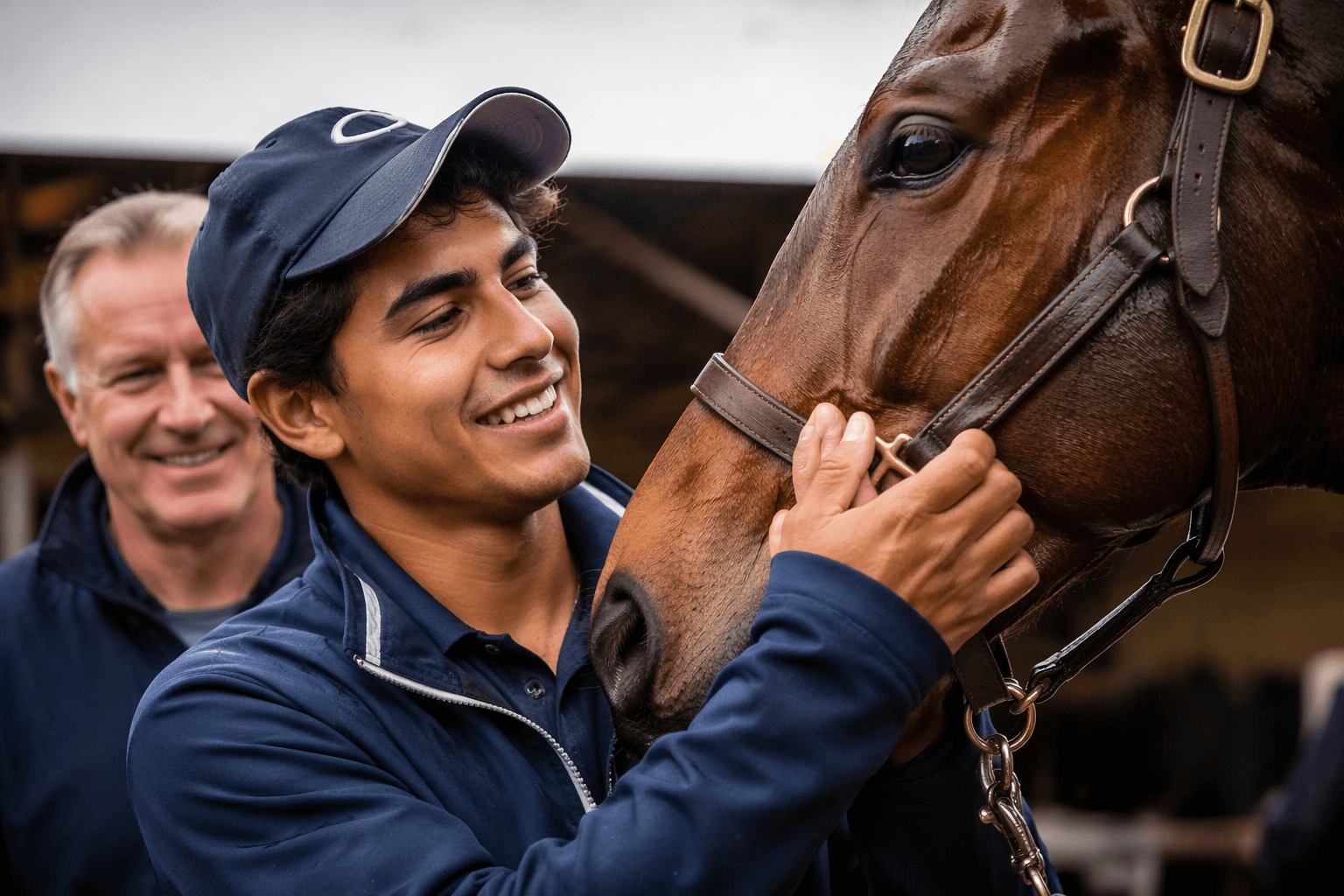
Mohammad Alkhairat is helping prove that horse racing does not have to rely on family ties to replenish its backstretch. At 20, he is already working with Diriyah Bloodstock, and the path that brought him there runs through mentorship, sales-ring relationships, and a willingness to start at the bottom and keep moving.
A young entrant with a real foothold
Alkhairat’s story matters because it is not a story about one big race day or one lucky break. It is about how a newcomer gets inside the industry and stays there long enough to become useful. He got his start through Amplify Horse Racing, a program designed to connect young people with Thoroughbred professionals for career exploration and guidance, and he has turned that introduction into a working role with Diriyah Bloodstock.
That progression is the kind racing needs more often. The sport talks constantly about the shortage of new owners, grooms, agents, analysts, and bloodstock staff, but those pipelines only matter if they produce people who can actually move horses, build trust, and learn the business from the inside. Alkhairat is already there, not as a name on a guest list but as someone helping shape where horses go next.
Mentorship is the real engine
The most revealing part of Alkhairat’s path is how personal it is. He says Ben Henley mentored him, and he still visits Henley at the Airdrie Stud consignment at sales. That matters because the Thoroughbred business is still built on repeated contact, shared time, and the kind of guidance that cannot be automated or rushed.
Amplify Horse Racing formalized that kind of access when its mentorship program launched in 2021. The program pairs youth and young adults ages 15 to 25 with experienced Thoroughbred-industry professionals in three-month spring or fall sessions. In other words, it gives aspiring horsemen and horsewomen a structured entry point into a sport that too often assumes people will find their own way in.
For racing, that structure is not a feel-good extra. It is an answer to a business problem. The sport needs more people who understand the rhythm of sales, the pressure of placements, and the value of strong introductions. Alkhairat’s journey shows what happens when that support is real: a young person gets taught, stays engaged, and starts becoming part of the network himself.
From being helped to helping move horses
Alkhairat’s place in the sport is not symbolic. According to the reporting, he has had a hand in sending three horses to trainer Robbie Medina, who was his first boss in horse racing. That detail is the heart of the story because it shows a quick transition from beneficiary to connector.
In Thoroughbred racing, those connections are the business. Horses do not just appear in barns and stakes races. They pass through sales, consignments, bloodstock offices, trainers’ benches, and trusted relationships that determine whether a horse gets seen, placed, and developed. A 20-year-old helping route three horses to a trainer is not a footnote. It is evidence that the next generation can contribute far earlier than many assume, if it is given a doorway and a little trust.
That is why Alkhairat’s comments about wanting to give back carry weight. He is speaking from the position of someone who knows what it means to be turned away, then welcomed in. Racing’s talent pipeline depends on that shift, because the industry cannot only celebrate established names and expect continuity to take care of itself.
Why the backstretch should care about the pipeline
Owners care because better mentorship creates a deeper bench of people who can identify opportunities, spot horseflesh, and help place runners where they can succeed. Trainers care because every good barn depends on people who understand the work, the sales cycle, and the value of relationships built before the horse ever walks onto a racetrack. Fans should care because the long-term health of the sport depends on whether there are enough capable horsemen coming behind the familiar names.
That is the larger message inside Alkhairat’s story. Horse racing talks a lot about purses, fields, and headline horses, but its future also depends on whether a 20-year-old can find a mentor, learn the business, and become part of the chain that keeps horses moving. Alkhairat is already doing that work through Diriyah Bloodstock, and the sport should take note whenever a young worker moves from being introduced to being indispensable.
A name that is already circulating
The Diriyah name also has a footprint on the racetrack itself. BloodHorse lists a 2022 Kentucky-bred filly named Diriyah who won a maiden special weight race at Indiana on November 6, 2024, and later ran in graded stakes, including the 2025 Gazelle Stakes (G3). The profile includes trainer Richard E. Dutrow, Jr., jockey Jose Lezcano, and owner FMQ Stables.
That kind of overlap between bloodstock, sales, and active racing is another reminder of how interconnected the sport is. The people building the future are often working around horses that are already in motion, already winning, already moving through the same network they hope to strengthen.
What comes next for racing’s next generation
Alkhairat’s path does not end with entry. It points to what he still needs: more reps, more mentors, more exposure to how horses travel from sales barn to training barn to race day. He has already shown that a young worker can become a real part of the process, but the industry’s challenge is to make sure that kind of opportunity is not rare.
That is the future of the backstretch in one case study. When mentorship is organized, when sales barns stay open to young eyes, and when a first boss like Robbie Medina becomes part of a longer professional chain, racing gains more than one promising 20-year-old. It gains continuity, and continuity is what keeps the whole business from thinning out.
This article was produced by Prism’s automated news system from verified source data, official records, and press releases, then run through automated quality and moderation checks before publishing. The system is built and supervised by the people who set the standards it runs under. Read our full AI policy.
Did this article answer your question?