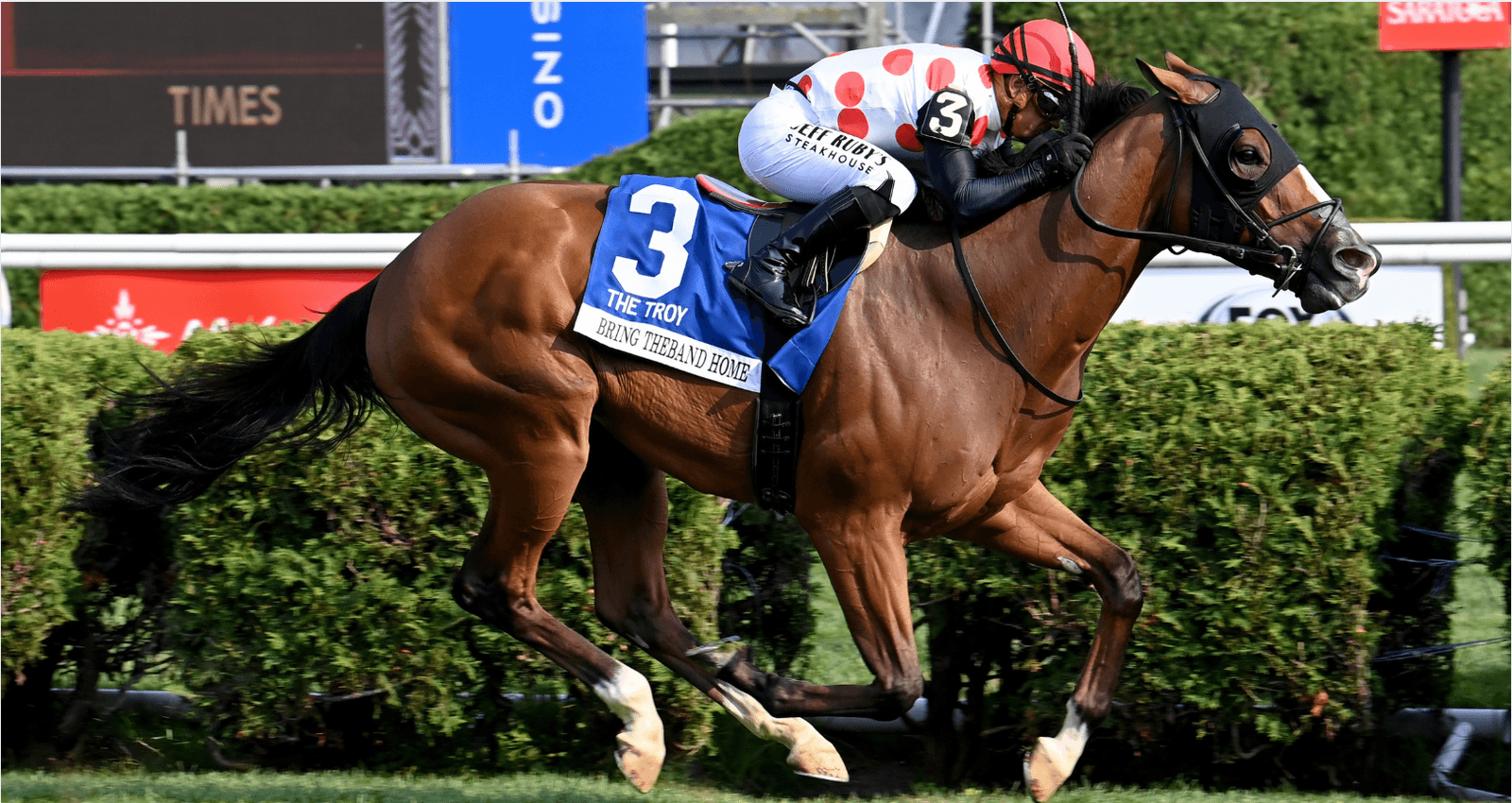
Renegade’s Belmont case grows as trip troubles cloud Derby loss
Renegade's Derby loss looks more like traffic damage than weakness, and Saratoga's Belmont trip could turn that into a betting edge.

Why the Derby finish may be the wrong headline
Renegade’s Belmont case starts with a simple correction: the Kentucky Derby result does not tell the whole story. The colt drew the rail, got bumped after the break and again late, and was forced into a race shape that left him buried near 16th and almost 10 lengths back before he launched his run. Even with all of that, he finished with enough authority that, in many runnings, that kind of late kick would have been good enough to win the Triple Crown opener.
That matters because the obvious form line, Derby runner-up, can hide the more useful handicap. A horse who was compromised early, asked to recover through traffic, and still finished hard is often more dangerous next time than a cleaner loser who simply lacked punch. Renegade’s appeal is not that he was unlucky in a vague, feel-good sense. It is that his Derby trip created a result that may underestimate what he can do when the path is cleaner and the race unfolds in a more manageable rhythm.
Why Saratoga changes the equation
The 2026 Belmont Stakes is the 158th running and is scheduled for Saturday, June 6, 2026, with official post time listed at 7:04 p.m. ET. The Belmont Stakes Racing Festival at Saratoga Race Course in Saratoga Springs, New York, stretches across five days and includes 25 stakes races, so the Belmont is part of a much larger card with plenty of betting pressure and attention built around it.
The race itself will be run at 1 1/4 miles because of Saratoga’s main-track configuration, which is a different test than Belmont Park normally provides. That difference matters for a horse like Renegade because the race is not just about raw talent, it is about spacing, positioning, and whether a colt gets a clear lane when the field starts to sort itself out. NYRA and Gov. Kathy Hochul have also made clear that 2026 is the third and final Belmont Stakes at Saratoga before the race returns to Belmont Park in 2027, once reconstruction there is complete. That gives this year’s edition a temporary feel, but it also raises the stakes for how the race is shaped and how bettors read it.
The workout pattern says he came out of the Derby ready
Todd Pletcher has helped keep the Renegade story alive by confirming that the colt bounced out of the Derby with good energy and remained on target for Belmont. NYRA’s May 21 workout note said Renegade and stablemate Powershift worked in company over the Oklahoma dirt training track, covering a half-mile in 49 and 4/5 seconds. Then, after a half-mile breeze in :49.80 at Saratoga on May 23, Pletcher said the work was “very good,” said Renegade recovered quickly, and stressed that the colt did not seem fatigued.
That sequence is important because it tells you this is not a horse trying to survive a hard Derby and limp into the next start. It is a horse whose trainer believes the race left him with enough left in the tank to keep moving forward. Around the same time, other top sophomores such as Golden Tempo, Commandment, Emerging Market and Chief Wallabee were also working, which points to a Belmont field that could be deep and potentially chaotic.
Pletcher’s broader point also fits the current game. Lightly raced horses have increasingly become the kind of runners that can take over marquee races, and that trend helps explain why Renegade can attract significant betting support even after a Derby loss. Some recent Belmont preview coverage has already had him around 2-1, which tells you the market is treating him as more than a rebound story.

Recent Belmont history gives the argument real teeth
This is where the trip case becomes more than a theory. Recent Belmonts at Saratoga have already shown that the race can reward the exact type of profile Renegade brings. Mo Donegal won the 2022 Belmont after skipping the Preakness. Arcangelo followed in 2023 after also bypassing the Preakness. Dornoch won the 2024 Belmont at Saratoga after a troubled Kentucky Derby trip and without a Preakness start.
That pattern does not guarantee anything in 2026, but it does mean the comparison is grounded in recent precedent rather than old handicapping folklore. The market has seen this kind of setup work before: a Derby horse with a compromised run, enough freshness, and a route to a cleaner trip in the Belmont. Renegade fits that mold closely enough that the public is likely to overvalue the raw finish position if it ignores how much was lost to circumstance.
The rail angle adds another layer. Historical Derby-post coverage still treats post 1 as a major disadvantage, and Ferdinand remains the last horse to win the Kentucky Derby from the rail, in 1986. That number has staying power because it reminds bettors how rarely the inside draw turns into an easy trip in Louisville. When a horse draws that post, takes bumps, and still finishes strongly, the form may actually point upward rather than flat.
What the pace and spacing picture could decide
The real Belmont question is not whether Renegade belongs. It is whether the race will give him the kind of trip that lets his Derby effort translate. If the Belmont develops into a compact, high-quality test with enough pace to keep the field honest and enough spacing for a late runner to launch, Renegade’s profile becomes even stronger. He already showed he can finish through adversity, so the ideal setup is one where the race opens up late and he is not forced to restart his run after every minor collision.
If the pace is muddled and the field strings out in a way that rewards perfect midrace position, the value case gets thinner. That is why his Belmont appeal is more sophisticated than simple horse-for-course logic. The argument is that the Derby trip was bad enough to hide his best run, and Saratoga’s Belmont configuration, combined with a likely deep field, may finally give him the smooth passage that Louisville denied.
For bettors, that is the difference between a horse who merely ran well last time and a horse whose better trip could turn a near-miss into a win. For Pletcher, it is a chance to prove that Renegade’s Derby loss was a distorted result, not a ceiling. If the Belmont unfolds the way his profile suggests, the obvious form may be the least useful thing on the page.
This article was produced by Prism’s automated news system from verified source data, official records, and press releases, then run through automated quality and moderation checks before publishing. The system is built and supervised by the people who set the standards it runs under. Read our full AI policy.
Did this article answer your question?