How parkour judging works: speed, freestyle and FIG scoring rules
Parkour judging is a points race, not a vibe check: FIG uses formal speed and freestyle rules, with eight-judge panels and deductions for slips, stalls and bad landings.
Parkour judging turns a run into a measurable decision. Under FIG’s system, a fast-looking line can lose to a cleaner one, and a huge freestyle hit can fall behind a less dramatic run if the landing breaks down. That is why the Code of Points matters so much: it tells athletes exactly what earns reward, what costs control, and how a panel of trained judges turns movement into a score.
Speed and freestyle reward different kinds of risk
The sport’s two headline formats ask for different things. Speed is simple to read at first glance: get from start to finish as quickly as possible while staying within the course rules. Freestyle is more interpretive, built around line selection, creativity, difficulty, and control, so the athlete has to think about composition as much as raw athleticism.
That difference creates the sport’s central tension. In speed, a technically difficult route can backfire if it slows momentum or forces a hesitation. In freestyle, a daring sequence may look unforgettable, but if execution breaks down, the score drops anyway. The cleanest path is not always the flashiest, and FIG’s rules make that trade-off part of the competition rather than an afterthought.
Why a spectacular run can still lose
A useful way to watch a freestyle round is to imagine two athletes. One throws a difficult sequence with a big wall element and a precise transfer, but lands with visible imbalance and a small stumble. Another takes a slightly less ambitious line, stays smooth, and finishes with control. Under FIG’s scoring priorities, the second run can win because the panel is measuring both difficulty and the quality of the execution.
The 2024 freestyle reference table makes that logic concrete by listing deductions for minor slips or stumbles, bigger slips, visible imbalance, partial loss of control, and landing problems. It also gives examples such as a fall after landing on the feet, hitting the wall after a trick, or landing flat on the stomach. Those are not abstract style points, they are score-changing errors that can erase the value of a risky choice.
The Code of Points is the rulebook that decides the outcome
FIG’s parkour system is not improvised from event to event. The 2022-2024 Parkour Code of Points was approved by the FIG Executive Committee in May 2023 and entered into force on 1 January 2024, while the 2025-2028 Parkour Code of Points was approved in February 2024 and published on 22 April 2024. The 2024-2025 FIG Parkour World Cup rules document also spans both the 2021-2024 and 2025-2028 cycles, showing that parkour is governed through recurring rule revisions rather than one-off fixes.
That matters because FIG treats parkour as part of its gymnastics disciplines, with dedicated parkour technical and judges’ materials. The FIG Technical Regulations even include a dedicated Section 7 for Parkour. For fans, that means competition parkour is now organized like the rest of FIG’s system: structured, codified, and judged against published standards instead of a loose event-by-event impression.
What the freestyle score sheet is actually looking at
The freestyle reference tables are where the judging system gets especially practical. The 2024 table lays out E-score and D-score criteria for safety, landing quality, and deductions, and the 2025 reference list goes further by assigning safety values of 9 points and 6 points, plus landing quality worth 3 points. That makes the score feel less mysterious: judges are not just admiring a run, they are separating controlled execution from avoidable error.
The 2024 table’s deduction list is the part athletes feel most directly. Minor slips or stumbles cost points, bigger slips cost more, visible imbalance suggests the movement was not fully controlled, and partial loss of control is a clear warning sign that the run drifted away from the intended line. The landing is decisive too, because a big aerial moment only pays off if the athlete absorbs it cleanly and keeps the run alive.
The panel is formal, not improvised
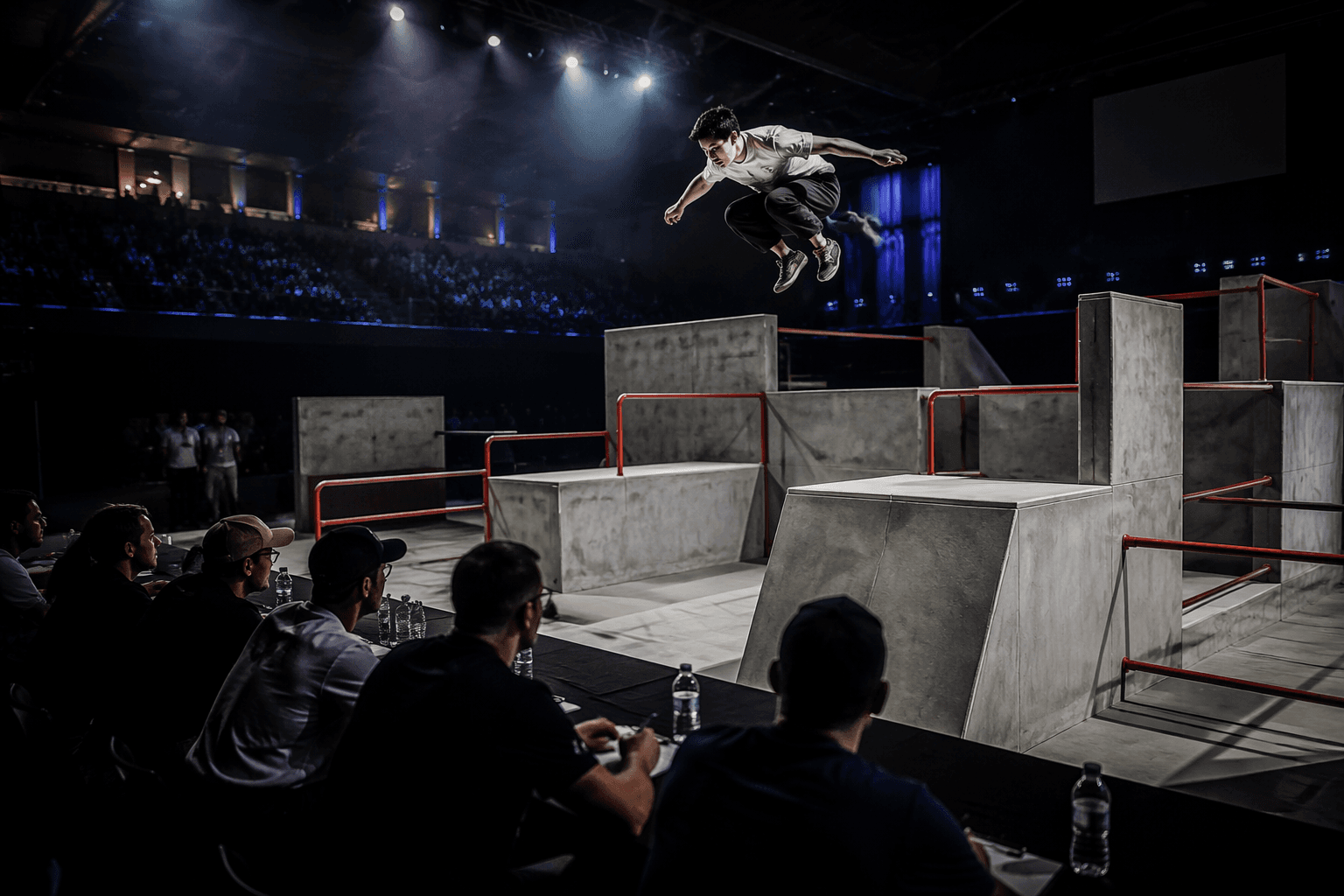
One of the biggest misconceptions about parkour judging is that it comes down to taste. FIG’s competition materials show the opposite: the judging panel is formally structured. A parkour World Cup Montpellier work plan states that freestyle uses a minimum of eight judges, including one acting as CJP, and depending on the competition level the panel includes three E judges and three D judges.
That setup matters because it spreads the responsibility across trained officials instead of asking one person to freestyle the decision. It also gives the sport consistency from one event to the next, which is essential when an athlete’s score may depend on tenths and deductions. The more formal the panel, the less room there is for a routine to be rescued by reputation or by the illusion created on a social media clip.
How judges are trained to apply the rules
FIG’s specific judges’ rules make clear that parkour judging depends on education and testing. The 2022-2024 judges’ rules include online testing for judges who meet FIG criteria, and regional judges’ courses were to be organized by national gymnastics federations upon request and FIG approval in 2023. The 2025-2028 judges’ rules add another layer of structure: intercontinental and international courses last one day of course work and one day of examination, with the course ending in a practical video exam.
That training pathway is a big reason the system can function at all. Parkour runs move fast, athletes stack complex decisions in seconds, and judges have to separate controlled difficulty from a near-miss in real time. FIG’s education model is built to make those calls repeatable, which is exactly what a credible judging system needs.
What this means when you watch a World Cup run
Once you know the rulebook, the sport becomes easier to read in real time. A speed run is not just about looking efficient, it is about protecting momentum while staying inside the course. A freestyle run is not just about pulling a difficult move, it is about chaining difficulty to landing quality, with the E-score and D-score framework deciding whether the risk was worth it.
That is why parkour judging shapes the sport’s progression. The Code of Points pushes athletes to choose lines with intent, not just spectacle, and it gives coaches a target for training instead of a vague demand to “be better.” In FIG parkour, the score does not merely record what happened. It determines which runs survive, which runs stand out, and which athletes move the sport forward.
This article was produced by Prism’s automated news system from verified source data, official records, and press releases, then run through automated quality and moderation checks before publishing. The system is built and supervised by the people who set the standards it runs under. Read our full AI policy.
Did this article answer your question?