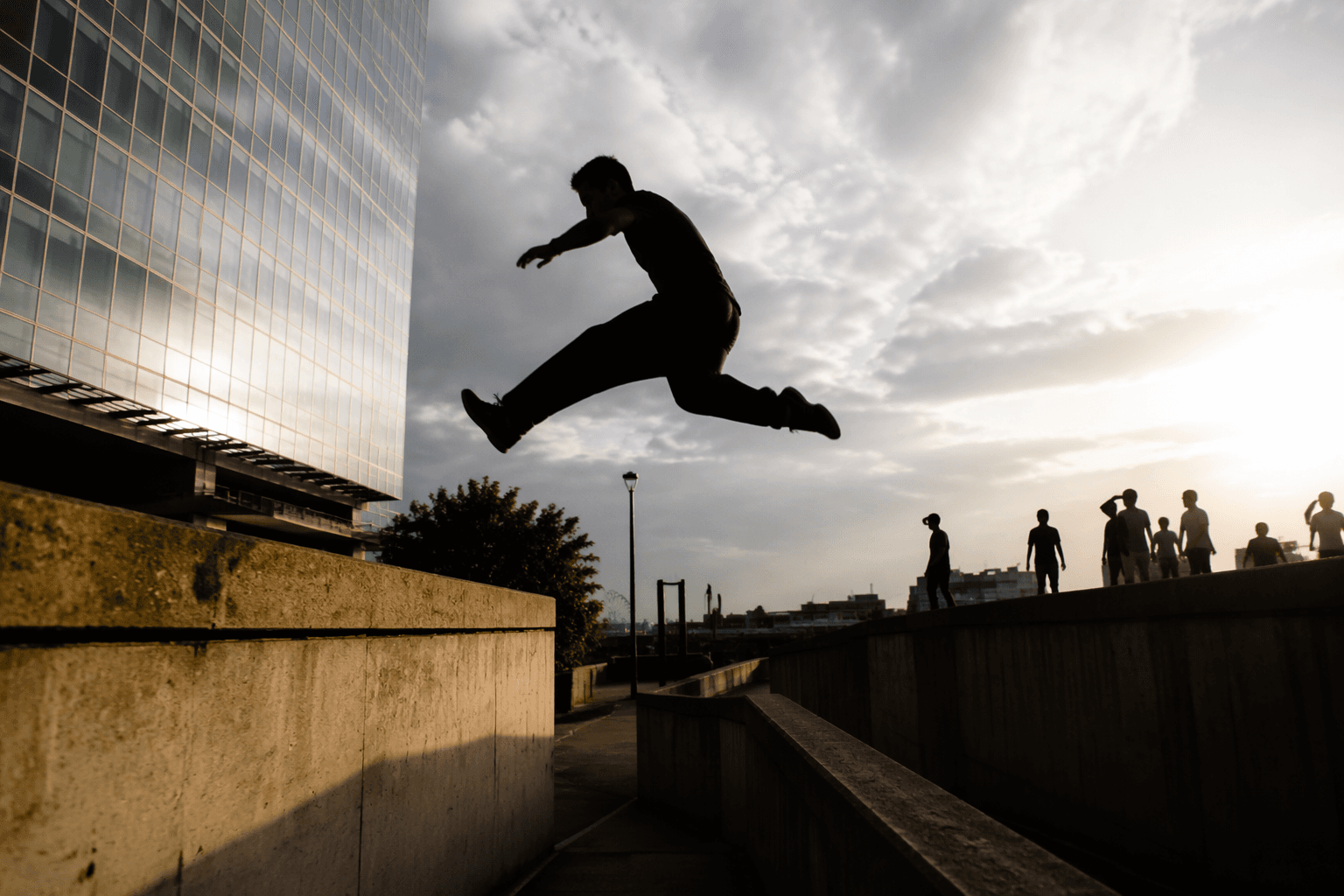
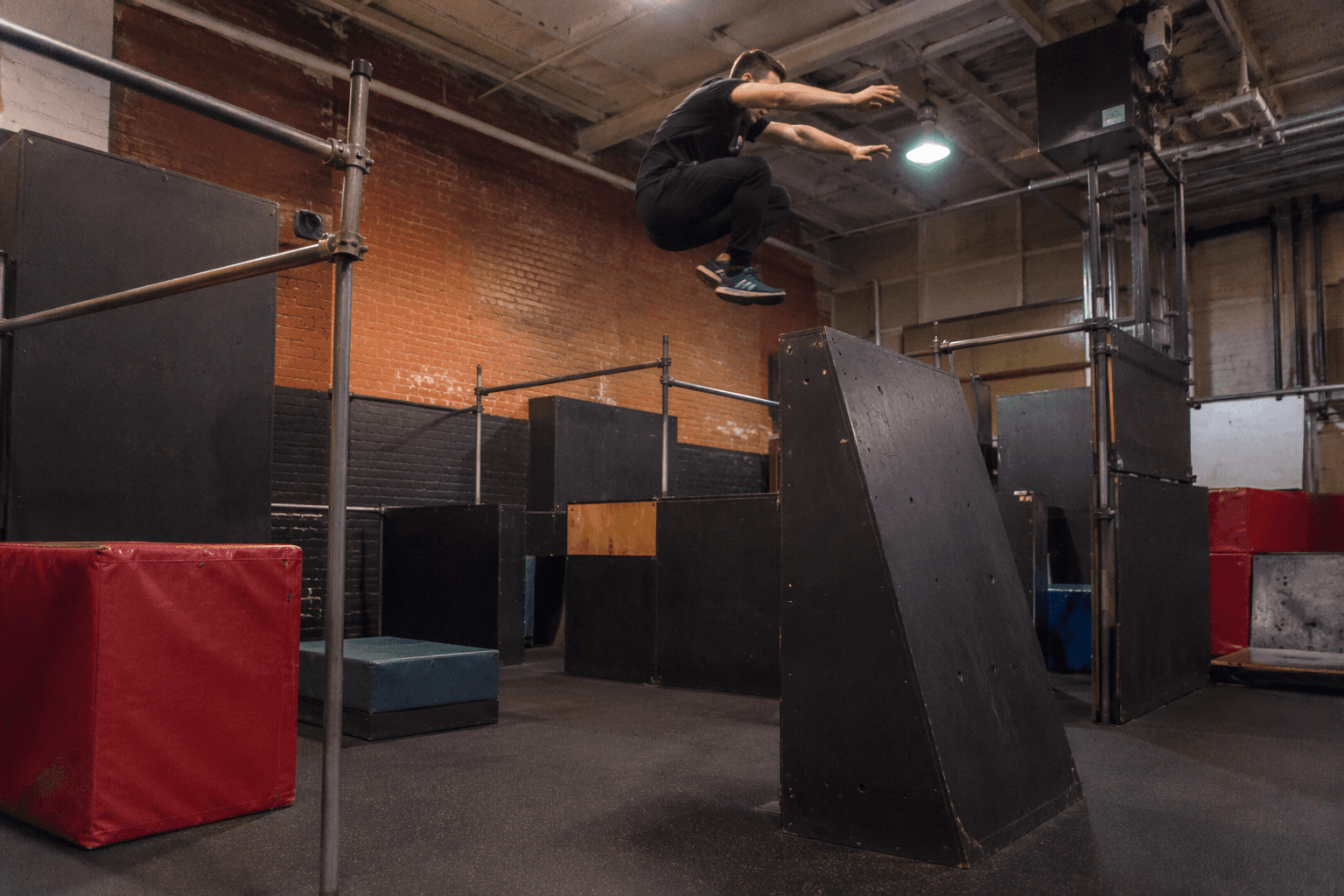
How parkour landing mechanics turn impact into control
The real parkour skill starts at contact: landing mechanics decide how much force the body absorbs, when to roll, and how to keep moving.
A traceur drops to the ground, the feet meet first, and the run is not over yet. In parkour, that instant is the sport’s hardest test: not the leap, but the landing that follows. The body has to absorb force, keep balance, and decide whether the next move is a step, a precision, or a roll.
What the ground is asking the body to do
Parkour landings are about managing force, not just surviving it. When the athlete meets the ground, the ankles, knees, hips, and trunk work together to slow the body and keep the center of mass under control. A stiff, upright landing sends more stress into the lower limbs and leaves less room to recover, while a well-timed landing gives the athlete a way to stay composed and continue the line.
Every jump, drop, precision step, and cat leap ends with the same problem: how to convert impact into control. The sport’s technical side is easiest to see at ground contact, where the difference between a clean exit and a crash is measured in posture, timing, and load.
What the biomechanics studies actually measure
Massey University published “The mechanics of a parkour landing” on Monday 26 March 2018. Parkour biomechanics work has focused on ground reaction forces, loading rates, muscle activity, and landing strategy instead of spectacle alone. A separate parkour biomechanics study in the Massey University Research Repository examined ground reaction forces and electromyography in a parkour obstacle course, looking at both the force going through the body and the muscles firing to control it.
One 2020 study, “Kinematic Analyses of Parkour Landings From as High as 2.7 Meters,” examined drops of 2.7 meters. At that height, the athlete is dealing with a meaningful vertical load, and the way the body organizes the landing becomes the difference between control and a harsh impact.
Another line of research, “Ground Reaction Forces and Loading Rates Associated with Parkour and Traditional Drop Landing Techniques,” compared parkour landings with traditional drop landings. The key issue is not only how much force reaches the body, but how quickly it arrives. A faster loading rate is harder to manage, which is why parkour technique is built around spreading the work across joints and, when needed, across a roll.
Why soft landings are a skill, not a style choice
Soft landings in parkour are not about looking gentle. They are about controlling the rate of deceleration so the athlete can stay balanced and make the next decision. A precision landing is one of the clearest examples: it is useful because it lets a traceur arrive on a small target with stability, even after a gap that looked far bigger in the air.
A paper on strategies for executing soft landings put special focus on the precision landing technique as fundamental to most parkour motions. Precision landings are the quiet, exacting side of parkour, where the goal is not to sink into the ground but to stop with enough control to move again immediately.
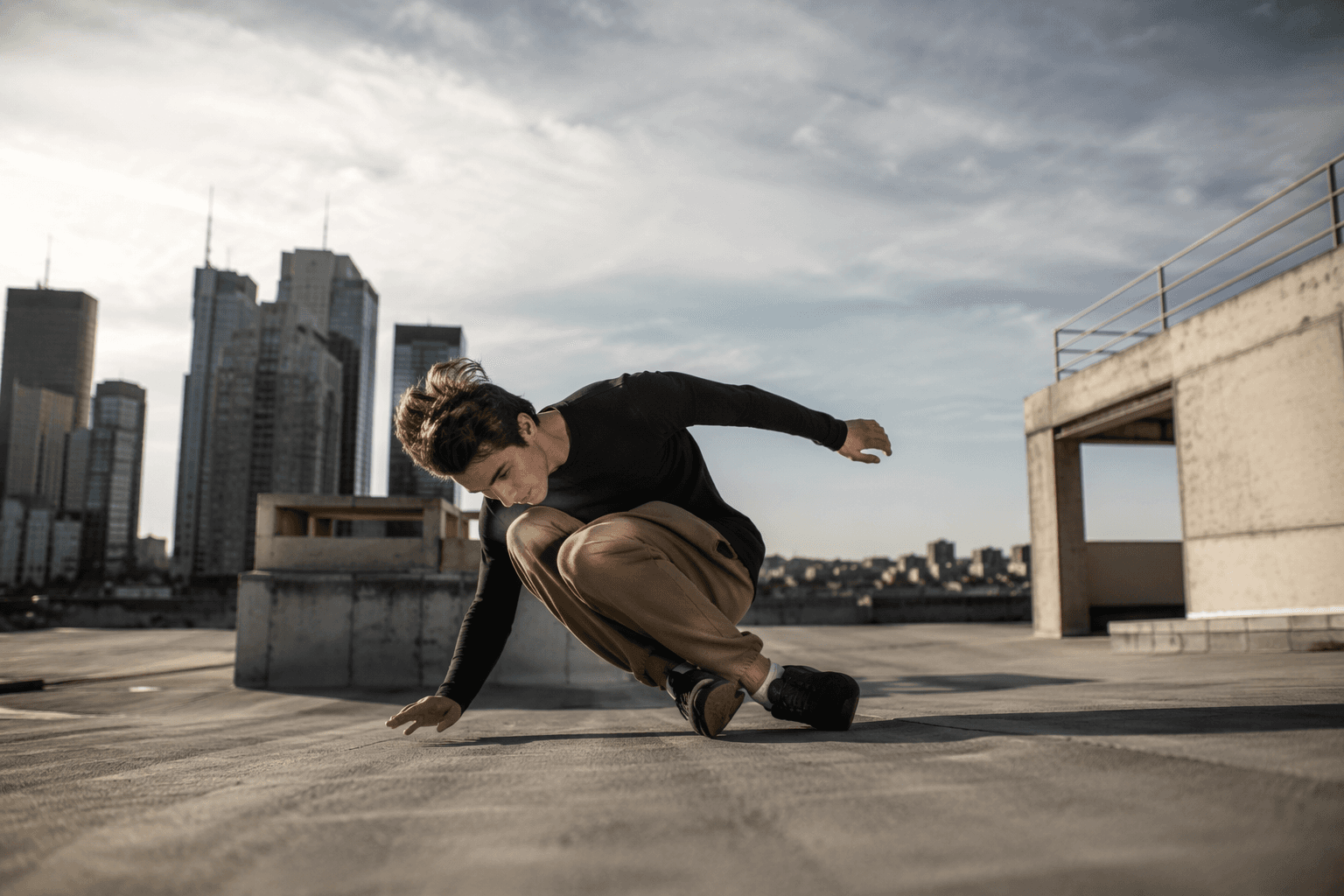
When the landing has more speed or height behind it, the roll is a deliberate way to distribute energy over a longer sequence, reducing peak stress on the legs and helping preserve momentum after impact.
- A precision landing is for small targets and clean continuation.
- A roll is for higher drops or moments when momentum needs to be redirected.
- A stiff landing limits recovery and increases stress on the lower limbs.
- The best landing is the one that leaves the athlete ready for the next move.
How height and intent change the landing
The landing strategy changes with the drop height, the direction of travel, and what comes next. A controlled descent onto a ledge asks for a different solution than a drop into flat ground, and a landing that must flow into another vault or sprint needs a different body position than one that ends the sequence. That is why parkour practitioners do not land like untrained participants, and why researchers have compared precision landings by practitioners with more natural-style landings by untrained people.
The 2.7-meter kinematic study shows how much more demanding landings become as height rises. At lower heights, the body may manage with a compact, joint-driven absorption pattern. At higher ones, trunk control and momentum management matter more, and the athlete has to think about the next action even as impact arrives.
Landing in parkour is inseparable from route planning. The jump is only one part of the problem. The athlete has to know whether the next contact will be a precise stop, a running continuation, or a roll that redirects force forward.
Why the safety conversation starts with the landing
A U.S. emergency-department study examined parkour injuries presenting between 2009 and 2015. Each landing puts real loads through the body, and technique changes how those loads are handled.
The discipline is traced to France in the late 1980s and is closely associated with David Belle and Sébastien Foucan. Its history also connects to Georges Hébert’s méthode naturelle, a system built around practical, adaptable movement.
This article was produced by Prism’s automated news system from verified source data, official records, and press releases, then run through automated quality and moderation checks before publishing. The system is built and supervised by the people who set the standards it runs under. Read our full AI policy.
Did this article answer your question?