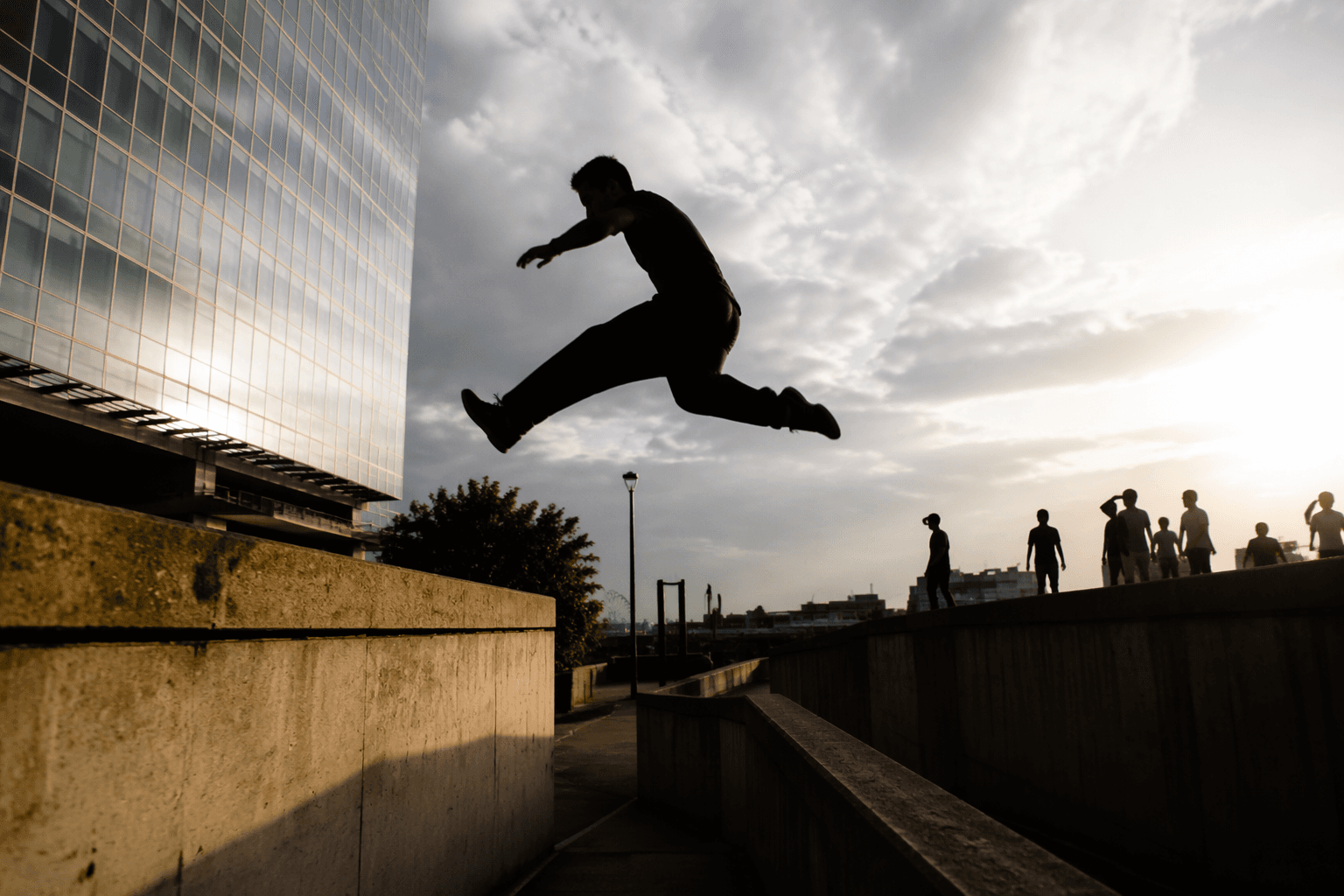
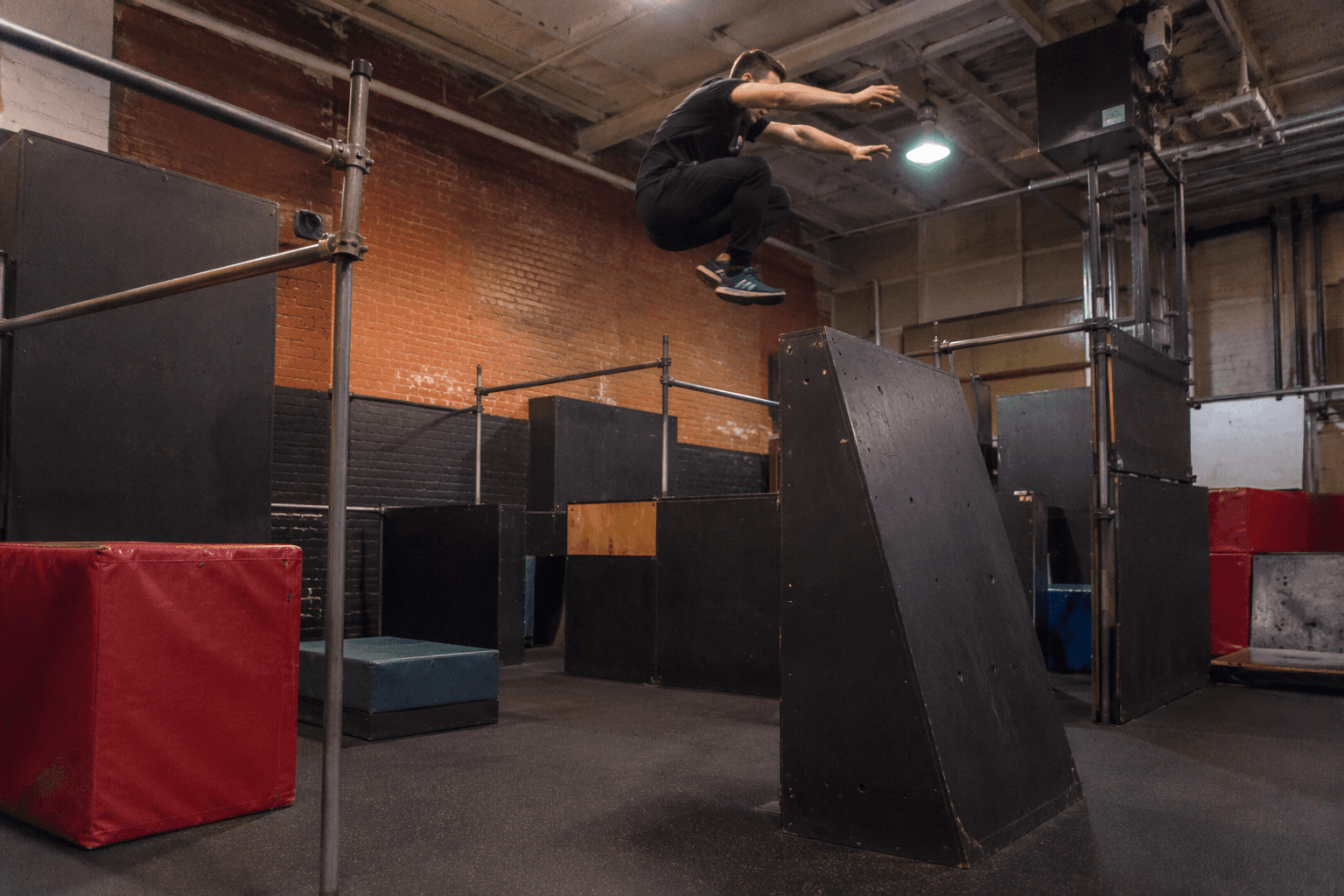
How parkour looks on screen differs from real practice
Parkour clips can turn a controlled line into pure spectacle. The camera's cuts, angles, and slow motion often hide the training and risk that make the move possible.
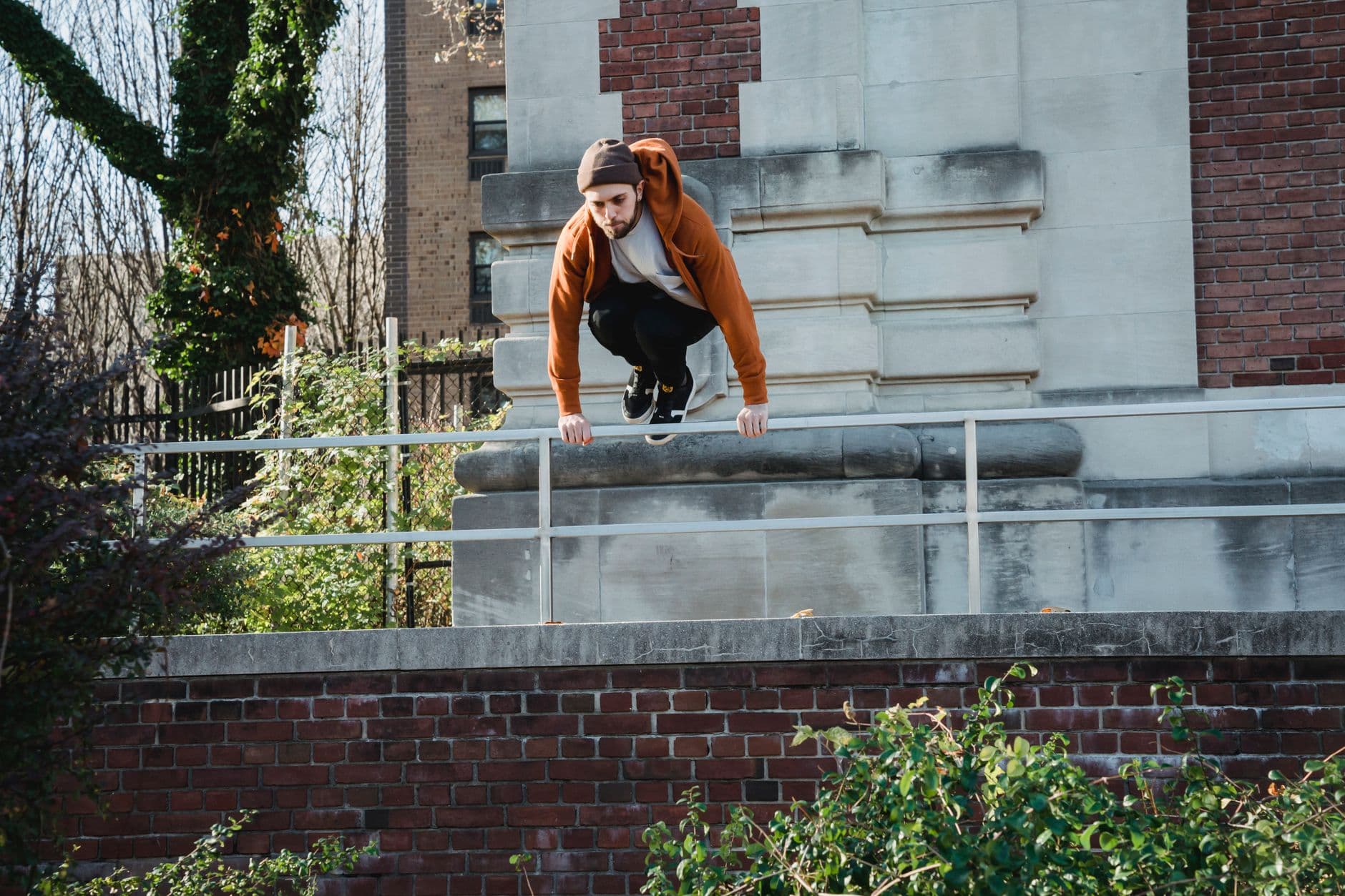
Roof gaps, flips, dramatic descents, and chase scenes are the version of parkour that travels fastest. On screen, a rooftop gap can look reckless; in real life, measured. The camera chooses the most dramatic moment, then edits, angles, and slow motion do the rest.
What the camera emphasizes
The version of parkour that travels fastest usually compresses the line into a few high-impact seconds, while the actual practice is usually slower, more technical, and more repetitive than the edit suggests. What looks effortless in a finished video often depends on distance judgment, momentum control, body position, landing mechanics, and constant risk calculation.
Lens choice changes that story before the first move begins. A tight focal length can flatten a gap and make a route look shorter than it is, while a wide angle can stretch space and make a jump feel even bigger. Slow motion can turn one clean takeoff into a moment of apparent suspension, and a hard cut can hide the footwork, the reset, or the failed attempts that came before it.
The discipline behind the highlight reel
Liminalities: A Journal of Performance Studies places parkour in a complex yet co-constituting media environment. Parkour is performed in cities, and it is also shaped by how it is filmed, edited, circulated, and consumed. Media representations fascinate outsiders, but they can also leave practitioners uneasy when the spectacle overwhelms the technique.
The contrast is clearest when a clip lingers on the biggest move and skips the setup. Real training sessions spend far more time on precision, efficiency, and repeated problem-solving than on the kind of one-off stunt that makes a viral edit. The athlete is reading the surface, the spacing, and the landing zone in real time, while the finished video often turns all of that into a single dramatic line.
A Brunel University Research Archive entry for Ciné Parkour calls it a cinematic and theoretical contribution to understanding parkour. Its ethnographic approach uses participant observation and documentary filmmaking, showing how closely the discipline and its media representation have been intertwined from the start. Another line of academic work argues that parkour vision remaps urban landscapes, which helps explain why the same stair set or wall can seem ordinary on the street and cinematic on a feed.
Parkour starts long before the clip
Parkour is traversing obstacles in man-made or natural environments through running, vaulting, jumping, climbing, rolling, and other movements. Efficiency and passage sit at the center of the discipline, not pure danger. Britannica ties parkour to French origins and to David Belle, with an image of an athlete bounding over an obstacle in Vienna showing how far the practice has traveled from those beginnings.
The story traces to France in the late 1980s and 1990s, with the Yamakasi group part of the early history. Early practitioners did not always train together constantly, and they did not necessarily agree on what the discipline was supposed to become.
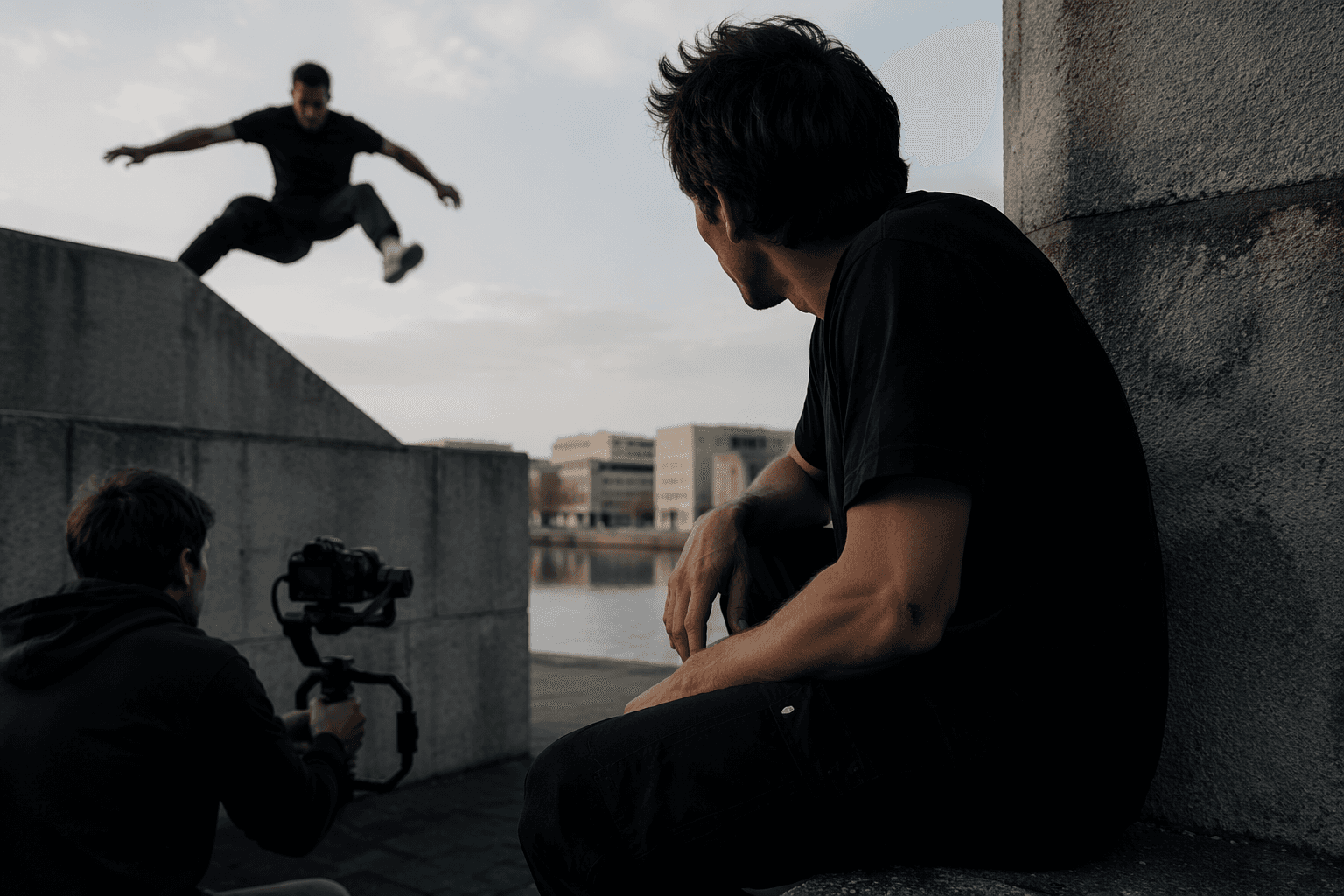
History pages from Parkour Generations and the World Freerunning Parkour Federation trace that development and the language around it. Those references sit alongside the broader record of film and television coverage that has shaped the sport's mainstream image for years.
Why the city looks different through a camera
Parkour's stage is not a conventional arena. It is stairs, walls, rails, ledges, and public architecture that the practitioner temporarily reinterprets as a movement route. That means filming does more than document a run; it changes the meaning of the space itself, turning the same block into a playground, a challenge, a route, or a cinematic backdrop depending on where the camera sits.
This is where viewers can get misled. A low angle can make a wall feel taller, a cut can erase the careful approach that made a vault possible, and a replay can make one precise landing look like a piece of pure bravado. On the street, the athlete is working through the obstacles one by one; on screen, the edit can make the city seem to vanish behind the move.
How to read a parkour clip more carefully
- Watch the approach as closely as the jump. In parkour, the run-up often reveals whether the athlete is measuring distance, adjusting speed, or setting up a landing.
- Look for what the cut removes. If the clip jumps from takeoff to landing, the hard part may be the setup that was left on the editing room floor.
- Treat slow motion as emphasis, not truth. It can make a movement feel smoother or larger than it was in real time.
- Notice the camera height and lens. Angle selection can either compress a route into something manageable or stretch it into something extreme.
- Ask what kind of urban space is being shown. A rail, stairwell, or wall can read as a route, an obstacle, or a backdrop depending on how it is framed.
This article was produced by Prism’s automated news system from verified source data, official records, and press releases, then run through automated quality and moderation checks before publishing. The system is built and supervised by the people who set the standards it runs under. Read our full AI policy.
Did this article answer your question?