Lisses and Évry, parkour's birthplace and lasting pilgrimage site
Lisses and Évry still draw traceurs to the Dame du Lac because parkour’s birthplace is also its clearest live test of technique, memory, and identity.
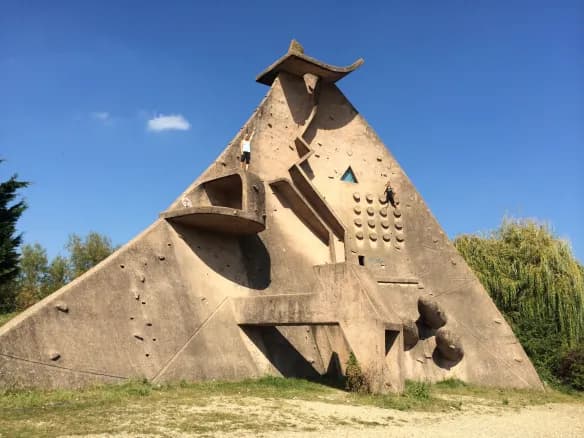
At the Dame du Lac in the Paris suburbs, parkour stops being an abstract idea and becomes a place you can point to. Lisses, with Évry next door, is where the sport still sends people when they want to stand in the middle of its origin story and see how the first generation read a city as a movement problem, not a background.
The climb that keeps drawing traceurs back
Ampisound’s Lisses & Evry page is blunt about the site’s status: Lisses is widely regarded as the birthplace of parkour. The signature structure is the Dame du Lac, a climb that became famous because early traceurs treated it like a real-world training environment, not a monument to be admired from a distance. That distinction matters, because parkour was never built around a gym floor or a marked course. It was built around what a place could ask of a body.
That is why traceurs have traveled to Lisses for years. The attraction is not nostalgia in the soft, souvenir-shop sense. It is a working pilgrimage to a spot that still gives the sport a physical reference point, one that appears in Duncan Germain’s feature-length documentary, Pilgrimage, and in the stories practitioners swap whenever they talk about roots, routes, and authenticity.
Why a suburb became the sport’s reference point
Lisses and Évry matter because they were not designed as parkour facilities. That is the point. The sport’s original logic was to see walls, ledges, climbs, and open space as possibilities for movement, problem-solving, and control, and the suburban landscape gave that logic a testing ground. In parkour terms, the birthplace is not a museum piece. It is the place where the discipline learned to read the built environment as a conversation.
That is also why the site still carries technical weight. The landmark helped crystallize parkour’s vocabulary of climbs, jumps, vaults, and routes, and it gave later generations a concrete place to attach to a sport that can otherwise look diffuse when viewed only through clips, edits, and social feeds. A lot of athletic cultures have an origin story; parkour has a landscape.
The origin story is bigger than one clean date
Parkour history sources place the discipline’s development in France in the late 1980s, but they also make clear that the exact moment of birth is hard to pin down. That ambiguity is part of the sport’s DNA. The Yamakasi-era founders most often named in that story are David Belle, Sébastien Foucan, Williams Belle, Yann Hnautra, Châu Belle-Dinh, Laurent Piemontesi, Malik Diouf, Guylain N’Guba Boyeke, and Charles Perrière, a group whose influence is still baked into the way the discipline talks about movement and discipline.
The Fédération de Parkour pushes the point further by describing the practice’s birth as a mix of several personal stories. Each practitioner brought a different vision, creativity, and definition of the movement’s origin, and the federation says the practice continues to evolve with new generations. That framing fits Lisses and Évry perfectly: the place is important not because it freezes parkour in one heroic moment, but because it shows how multiple stories can converge on the same concrete surfaces.
Why visitors still make the trip
American Parkour’s Visiting Lisses, published in 2014, introduces the area to newcomers by saying plainly that Lisses and its neighbor Évry is where parkour began. That phrasing still works because it gives the sport something many disciplines never get: a place name that functions like a compass. When athletes go there, they are not just sightseeing. They are checking their movement against a reference point that has been discussed, filmed, and revisited long enough to become part of parkour’s global language.
For newcomers, that matters in practical ways:
- It separates parkour from generic obstacle training by tying the discipline to a specific place and history.
- It helps explain why authenticity in parkour is so often argued through movement, not branding.
- It shows how a non-purpose-built environment can shape technique more powerfully than any formal course.
The pilgrimage also reveals something subtle about the sport’s culture. Parkour prizes adaptation, but it also prizes lineage. Lisses and Évry give traceurs a place to measure both, because the same walls that once invited experimentation still stand as a reminder that the discipline began with people who saw more in a suburb than a suburb was supposed to offer.
That is why the birthplace story refuses to fade. Lisses and Évry are not only where parkour started drawing its map. They remain one of the clearest places to see how the sport thinks, how it trains, and how it remembers itself.
This article was produced by Prism’s automated news system from verified source data, official records, and press releases, then run through automated quality and moderation checks before publishing. The system is built and supervised by the people who set the standards it runs under. Read our full AI policy.
Did this article answer your question?