Parkour athletes show better balance in pilot study
A PubMed pilot study found traceurs held steadier balance with eyes closed, pointing to the control behind cleaner landings, rail work, and safer training.
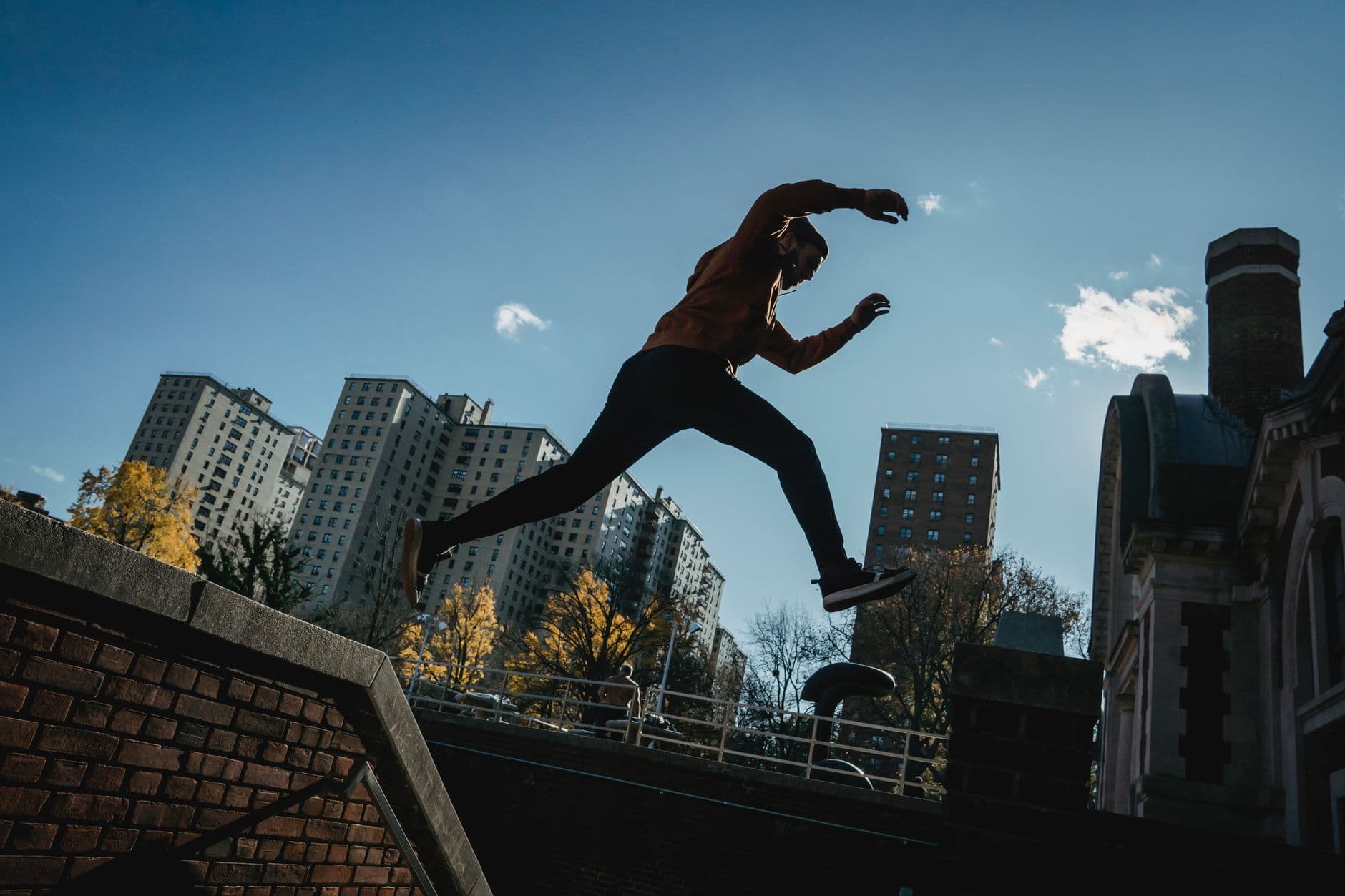
A precise landing on a narrow edge, a quiet cat balance, and a rail step that stays composed even after a hard takeoff all depend on postural control, the body’s ability to stay stable while standing, moving, landing, and recovering from imbalance. That is one of the clearest differences between trained parkour athletes and recreational movers handling the same challenge.
Why balance is the skill that shows up everywhere
In parkour, balance is not an isolated drill. It is present in precisions, cat passes, vault exits, turning landings, and wall contacts, where the athlete has to absorb force and immediately organize the next move. That makes postural control a practical performance measure, not an abstract lab term, because the sport is built around open, unpredictable environments where the body has to correct itself on the fly.
The study titled “Postural control of Parkour athletes compared to recreationally active subjects under different sensory manipulations: A pilot study” asks a concrete question that matters to athletes and coaches: do traceurs control their bodies differently from people who are only recreationally active?
What the pilot study found
The PubMed-listed paper, identified as PubMed ID 30303464, was explicitly a pilot study, so it should be read as an early, limited comparison rather than a final verdict. Even so, traceurs showed significantly lower center-of-pressure, or CoP/CoPA, values than recreationally active subjects when vision was removed.
That eyes-closed condition is the most revealing part of the comparison. When the visual system is taken away, the athlete has to lean more heavily on vestibular and proprioceptive information, and the traceurs in this study handled that challenge better. In practical terms, that suggests a body that can settle faster after disturbance, which is exactly what parkour asks for after a landing or a miss that needs quick recovery.
What that looks like on a wall, rail, or landing
Lower center-of-pressure values are not just a lab statistic. In parkour terms, they help explain why trained athletes often look calm on narrow rails, uneven surfaces, and awkward takeoffs where another mover would wobble or need extra steps. The nervous system is making faster corrections, so the athlete can stay quieter through the feet, hips, and torso even when the surface is unforgiving.
The difference shows up in sticking a precision cleanly, holding a cat balance without a hand flail, or keeping control late in a session when fatigue usually starts to expose errors. Better postural control can translate into fewer mistakes and safer training because the athlete is not scrambling to recover after every landing.
Why parkour’s roots make this result feel familiar
Parkour has always been about moving from point A to point B as safely and efficiently as possible. Parkour Circle Chennai uses that same framing. The movement language is not built around showy extras first. It is built around solving terrain with the least wasted motion, which makes balance and control foundational rather than optional.
Its history reinforces that point. The discipline was founded in France in the late 1980s by a group of young men including David Belle, Yann Hnautra, Chau Belle, Laurent Piemontesi, Williams Belle, Sébastien Foucan, Malik Diouf, Guylain N'Guba Boyeke, and Charles Perriere. Freerunning adds flips, spins, and other more expressive movements, while parkour keeps its center of gravity on practical efficiency and movement through space.
Why researchers are paying closer attention now
A 2022 narrative review in Sports Medicine, “What Makes Parkour Unique? A Narrative Review Across Miscellaneous Academic Fields,” describes parkour as a growing sport. The field is now treating the discipline as something more than a visual novelty. As the sport grows, the questions get sharper, and postural control becomes one of the cleanest ways to measure what parkour athletes actually do differently.
For coaches, that gives balance work a clearer purpose. It is not just a warm-up item or a general athletic quality; it is central to how athletes manage landings, maintain stillness after impact, and keep moving when the environment does not cooperate.
What the finding means on the floor
Trained traceurs do not just jump farther or move faster than recreationally active people. In this pilot comparison, they also held steadier when sensory information was reduced, which points to sport-specific adaptation in postural control.
This article was produced by Prism’s automated news system from verified source data, official records, and press releases, then run through automated quality and moderation checks before publishing. The system is built and supervised by the people who set the standards it runs under. Read our full AI policy.
Did this article answer your question?