Parkour landings cut impact force, study finds
Parkour’s real edge is the landing: precision and roll techniques cut impact force sharply and spread deceleration across the body.

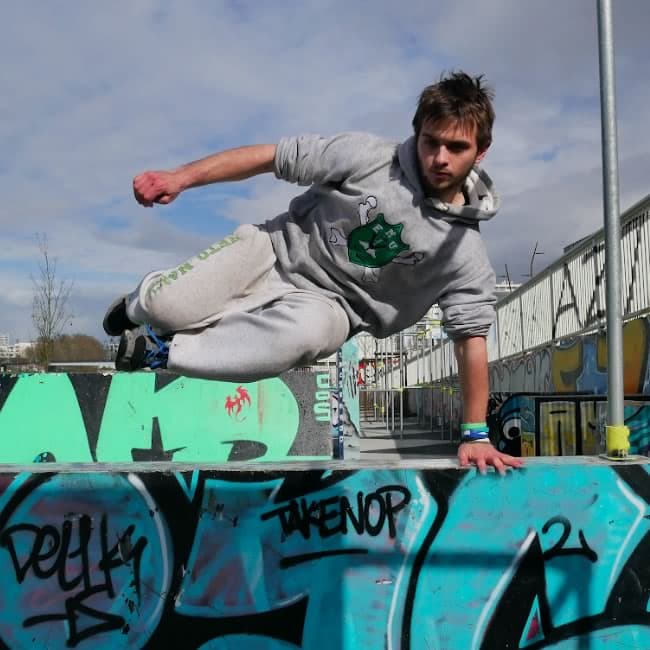
When a traceur hits the ground, the landing turns a dangerous collision into controlled motion through body position, timing, and technique. The sport’s best movement looks less like a stunt and more like force management: ankles, knees, hips, and connective tissue all share the load instead of letting one joint take the hit.
The landing is where parkour reveals its logic
Parkour Generations put the question bluntly in a September 21, 2021 explanation: how do practitioners avoid “exploding joints” when they come down from a jump? The answer runs through the same language sports science uses to describe impact absorption. Parkour bodies are treated as connected systems that coil and uncoil, which means the landing is not a dead stop but a transfer of energy through multiple links in the chain.
Parkour grew out of practical movement, not showmanship. The discipline developed in France in the late 1980s and became associated with David Belle’s training in Lisses and Évry outside Paris, shaped by methods linked to Raymond Belle and military obstacle-course thinking.
What the force plate numbers say
A 2013 force-plate study in the Journal of Sports Science & Medicine tested 10 male participants performing three drop-landing techniques: parkour precision, parkour roll, and a traditional landing. The parkour-specific techniques reduced the size and speed of the impact in measurable ways.
Compared with the traditional landing, the parkour precision landing produced 38% less maximal vertical landing force and a 54% lower loading rate. The parkour roll did even better on those measures, with 43% less maximal vertical landing force and a 63% lower loading rate. The authors concluded that both parkour techniques were more appropriate than the traditional landing because they exposed the body to lower forces and slower loading.
Loading rate, the speed at which the force arrives, helps determine how harsh the landing feels to the body. A technique that slows that arrival gives the athlete more time to absorb and redirect energy, which is exactly what parkour landings are built to do.
Why the roll is central to the craft
A later kinematic study tested squat, forward, roll, and stiff landings from 0.9 meters, 1.8 meters, and 2.7 meters, using 17 male and 3 female parkour practitioners. The roll landing showed the longest landing time at 1.8 meters and 2.7 meters, while researchers flagged the stiff landing as potentially higher risk because it caused a quick decrease in vertical velocity.
By spreading horizontal and vertical deceleration over a longer period, the roll likely lowers peak loading on the lower extremities. In plain terms, the body is not trying to “stick” the landing as abruptly as possible. It is choosing the right shape for the obstacle, the height, and the amount of room available.
For a traceur, that means technique is situational:

- precision landings help when the goal is a controlled stop on a target
- rolls help when the drop is bigger and the body needs to dissipate force across more tissue
- stiff landings compress the force into a shorter window and can be riskier
- body position decides whether force is absorbed, redirected, or concentrated
From street training to global sport
Parkour’s evolution from informal practice to formal sport has changed the context, but not the mechanics. The discipline rose from France in the late 1980s and gained global visibility through Internet videos, commercials, and films, including Casino Royale in 2006.
The Fédération Internationale de Gymnastique helped push parkour into institutional sport. Workshops at the Lillehammer 2016 Youth Olympic Games, led by Charles Perrière, helped spark wider interest in the discipline. FIG later introduced parkour event formats built around Speed and Freestyle, with athletes using moves such as cat leap, arm jump, drop jump, and wall run on obstacles designed to mirror urban environments.
That shift also created tension. On February 24, 2017, FIG publicly announced plans to develop parkour as a gymnastics discipline, a move that drew criticism from parts of the parkour community.
The competitive calendar has caught up to the science
Parkour’s jump into major events made the landing problem even more visible. The sport debuted at The World Games in Birmingham, Alabama, in July 2022, where Greece’s Ioakeim Theodoridis won the first-ever World Games parkour gold medal in men’s freestyle. The women’s freestyle title went to the Netherlands’ Noa Diorgina Man, giving the event a first set of champions that immediately placed parkour on a bigger stage.
The first FIG Parkour World Championships were originally scheduled for April 2020, then delayed by COVID-19. The second FIG Parkour World Championships took place in Kitakyushu, Japan, from November 15 to 17, 2024.
What to watch in a clean parkour landing
The best parkour landings share the same traits across studies and styles. The body stays organized, the joints do not lock out under load, and the energy is carried through multiple points instead of one. Ankles, knees, hips, and torso work together, while the roll extends the deceleration when the drop gets bigger.
This article was produced by Prism’s automated news system from verified source data, official records, and press releases, then run through automated quality and moderation checks before publishing. The system is built and supervised by the people who set the standards it runs under. Read our full AI policy.
Did this article answer your question?