How Lisses and Évry shaped the birth of parkour
Lisses and Évry are parkour’s ground zero: one suburb forged the discipline’s logic, the other gave it its signature leap. Together they turned suburbia into a global myth.
Lisses and Évry are ordinary suburbs on paper, but parkour turned them into origin points. Lisses was the home base of David Belle, the man most often credited with crystallizing modern parkour, while Évry supplied the Manpower gap-jump that became part of his legend. Put them together and you get the sport’s real founding map: not a stadium or academy, but concrete, stairs, rails, walls, and gaps that forced movement to become a language.
The family tree runs through Hébert
Parkour did not begin as a stunt culture. Its physical logic runs through Raymond Belle, who was trained on Georges Hébert’s methods while serving in the military during the 1940s and 1950s, then carried that approach into a career as an elite firefighter. Hébert’s system, la méthode naturelle, emphasized running, jumping, climbing, balancing, swimming, and defending, along with obstacle courses called parcours du combattant. That heritage still shows in the way parkour prizes efficient traversal over decoration: the point is to solve terrain, not to impress it.
That rescue-minded practicality matters because it explains the sport’s ethos as much as its movement. David Belle did not inherit a dance form or a trick system, he inherited a way of reading obstacles as problems to be negotiated cleanly and quickly. The result is why parkour still looks less like performance for the camera and more like a field test for bodies under pressure.
Lisses was a laboratory, not a backdrop
Lisses, a quiet suburb south of Paris in Essonne, became one of the most important place-names in parkour because it was where David Belle built the modern discipline’s early identity. France 3 identifies Belle as the inventor of modern parkour at the beginning of the 1990s in Lisses, and his official channel says footage in the Parkour History series was filmed there in the mid-1990s. That matters because the legend was not invented later from afar; it was documented in the town itself, in the streets and housing blocks where the movement was taking shape.
The terrain in Lisses was the sport’s first training room. Parkour Generations describes stairwells, rails, ledges, walls, and gaps as repeatable test pieces, the kind of architecture that lets a traceur refine precision over and over until the body stops negotiating and starts solving. One especially vivid detail is the school-adjacent fire-escape stairwell, which became notorious among practitioners as a punishing precision-training structure. That kind of spot explains why Lisses still carries almost sacred weight: it was not just where parkour happened, it was where parkour learned what it wanted to be.
The social context is just as important as the concrete. Parkour Generations describes the scene in those years as unknown to the world, a small circle of young men training for hours a day before the wider culture had any language for what they were doing. The phrase “a few crazy young guys” captures the scale of it better than any glossy retrospective. Lisses was not a stage built for spectators. It was a proving ground where repetition, discipline, and the refusal to waste motion became the sport’s first principles.
Évry gave parkour its leap of faith
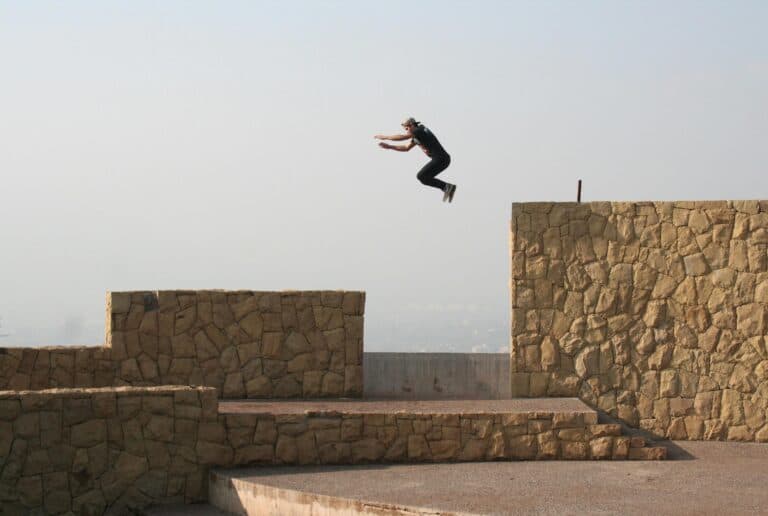
If Lisses taught parkour how to move, Évry gave it one of its defining monuments. Parkour Generations says the city is best known for the enormous Manpower gap-jump associated with David Belle, and a parkour archive adds a detail that makes the site even more revealing: the gap is named after the business that used to occupy the building. In other words, one of the discipline’s most famous landmarks came from ordinary commercial architecture, the sort of place most people would pass without looking twice.
That is exactly why Manpower became mythic. It was not only big, it was legible as a challenge, a benchmark that later generations could chase, study, and measure themselves against. The archive notes that people have traveled from around the world to Évry to jump and flip it, which tells you everything about how parkour turns a location into a rite of passage. The obstacle is famous because it is difficult, but it is sacred because it is repeatable: a single piece of urban infrastructure that keeps asking the same question of every athlete who steps to the edge.
From local practice to global discipline
Parkour developed in France in the late 1980s and later spread through internet videos, television commercials, and films, including Casino Royale in 2006. Before that broad visibility, the movement already had an internal turning point: France 3 reports that Belle and Sébastien Foucan split from the Yamakasi in 1998, after which Belle formed Les Traceurs and la Relève. That split did not just rearrange a group of athletes, it helped separate parkour’s core identity from the looser public image that would later follow it into media.
The timeline is crucial because it shows how local training became public culture. David Belle’s official channel places the mid-1990s footage in Lisses, France 3 places Belle’s recognition as modern parkour’s inventor at the beginning of the 1990s, and Parkour Generations describes the late-1990s training scene as still unknown outside its small circle. By the time Yamakasi reached audiences as film and iconography, the discipline had already been built in those suburbs, on those stairwells, and around that gap in Évry.
Why the pilgrimage still matters
The local roots have not been washed away by competition or media. In 2020, Évry-Courcouronnes marked the 20th anniversary of Yamakasi with an event meant to better explain the discipline, a reminder that the city now treats its parkour history as civic identity as well as sporting lore. The formal side of the sport has moved too: the first FIG Parkour World Championships were scheduled for April 2020, delayed by COVID-19, held in Tokyo in 2022, and followed by a second edition in Kitakyushu in 2024. France also held its first national Parkour Championships in Bourges in 2026.
Even with championships, screens, and global travel, Lisses and Évry still matter because they hold the original grammar of the sport. Lisses shows the repetition, the precision, and the grind of learning movement in a hostile urban landscape. Évry shows the benchmark leap that turned a local practice into a shared myth. Every new generation of traceurs still ends up measuring itself against those two places, because parkour’s birth was not just a moment in time, it was a geography.
This article was produced by Prism’s automated news system from verified source data, official records, and press releases, then run through automated quality and moderation checks before publishing. The system is built and supervised by the people who set the standards it runs under. Read our full AI policy.
Did this article answer your question?