Parkour training borrows golf balance tips for sharper landings
Golf balance cues map cleanly to parkour’s hardest test: sticking precise landings on tired legs, narrow rails, and off-axis recoveries.

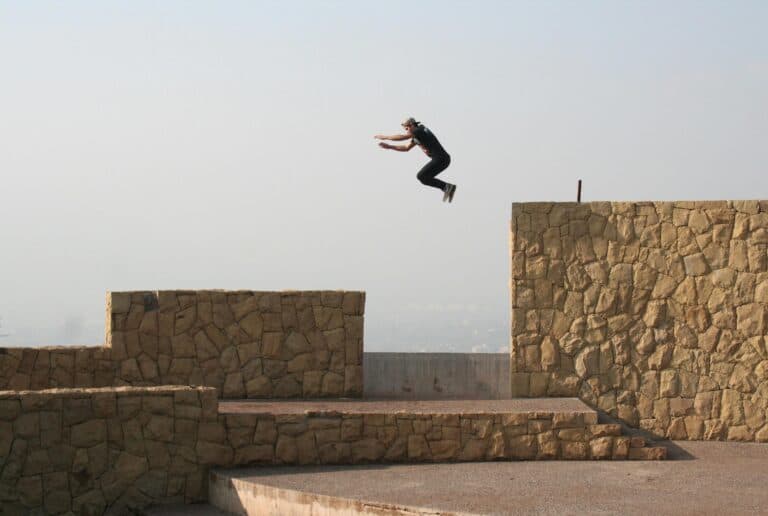
Advanced traceurs scored 41 to 44 out of 45 in a parkour skills course; beginners scored 27 to 33. Parkour’s newest crossover lesson comes from golf, where stable stance, even weight distribution, core control, and a disciplined finish all serve the same goal traceurs chase on precisions, rail landings, and cat-pass recoveries: no wobble, no bailout, no wasted motion.
Why this crossover works
Parkour research treats precision jumps and landings as highly dynamic movements, the kind that force the body to generate and then counter external forces in a hurry. Balance is not a soft skill in this sport. It is the difference between a clean continuation and a recovery step that kills momentum.
In one biomechanics study of 20 parkour practitioners, 17 men and three women landed from 0.9, 1.8, and 2.7 meters using squat, forward, roll, and stiff techniques. The stiff landing produced the shortest landing time, while the roll landing produced the longest time at 1.8 and 2.7 meters, a reminder that the choice of landing strategy changes how fast the body can settle and how much impact it absorbs.
A quick precision to a narrow target, a rail landing with a short exit, or a drop into a cat balance position all ask for a body that can organize itself instantly. Parkour’s skill tests reflect that reality: in a course used for reliability research, athletes were scored through monkey vault, parkour roll, tic-tac, precision jump, cat balance, step vault, corkscrew pop-up, and parkour landing.
Set the stance like a golfer sets the shot
The first golf lesson that transfers cleanly is simple: control starts before the movement starts. Golf teaches a stable stance and even weight distribution; in parkour, that same idea helps a traceur leave the ground in a position that can actually be controlled when the feet return. If the takeoff is rushed or the body is leaning, the landing has to solve a problem the athlete created earlier.
A useful drill is to build every precision from a quiet setup. Stand on a low line, curb, or rail edge, center the weight so neither leg is doing all the work, and set the torso before you jump. Then land and freeze the body in place, especially if the target is narrow or the setup is slightly off-axis, because that is the moment when the landing shows whether the stance held up under pressure.
That freeze matters most when you are tired. The body wants to drift, the chest wants to turn, and the feet want to search for help on the ground.
Use the core to keep the line intact
The second lesson is about body organization. Core strength and alignment match what balance studies keep showing: advanced golfers demonstrate better postural control at maximum arm speed, and their center of mass stays closer to impact than it does for less skilled players. In other words, the better athlete keeps the system together when the action is moving fastest.
Parkour asks for the same thing during a cat balance recovery or a short vault sequence that ends with a precision. Once the body rotates, reaches, or absorbs force, the core has to reconnect the upper and lower halves fast enough to stop the landing from unraveling. That is why a clean torso position matters just as much as foot placement on a rail or ledge.
The practical drill is a landing-and-hold pattern. Come out of a low vault, a tic-tac, or a small rebound, land on one foot or both feet, and stack the torso over the hips before moving again. Keep the chest quiet and the hips level.
Borrow the golfer’s focus before takeoff
Golf also brings a mental habit that parkour often underuses: visualization. Discipline, focus, and the ability to picture the outcome before the motion begins matter in both sports. On a precision jump, hesitation is often more costly than a small technical flaw, because the body no longer commits cleanly to the landing.
Try the golfer’s pre-shot routine on your next parkour attempt. Pick the exact landing point, picture the path through the air, and rehearse the finish before you move. That mental lock-in is especially useful on narrow targets, where the body wants to overcorrect, or on awkward recoveries where the landing surface gives you almost no margin for drift.
Why the research backs the feeling traceurs already know
A 2023 balance study found parkour practitioners had “good balance abilities.” Parkour is full of movements that test the same skill: land, absorb, redirect, and keep going.
At American Parkour, the basic parkour landing is one of the first building blocks of learning the discipline, and its physical literacy work lists balance, precise foot placement, stable landings, and controlled deceleration.
This article was produced by Prism’s automated news system from verified source data, official records, and press releases, then run through automated quality and moderation checks before publishing. The system is built and supervised by the people who set the standards it runs under. Read our full AI policy.
Did this article answer your question?