Asia's First Fully Funded U19 Pickleball Finals Draw 22 Teams to Hainan
More than 110 U19 players from nine countries competed at Hainan's PCL Asia Rising Stars Grand Finals, Asia's first fully funded junior pickleball championship.
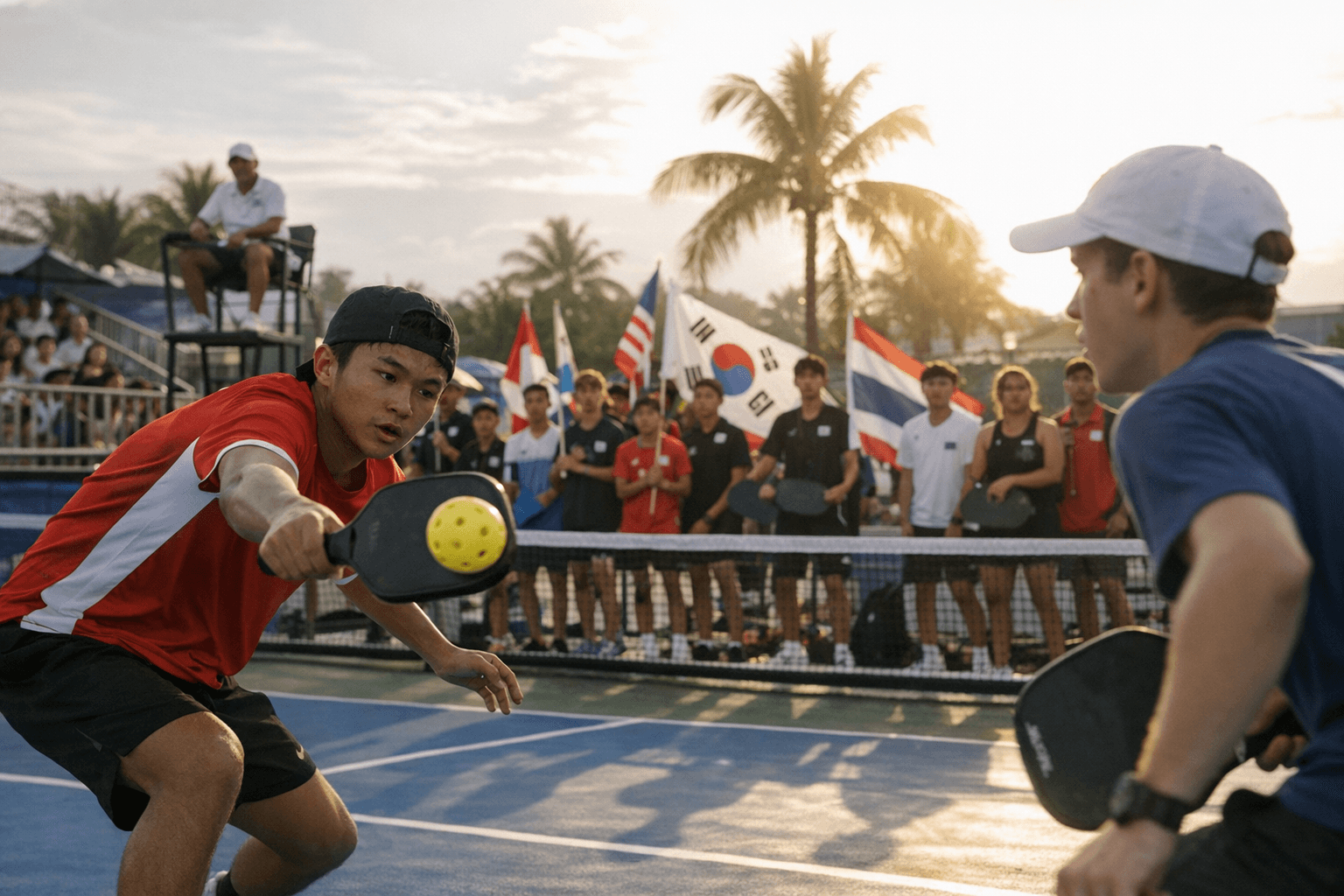
Twenty-two teams, more than 110 U19 athletes, nine countries and a fully funded model that covered travel and hospitality for every finalist: the PCL Asia Rising Stars Grand Finals set a new standard for junior pickleball development when it concluded at Hainan Island's Asia Elite Pickleball Academy on April 5.
The field alone signaled how far the sport has spread across the region. Qualifiers arrived from the Philippines (Davao, Cebu and Manila), India (Indore, Pune and Mumbai), Indonesia (Bali and Surabaya), Malaysia (Kuala Lumpur and Ipoh), China (multiple regional teams including squads from Wuhan and Foshan), Chinese Taipei, Japan, Turkey and invited squads from Russia. Group-stage matches featuring Cebu, Indore, Wuhan and Foshan produced competitive scorelines before elimination rounds narrowed the bracket toward a single champion.
That breadth was not accidental. PCL Asia Chairman Steve Kuhn framed the event's funding philosophy plainly: "We built Rising Stars because the talent has always been here in Asia. We do not want a family's financial situation to be the reason a talented kid does not make it to Hainan." That commitment translated into guaranteed travel and hospitality support for every finalist, with the tournament positioned as part of a broader $100,000 development initiative from PCL Asia.
Before competition began, the event ran a two-day pro coaching block on April 1 and 2 in which eight international coaches worked with every participating team on movement mechanics, serve technique, third-shot strategy and high-performance routines. The training-to-competition structure, which placed professional mentorship ahead of elimination pressure, reflected the tournament's dual purpose: scouting talent while actively developing it.
An opening ceremony on April 2 at AEPA marked the formal start of the program. At the ceremony, AEPA and the host school signed an agreement covering youth training pathways, coach education and long-term athlete exchange intended to funnel Asian juniors into higher-level international competition. Hainan tourism and sports officials attended and described the event as part of a broader effort to establish Hainan as a regional training and competition hub.
The bracket ran across six championship-calibre courts at AEPA plus additional campus courts for pool play. Baseline provided tournament software for on-court scoring and live-streaming feeds. The format combined group-stage play, elimination rounds and a team mixed structure in which individual match results contributed to team advancement, with a single overall winner crowned on April 5.
Scholarship awards, university-linkage sessions and mentorship programming ran alongside the bracket, making the finals as much a development pipeline as a competition. For national associations and academies across Asia, the results from Hainan now offer a first real benchmark: which junior programs are producing players with the tactical maturity to handle international elimination formats at U19 level.
The model PCL Asia deployed here, pairing guaranteed financial access with pro coaching and measurable scholarship outcomes, is a direct challenge to the ad hoc sectional events that have previously defined junior pickleball development across the region. Rising Stars has set the bar; now the question is whether national federations step up to match it.
This article was produced by Prism’s automated news system from verified source data, official records, and press releases, then run through automated quality and moderation checks before publishing. The system is built and supervised by the people who set the standards it runs under. Read our full AI policy.
Did this article answer your question?