How to Become a Certified Pickleball Coach Anywhere in Asia
Pickleball's coaching certification landscape in Asia is more navigable than ever, with recognized pathways from online-only to in-person workshops starting at $250.
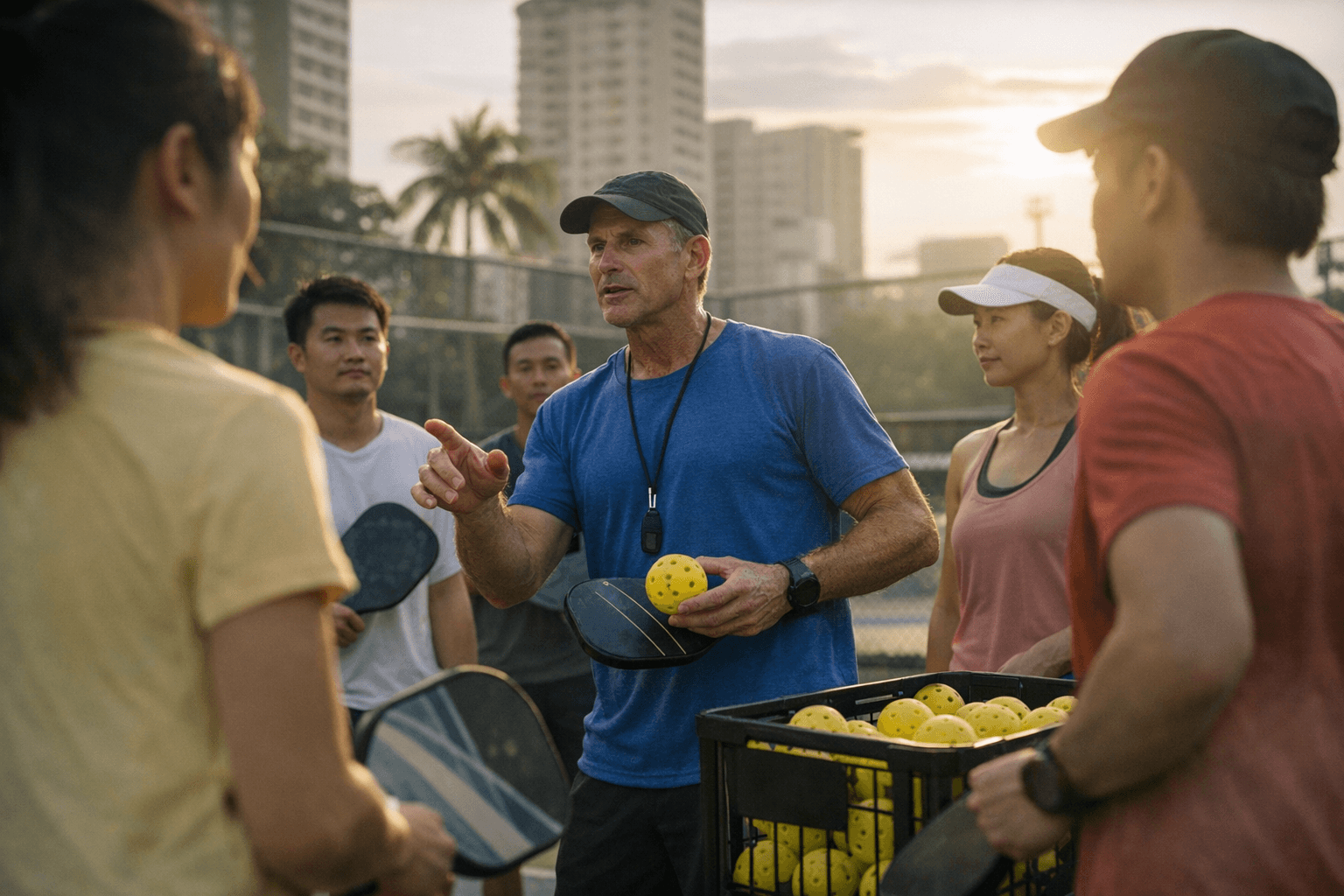
Pickleball's growth across Asia has outpaced its coaching infrastructure. Courts are going up in malls and community centers from Kuala Lumpur to Guangzhou, but quality instruction is still uneven. A formal coaching credential is how you close that gap, and it also happens to be the fastest way to turn court time into a sustainable income stream.
Why Certification Is Non-Negotiable
A recognized credential does more than signal competence. It demonstrates that you understand stroke mechanics, footwork, competition rules, injury prevention, and how to design training appropriate for different age groups. Practically speaking, many national federations and international tournaments now require certified coaches for sanctioned clinics and for official accreditation on team rosters. If you want to run programs that feed into local leagues or national competition pathways, certification is the baseline, not the bonus.
The Main Certification Pathways Available in Asia
The Asia Federation of Pickleball (AFP) partners with both the Professional Pickleball Registry (PPR) and the International Pickleball Teaching Professional Association (IPTPA) as its official education and certification partners across the continent. These two organizations represent the most widely recognized routes into coaching, but they are not the only ones.
PPR (Professional Pickleball Registry)
PPR is the official education and certification partner of USA Pickleball, which gives its credential strong international recognition. PPR Level 1 workshops target instructors working with adult beginners and improvers, and assessment covers three areas: skills, teaching ability, and knowledge. Candidates are required to hold at least a 3.5 player rating before sitting the certification. The workshop format blends pre-course online materials with on-court live assessment, so you cannot simply paper your way through it.
IPTPA (International Pickleball Teaching Professional Association)
The IPTPA Level I Certified Pickleball Instructor course is structured around fundamental skills, teaching techniques, and lesson planning for beginner and intermediate players. It includes a workshop based on the IPTPA Handbook, a written exam, and an observed teaching lesson. The workshop fee is $250, with a continuing education renewal fee of $150. IPTPA-certified instructors gain access to liability insurance and promotional opportunities. The organization has already run workshops in Guangzhou and Shenzhen, making it one of the few bodies with a direct on-the-ground presence in mainland China.
RPPk Asia (Registry of Pickleball Professionals)
The Registry of Pickleball Professionals has certified more than 2,000 coaches across 40 countries, and maintains a dedicated Asian/Pacific branch. Its qualifications are recognized by DUPR (Dynamic Universal Pickleball Rating), which matters because DUPR is increasingly the rating standard used for tournament entry across the region. RPPk certifications combine online theory modules with practical assessments, making them accessible to coaches in countries where in-person workshops are not yet regularly scheduled.
Online-Only Options for Remote Markets
For coaches in markets where live workshops are infrequent, Pickleball Coaching International (PCI) offers Level 1 and Level 2 instructor certifications that can be completed 100% online at your own pace. Group discounts of 20% are available when certifying five or more coaches simultaneously, which makes it a practical entry point for school PE departments or club programs looking to credential a full coaching staff in one go.
National Federation Pathways
Beyond the international bodies, national federations in Malaysia, India, and Japan run their own coach education programs. These national certificates are typically aligned with each federation's competition structure, which makes them the preferred credential for local tournament organizers and school programs operating within a domestic sporting system. If your primary goal is coaching at club level or within a school PE context, obtaining the national federation certificate alongside an international credential provides the most complete coverage.
The Four-Step Certification Process
Most pathways follow the same progression:
1. Complete online theory covering rules, safety protocols, and beginner progressions.
2. Attend a practical workshop or live clinic with real-time coaching feedback.
3. Pass a written and/or practical assessment, which typically includes an observed teaching session.
4. Maintain certification through continuing education credits or annual renewals.
The cost gradient is predictable: online-only modules are the least expensive entry point; in-person practical certifications with live assessment cost more, and IPTPA's $250 workshop fee is a useful benchmark for what to expect at the fully supervised end of the market.
What the Curriculum Actually Covers
Core technical content spans stroke fundamentals (serve, return of serve, groundstrokes, volleys, and dinks), court positioning, footwork patterns, and doubles strategy. Injury prevention is integrated throughout, including shoulder-safe overhead mechanics and progressive volley/dink drill sequences designed to reduce overuse risk. Equally important are the pedagogical modules: how to run structured group drills, how to manage participant risk, and how to adapt technical content from junior beginners through to senior recreational players.
Some programs also include operational modules covering lesson pricing, class scheduling, basic clinic marketing, and video/photography for remote coaching. These are worth prioritizing if you plan to run a commercial program rather than purely club-based sessions.
Launching a Program: Practical Steps
The credential is the starting point. Converting it into paying students takes a different kind of planning.
- Run 4–6 week clinic blocks rather than open-ended programs. Short-term commitments make it easier for parents and adult learners to sign up, and they make retention measurable.
- Partner with malls or community centers early. Mall-based pop-up courts have demonstrated consistent success in Asia for recruiting first-time players who would not otherwise seek out a dedicated pickleball facility.
- Use DUPR or UTR-P ratings with your students from the beginning. Rating systems give recreational players a tangible measure of progress and create a natural bridge between your clinic and competitive play.
- Keep junior student-to-coach ratios between 6:1 and 8:1, and build a scaffolded curriculum across the season rather than repeating the same drills each week.
- Ensure access to demo paddles, spare balls, and correctly sized nets, especially when teaching in non-standard venues like school gymnasiums or mall atriums.
Turning Certification Into Paid Coaching
The operational infrastructure matters as much as the credential itself. Coaches should carry liability insurance, either through their certification body (IPTPA includes this for members) or through a separate policy. Venue partnerships should be formalized in writing, with clear agreements on court time, revenue share, and cancellation terms.
Join local coaching networks and subscribe to federation newsletters to stay current on tournament schedules, referee education opportunities, and sanctioned clinic listings. Cross-certifications in first aid and children's coaching are worth adding to your profile, particularly if you work with juniors or corporate wellness groups. Most federations and private operators in the region also run mentorship schemes where newly certified coaches can apprentice under established trainers, which accelerates the gap between passing an assessment and running a full program confidently.
The pipeline is visible: a well-structured clinic series, consistently delivered in an accessible venue with transparent pricing, feeds players from first-time recreational participation through to local club leagues. For the most talented among them, the pathway extends to national and international competition. A certified coach is what makes that pipeline function.
This article was produced by Prism’s automated news system from verified source data, official records, and press releases, then run through automated quality and moderation checks before publishing. The system is built and supervised by the people who set the standards it runs under. Read our full AI policy.
Did this article answer your question?