India eyes Pickleball World Cup edge in Vietnam's humid conditions
Vietnam’s heat and humidity may be India’s hidden weapon in Da Nang, turning a supposed neutral site into a conditions edge over better-hyped rivals.
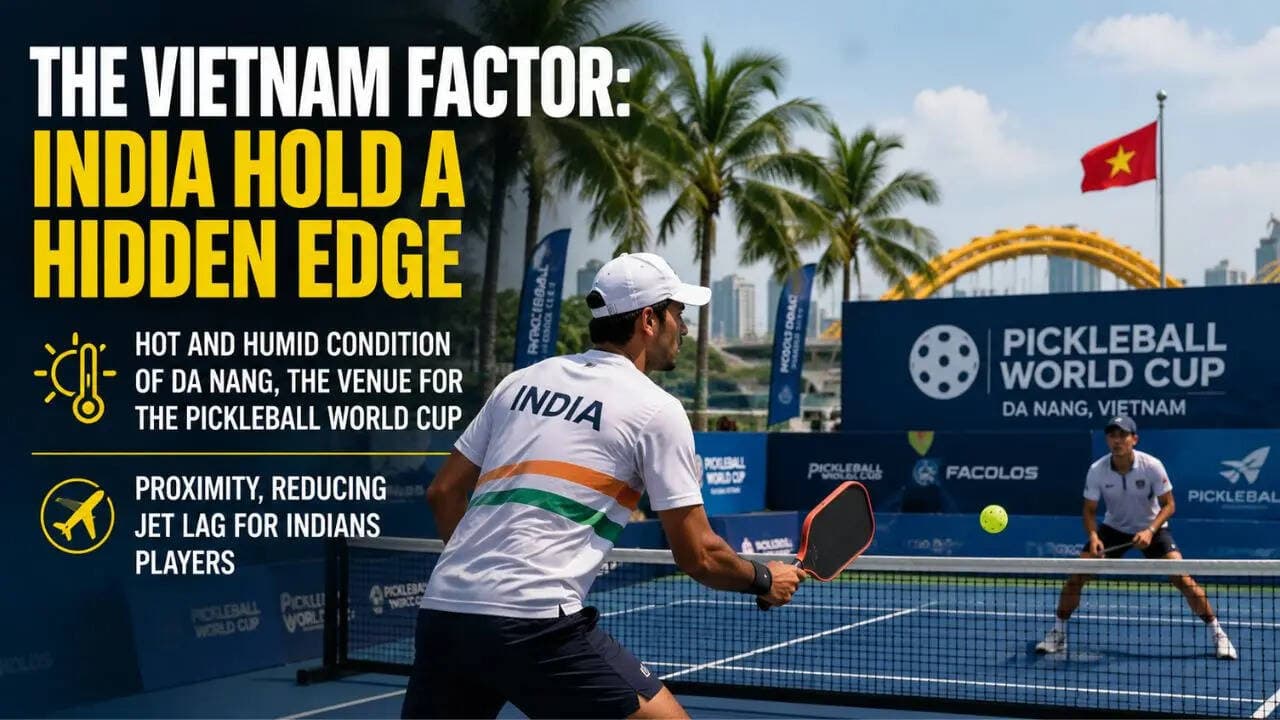
Vietnam could be India’s advantage
The surprise in the Pickleball World Cup 2026 is not just that Asia is hosting. It is that Da Nang’s conditions may quietly reward India more than teams arriving from cooler, longer-haul, better-publicized pickleball markets. The tournament runs from August 30 to September 6 in Vietnam’s coastal city, the first Asian host for the event, and the mix of humidity, travel familiarity and match-day grind could matter more than seedings alone.
India’s edge is not a headline-grabbing theory; it is a climate-and-recovery argument. When a tournament stretches across nearly a full week and brings together national teams, individual draws, multiple age groups and different skill levels, the players who settle fastest often gain the most. In Da Nang, settling fast may favor athletes already used to heavy air, sweating through long rallies and managing the kind of fatigue that builds one point at a time.
Why Da Nang’s weather changes the matchup
Da Nang in late summer is not a gentle backdrop. August averages around 33°C during the day, with humidity near 77% and about 22 rainy days on average. September stays hot and sticky too, with daytime highs near 31°C, humidity around 82% and roughly 18 rainy days on average. Those numbers matter in pickleball because humidity affects grip, footwork, breathing and the body’s ability to recover between matches.
That is where India’s climate familiarity becomes more than a talking point. Players from Mumbai, Chennai, Ahmedabad and Kolkata routinely train in conditions that demand patience and physical resilience. The ball may move differently, the courts may feel heavier and the recovery window between matches can shrink, but those are familiar stresses for Indian athletes who already live and compete in demanding weather.
Dhiren Patel, India’s chief pickleball coach, has already framed the tournament this way: Vietnam should feel more familiar than the United States because there is no jet lag, the weather is closer to home and the playing feel is more familiar. In a World Cup setting, that kind of comfort is not trivial. It can decide how quickly a team finds its rhythm in doubles, how long it can sustain intensity in singles and how well it rebounds from a three-set battle.

Travel, recovery and the Asia advantage
The other part of the equation is travel. Shorter flights within Asia can preserve sleep cycles, reduce stiffness and make it easier to hit the court with sharp movement patterns. By contrast, long-haul travel to North America, especially for players trying to adapt to the United States after the 2025 edition in Fort Lauderdale, Florida, can leave lingering effects for days.
That is why this tournament feels bigger than a venue change. It reflects a shift in pickleball’s competitive geography. Asia is no longer only a growth market for participation and sponsorship; it is also becoming a performance ecosystem where players train in conditions similar to those they will face at the highest level. If that trend continues, Asian athletes may increasingly convert regional familiarity into World Cup results.
For India, the point is even sharper. A team built in the subcontinent is likely to arrive with less adaptation work than better-hyped rivals who depend on pristine indoor conditions or cooler-weather preparation. In a sport where margins are tiny and momentum swings quickly, the first two days in Da Nang could be as important as the final medal rounds.
A tournament built for scale
The 2026 World Cup also arrives at a bigger, louder scale than the event has seen before. Reporting says the third edition of the tournament is expected to bring more than 4,000 athletes from over 80 countries and territories. The event will feature both national and individual categories across multiple age groups and skill levels, which means the field will be broad enough to test depth, not just top-end talent.
That scale marks a major jump from previous editions. The 2025 World Cup was held in Fort Lauderdale from October 27 to November 2, while the 2024 event in Peru drew more than 550 athletes from 32 countries. Da Nang’s version is being built as a far larger gathering, and that growth changes the competitive map. More athletes, more divisions and more countries usually mean more pressure on logistics, more court time and more room for conditions to influence outcomes.
Da Nang also enters the tournament with proof that it can handle a big pickleball crowd. PPA Tour Asia’s MB Vietnam Cup in the city produced a Guinness World Record crowd of 7,906 fans at Tien Son Sports Arena. That kind of turnout suggests the atmosphere will not be passive. It hints at the noisy, high-energy environment that can lift local-region players and unsettle opponents who are not used to playing in front of a packed, vocal crowd.
National Day timing could shape the backdrop
The calendar may add another layer. Vietnam’s National Day falls on September 2, right in the middle of the tournament window, and 2026 holiday schedules point to a multi-day break around late August and early September. That can affect travel demand, hotel availability and the size of the in-person crowd around Da Nang.
For an international tournament, that is not just an administrative note. Holiday timing can amplify the event’s visibility, create more local energy and make the city feel like it is leaning into the moment. It can also tighten logistics for arriving delegations, which makes familiarity with the region even more valuable.
India’s pipeline is already moving
India is not waiting to discover whether the conditions suit it. The Indian Pickleball Association has scheduled junior trials in Ahmedabad from June 12-14, 2026, to select U14 and U18 spots. Earlier national-team selection trials drew more than 140 players from across India, a sign that the pipeline is widening and the competition for places is becoming more serious.
That matters because a climate edge only becomes meaningful if the team has depth. If India can pair weather familiarity with a larger, more organized talent pool, it can exploit the conditions in Da Nang more effectively than countries that depend on a handful of standouts. Junior trials in Ahmedabad also show that the program is building from the bottom up, not just chasing a one-off result.
What makes the Vietnam matchup unusual
The counterintuitive part of this World Cup is simple: a first Asian host city may end up helping one of Asia’s most important emerging teams most of all. Vietnam’s humidity, the shorter regional travel, the familiar feel of outdoor rallies and the growing size of India’s national setup all point in the same direction. If India handles the early adaptation well, Da Nang could become less of an away assignment and more of a conditions advantage.
That is the real edge to watch in Pickleball World Cup 2026: not just who has the best ranking on paper, but who arrives ready to live and win inside the weather.
This article was produced by Prism’s automated news system from verified source data, official records, and press releases, then run through automated quality and moderation checks before publishing. The system is built and supervised by the people who set the standards it runs under. Read our full AI policy.
Did this article answer your question?