Japan builds junior pickleball pathway for Asia Open, with rising tier support
Japan is turning junior pickleball into a ladder, not a one-off call-up, with support, uniforms and a route into Asia’s fast-growing tournament stack.
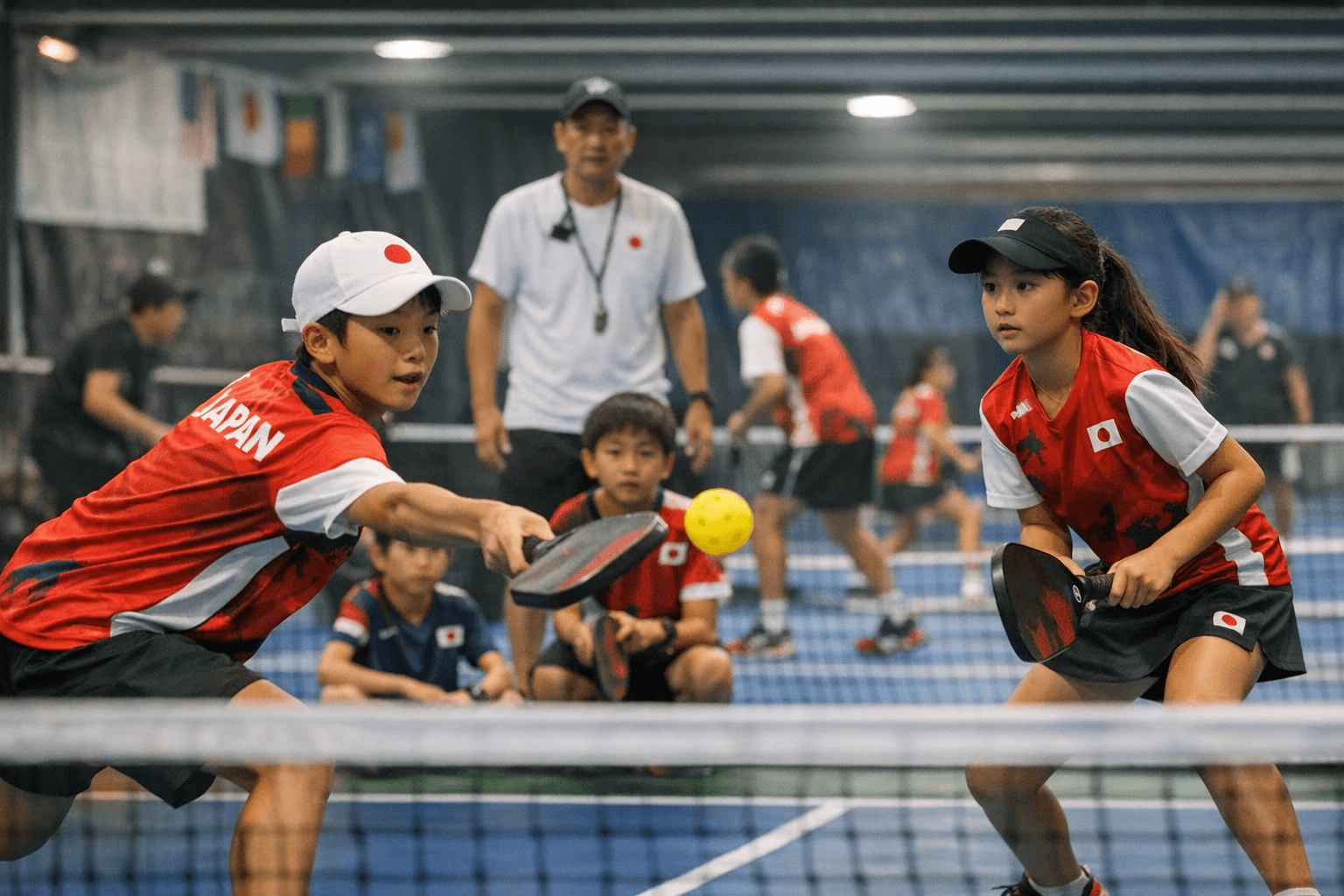
Japan’s junior ladder is starting to look like a real system
Japan’s latest junior selection notice does more than name players for a tournament in Thailand. It shows a federation building an official pipeline, from youth identification to national team support to a wider Asian competition calendar. The message is clear: junior pickleball in Japan is moving from a promising idea into a repeatable structure.
That matters because the sport’s growth in Asia is no longer just about one-off entries or casual participation. Japan is now linking age-group selection, development tracks and regional events into a single pathway. For a market that is still being shaped, that kind of organization can narrow the gap with more established Asian programs far faster than isolated results ever could.
How Japan’s selection works
The recruitment notice for the 2026 Asia Junior Open was published on April 22, 2026, with an application deadline of April 30. It covers four age groups, U12, U14, U16 and U18, with categories determined by birth year. That structure gives the program a clear ladder instead of a single open trial, which is exactly what a serious development system should look like.
Selection is also built around doubles intelligence, not just raw athletic ability. Applicants must submit at least three minutes of doubles-play video, which tells you what the evaluators value: communication, court patterns, transition play and the ability to function inside a pair. In a sport where doubles often decides the standard of play, that is a smart filter and a modern one.
The program also splits players into two tiers. Team Japan receives airfare and hotel support for the athlete, while Team Japan Rising is positioned as the next-step developmental group, with travel and lodging generally self-funded. That distinction is important because it creates an internal pathway. Players are not simply in or out; they can move upward through a recognized national progression.
Selected athletes also receive a free Japan national team uniform, which may sound small, but it matters. Uniforms give the program identity, and identity helps turn a roster into a national project. Japan is signaling that junior pickleball is not an informal gathering of promising athletes. It is building the look, language and structure of a federation-backed team.
Why Thailand is the right stage
The 2026 Asia Pickleball Junior Open is scheduled for July 28 to 30 at Mahidol University in Nakorn Pathom Province, Thailand, about 1.5 hours from central Bangkok. That location gives Japan’s juniors access to a regional stage with real visibility, while also placing them inside one of Asia’s most active pickleball corridors.
Mahidol University is a meaningful setting because the event is not being treated as a local exhibition. It sits inside a wider competitive environment that is becoming more organized by the month, and Japan is clearly using it as more than a standalone target. The federation even said it was considering support for PPA Singapore for Team Japan players from July 23 to 26, which shows how tightly the calendar is being stitched together.
That overlap is telling. Japan is not just aiming at one junior championship and then disappearing until the next season. It is trying to stack events so that younger players can move from one meaningful competition to another, gaining experience across the same window that stronger regional programs are also active.
A new national body is shaping the push
The junior program is landing inside a newly consolidated federation structure. The Japan Pickleball Association and the Pickleball Japan Federation signed a merger agreement on March 13, 2026, and the merger took effect on April 14, 2026, creating Pickleball Japan. That timing is not incidental. A unified governing body gives junior development a clearer command structure and a stronger public identity.
Pickleball Japan Federation had already been building momentum before the merger. It was established on May 1, 2024, and joined the Asia Federation of Pickleball in September 2024. That sequence shows how quickly Japan has moved from federation formation to regional integration to structured junior recruitment.
This is where the business and competitive implications start to intersect. A merged national body can standardize selection, reduce duplication and make the sport easier to present to sponsors, families and partner events. In a fast-growing sport, that kind of clarity can be as valuable as a deep player pool, because it helps convert early enthusiasm into durable infrastructure.
Japan is building across multiple age lanes
The Asia Junior Open is only one part of the picture. Japan has also selected four juniors for the PCL Asia Rising Stars U19 Asia Final in Hainan, China, which shows a separate development track for older juniors. That is significant because it means Japan is not relying on a single age bracket to carry its future. It is building continuity across youth and older junior categories.
Japan’s earlier junior pathway also gives the current plan a useful precedent. For the 2025 Asia Pickleball Junior Open, the federation recruited players for a July 13 to 15 tournament near Da Nang, Vietnam, with support for top selected players. The notice included a team uniform and team training sessions, and the event was described as part of a broader effort to develop competitive habits, not just event-day results.
The tournament itself had already shown real regional pull. The 2025 edition was the second Asia Pickleball Junior Open and drew more than 120 players from Vietnam, India, Malaysia, Taiwan and Japan. That kind of turnout matters because it shows junior pickleball is not a niche side event anymore. It is becoming a recognizable Asian platform where countries can measure the depth of their youth systems.
What the wider Asian pathway means
The Asia Federation of Pickleball has framed the Asia Junior Open and the APUN University Championships as a shared development pathway for young athletes across Asia. That is a crucial detail. It means juniors are not being asked to peak once and vanish; they are being guided toward university-level competition, which creates a longer competitive life and a deeper talent pipeline.
The bigger regional calendar only sharpens that point. PPA Tour Asia’s 2026 Singapore Open is scheduled for July 23 to 26 and carries US$70,000 in prize money and 500 ranking points. When a junior pathway sits in the same window as a meaningful professional event, the sport’s ladder becomes easier to see. Young players can imagine where development leads, and federations can see how youth investment connects to elite credibility.
That is why Japan’s latest move matters beyond the roster sheet. The country is building a recognizable junior route inside a newly unified federation, linking age-group selection, video-based evaluation, travel support and regional competition into one system. In a sport that is still sorting out its competitive hierarchy in Asia, Japan is not waiting for the market to settle. It is helping define what the next level looks like.
This article was produced by Prism’s automated news system from verified source data, official records, and press releases, then run through automated quality and moderation checks before publishing. The system is built and supervised by the people who set the standards it runs under. Read our full AI policy.
Did this article answer your question?