Brighton TTC coach Teresa Bennett builds community through varied sessions
Teresa Bennett’s coaching week runs from prisons to women’s nights, showing why English table tennis now depends on breadth, not specialization.
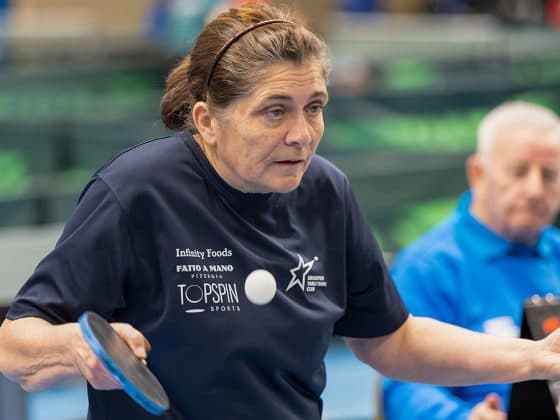
Teresa Bennett’s coaching week looks less like a timetable and more like a tour of where English table tennis is being held together. She works at High Down Prison, runs a pay-as-you-feel session at Fitz Cafe, leads after-school clubs, two women’s sessions, junior sessions, a 50-plus group, an adult disability session and work with a player who has complex needs. In Brighton, that range is not a side note. It is the model.
Breadth is the point
Bennett has built her coaching life around variety rather than a single lane, and that choice says as much about the sport as it does about her. The modern table tennis coach in a city club is no longer just a technical specialist feeding one pathway. In Brighton, the job is also social, rehabilitative and community-facing, with the coach moving between prisons, schools, cafés, disability sport and adult recreation without losing the thread.
That breadth matters because it keeps players in the sport at the moments when they are most likely to drift away. Bennett is not only introducing table tennis; she is meeting people where they already are, whether that is a school hall after class, a women-only session that feels welcoming enough for newcomers, or an accessible club night for adults who need a different kind of support.
A career built from the same club and many different rooms
Bennett’s route into that role started early. She first played table tennis at eight years old at Bexhill Youth Centre with her dad, Jim Bennett, and her brothers Stephen and Adrian. She began coaching at 18 while working in education, and later spent around 30 years as a PE teacher, a background that helps explain why she sees the game as something that can fit into daily life rather than sit apart from it.
Her service in Sussex has stretched across schools and Brighton Table Tennis Club, and it has included work with National Schools teams at internationals. That mix of school sport, club coaching and representative pathways gives her a wide lens on development: she has seen players when they are beginners, when they are learning habits, and when they are ready to test themselves beyond local sessions.

What Brighton TTC actually does
Brighton Table Tennis Club is built on the same principle Bennett carries through her own work. The club runs sessions for young people of all ages and backgrounds, those aged 50+, adults with learning disabilities, children in care, and at more than 10 schools and colleges. That is not a narrow performance structure with a few token community touchpoints. It is a broad operating system for the sport.
The club’s move into a second accessible venue in Moulescoomb in January 2025 made that ambition easier to scale. The venue was supported by a £250,000 grant from the London Marathon Foundation, with further support from Sport England, and it gave Brighton TTC more room to expand its community work across the city. In practical terms, that means the club can keep serving the people Bennett reaches in her weekly schedule, while also deepening the pathways that feed into those sessions.
Why women-only sessions and open access matter
One of the clearest signs that Bennett understands coaching as community-building is her women-only session at Brighton TTC. In 2021, Table Tennis England said that session had been successful in bringing new players into the sport and had already produced four volunteers who went on to become Level 1 coaches. That is the kind of outcome clubs chase but rarely get in such a direct line: participation leading to volunteering, volunteering leading to qualification, and qualification feeding back into the same club environment.
The lesson is bigger than one session. Women-only spaces, pay-as-you-feel access and disability sessions all lower different barriers, but they also do something else. They create continuity. A player who arrives for confidence can stay for belonging, then stay again because the coach knows how to adjust the pace, the group or the goal.
The prison work shows the wider value of the sport
Bennett’s work at High Down Prison gives her coaching profile real depth. Brighton TTC was reported in 2018 to have been running regular sessions there for 18 months, alongside UKCC Level 1 coaching courses for prisoners and staff. That report said the programme was credited with an 83 percent reduction in violence incidents among participating inmates, and that 11 prisoners completed their assessments with a 100 percent pass rate.
The prison work also sits inside a wider national research effort. Table Tennis England said in 2024 that it had partnered with HM Prison and Probation Service, backed by Sport England Small Grants from 2020, to pilot table tennis in prison sites and study its impact on psychological, social and physical wellbeing, especially after Covid. Professor Rosie Meek’s research drew on interviews with prisoners, prison staff and a community coach, underscoring that the game’s value in prison is being assessed as carefully as any other intervention. Bennett’s role in that ecosystem shows how a coach can become part of a rehabilitation framework, not just a sports programme.
Recognition that matches the scale of the work
Bennett’s influence has been acknowledged at the sport’s highest volunteer level. She won Coach of the Year at the 2023 Pride of Table Tennis Awards, and in 2025 she was named one of Table Tennis England’s new Vice-Presidents at the AGM. She also remains active in coach development, including a 2026 webinar with Brighton TTC head coach Pedro Santos on building a grassroots community.
That recognition makes sense because her work reaches both ends of the sport at once. More than 70 Brighton TTC members were signed up to travel to Paris in 2024 to support Will Bayley and Bly Twomey at the Paralympics, a reminder that the same club network serving children in care, adults with learning disabilities and older players also helps generate the atmosphere around elite Paralympic success.
Bennett’s career is a case study in how table tennis actually survives and grows. It is sustained in school halls, prison gyms, café sessions, women-only groups and accessible club spaces, then reinforced by a club structure that connects all of them. The sport’s future in Brighton is being built by coaches who can move across those settings without losing sight of the player in front of them.
This article was produced by Prism’s automated news system from verified source data, official records, and press releases, then run through automated quality and moderation checks before publishing. The system is built and supervised by the people who set the standards it runs under. Read our full AI policy.
Did this article answer your question?