How shakehand and penhold grips change table tennis strokes
Shakehand widens the court; penhold sharpens the forehand. A 27-player kinematic study shows why grip still changes reach, recovery and spin at the top.
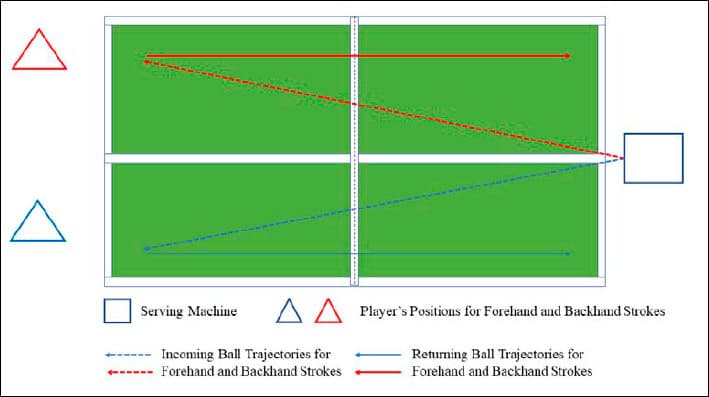
A grip in table tennis is not a style choice, it is a geometry decision. Shakehand gives players broader two-wing coverage, while penhold, the ITTF’s distinctive downward-pointing grip, turns the forehand into the main engine and makes the backhand corner a different problem entirely. In a kinematic comparison of 18 shakehand players and 9 penhold players, the same topspin or backspin ball demanded different body positions, racket angles and recovery steps depending on how the blade sat in the hand.
What the grip changes before the swing
The first difference is reach, and it shows up before the ball is even struck. Shakehand, the most common grip worldwide, usually gives a player a more symmetrical stance across forehand and backhand because the hand sits like a handshake around the handle. Penhold places the bat in a downward-pointing position, and that changes the arm’s geometry: the forehand can feel shorter and more direct, but the backhand side is less naturally covered.
That is why grip is not just about comfort. It changes wrist freedom, elbow angle and how quickly a player can switch from one wing to the other. A shakehand player can often recover to the middle with less reshaping of the forearm, while a penhold player may need to live closer to the table and manage the backhand corner with footwork, body turn or specialized technique. The difference is structural, not cosmetic.
What the kinematic study actually measured
The paper indexed in PubMed and PMC, published in the Journal of Sports Science and Medicine, compared forehand and backhand strokes while returning topspin and backspin balls. That matters because topspin and backspin are the two basic tests of control in the modern game: one forces the racket face to close and absorb, the other forces it to open and lift. Grip changes how naturally that adjustment happens.
The study kept the comparison clean. It included 18 shakehand players and 9 penhold players, and the table of group characteristics showed both groups had about 12 years of training experience on average, with similar age, height and mass. That makes the results useful for isolating grip mechanics instead of beginner inconsistency. When two groups of experienced players are built that similarly, the grip itself becomes the loudest variable on the table.
Reach, recovery and the backhand corner
Shakehand’s biggest practical advantage is coverage. It usually gives a player a broader map of the table, especially when the ball is driven hard into the backhand side or pulled wide after a deep crosscourt exchange. That is why so many modern stars, from Ma Long and Fan Zhendong to Timo Boll, Ding Ning, Liu Shiwen, Chen Xingtong, Wang Manyu, Zhu Yuling, Sun Yingsha and Mattias Falck, build their games around shakehand. The grip makes the backhand look stable, not like an emergency.
Penhold survives because it asks a different question: how much damage can you do before the opponent gets the chance to exploit the backhand gap? Historically, penhold has been tied to very strong forehand patterns close to the table, where the player can step in early, take the ball on the rise and keep pressure high. The trade-off is obvious in real rallies. If the ball is pushed wide or rushed deep to the backhand, recovery becomes harder and the player has less time to reset the body line.
That is why penhold often looks spectacular in the first two shots of a point and more complicated in the third and fourth. A player like Xu Xin has made a career out of stretching that model further than most, which is why ITTF coverage in 2018 described him as “a title away from being most successful of all.” The appeal is not nostalgia. It is the specific way penhold can turn forehand pressure into immediate offense when the player is quick enough to stay on top of the table.
Spin production is where the grip really shows
Topspin and backspin do not just change shot selection, they expose the hand position. A penhold forehand often gives the wrist more freedom to whip the blade through the ball, which can be a clean way to generate heavy spin close to the table. That same setup can also make backhand handling more demanding, because the racket face is not sitting in a naturally mirrored position.
Shakehand is less dramatic but more balanced. It lets players move between topspin and backspin receptions on both wings with fewer mechanical compromises, which is one reason it became the default in the modern elite game. When the ball changes spin quickly, the player with shakehand usually has an easier time keeping the racket angle consistent while adjusting only the amount of absorption or lift.
This is where the old stereotype gets too lazy. Penhold is not simply an antique grip, and shakehand is not just the safe option. The real difference is how each grip shapes the shot before contact: the amount of wrist available, the path of the elbow, the ease of body rotation and the speed of recovery after the stroke. In a live rally, those details decide whether the player controls the point or chases it.
Why penhold still matters at the top
The ITTF has been around since 1926, sanctions around 120 international tournaments yearly and had 227 member associations in its 2022 handbook and statutes material. In a sport that global, a grip can’t survive on tradition alone. It survives because it still wins points, and penhold still does enough things that shakehand does not.
That is why the federation’s own framing has shifted over time without ever fully writing penhold off. In 2016, ITTF coverage called it a “dying art” in a Rio Olympics context. By 2018, the same ecosystem was still writing about Xu Xin as one of the most threatening players in the game and using phrases like “battle of the pen-holders.” ITTF coverage in 2019 also described Kong Linghui as using the shakehand grip in “European mode” when he beat penholder Liu Guoliang, a reminder that grip is tied to style as much as nationality.
The deeper point is that table tennis is still built around competing geometries. Shakehand dominates because it covers more of the table with fewer compromises, but penhold survives because it compresses the game into a forehand-heavy, near-table style that can still overwhelm elite opponents. At the top level, the grip is not a fashion choice. It is the first tactical decision in the rally, and it keeps shaping what the best players can do next.
This article was produced by Prism’s automated news system from verified source data, official records, and press releases, then run through automated quality and moderation checks before publishing. The system is built and supervised by the people who set the standards it runs under. Read our full AI policy.
Did this article answer your question?