SummerSpike turns Coney Island beach game into premier roundnet event
SummerSpike turned Coney Island into roundnet’s ritual stage, with ESPN2, packed divisions, and a field that made the sport look fully grown.
SummerSpike stopped feeling like a beach stunt once it became a return date, a place people knew to circle on the calendar, and a broadcast worth putting on ESPN2. By the time the 2018 edition landed on the turf at MCU Park, the event still carried Coney Island’s DNA, but it had also crossed into something tighter and more formal: a premier roundnet stop with recognizable stars, defined divisions, and a stage built for spectators as much as players.
Coney Island gave roundnet its first real pilgrimage
The power of SummerSpike was never just the play. It was the setting, the repetition, and the way Coney Island made roundnet look like part of New York summer culture instead of a novelty on the grass. The 2018 tournament was the sixth iteration and, in Spikeball’s own framing, the longest-running roundnet tournament, a label that matters because it turns a young sport into a tradition with continuity.
That continuity became visible in the move from the beaches of Coney Island to the turf field at MCU Park just up the road. The switch did not erase the event’s identity; it sharpened it. Beach energy still hung over the weekend, but the new venue gave the competition a cleaner competitive edge, a better broadcast look, and the sense that roundnet was comfortable operating in a real sports facility.
Broadcasting changed the way the sport was seen
SummerSpike mattered because it was not the only roundnet event getting camera time, but it was one of the clearest examples of the sport breaking through to a wider audience. ESPN2 began airing Spikeball Roundnet Association tournaments in May 2018, and SummerSpike became the second Spikeball competition to air on ESPN. That kind of exposure does more than promote a weekend; it tells players the sport has enough texture, pace, and personality to hold television attention.
The date mattered too. ESPN2 aired the 2018 SummerSpike event on July 4, which gave the tournament a built-in summer sports slot and tied it to a holiday weekend when casual fans were already primed for outdoor spectacle. Roundnet had been created in 1989 by Jeff Knurek, but the modern push toward legitimacy came after Spikeball Inc. was founded in 2007 by Chris Ruder in Chicago. SummerSpike sat right in the middle of that transition, where backyard equipment became a branded circuit with an audience.
The field was big enough to show the sport’s depth
The most revealing part of the 2018 event was not the scenery, it was the size and spread of the field. SummerSpike drew 28 Premier-level teams, 18 women’s teams, 47 advanced teams, 64 intermediate teams, and 24 beginner teams. That mix tells you something important about roundnet’s structure: one weekend could host elite players and first-timers without flattening the sport into a single gear.
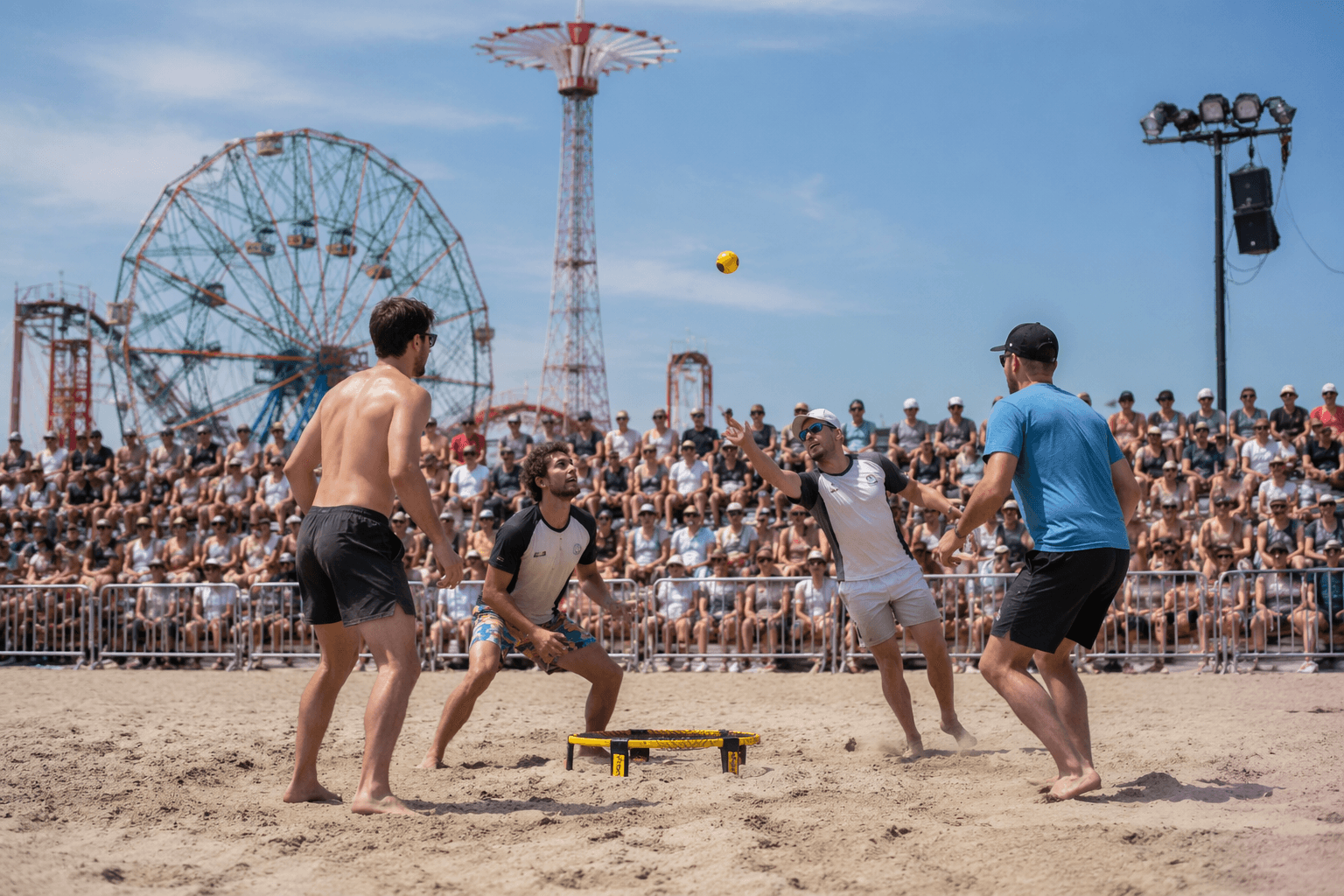
The names on the field made that structure feel real. Pairings such as Cisek/Showalter, Boles/Rouse, and Origin Vengeance gave the event actual competitive weight, the kind that lets fans follow lineups the way they would in any other sport. This is where roundnet started to separate itself from pure rec-league energy. The weekend had laddered divisions, known teams, and enough volume to make the top flights feel earned instead of decorative.
SummerSpike became a marker inside a bigger circuit
By 2019, Spikeball’s own tournament page was describing SummerSpike as the seventh annual tournament and the East Grand Slam. That language says a lot. It places the event inside a season-long competitive map, not just as a local beach gathering, and it gives Coney Island a role in the larger geography of the sport. In roundnet terms, SummerSpike was no longer a side quest. It was a destination.
The official 2019 page also leaned into the Coney Island identity with the boardwalk, the Cyclone, and Nathan’s Famous hot dogs, the kind of landmarks that turn an event into a ritual stop. That matters because roundnet was learning how to borrow the atmosphere of a place without losing its own identity. The sport did not need to pretend it was another mainstream game; it used Coney Island’s own shorthand for summer entertainment and made that part of its brand.
The structure behind the spectacle is what legitimized it
SummerSpike worked because the spectacle was backed by a competition format that looked organized from top to bottom. The Spikeball Tour Series’ official results page shows Nationals divisions stretching across Pro, Women’s, Youth, Premier, Advanced, Intermediate, Beginner, Masters, and Coed. That is not the profile of a fad. It is the profile of a sport building a ladder, one that can support newcomers, age-group players, and serious title chasers at the same time.
The International Roundnet Federation is pushing the same idea outward, building shared rules, rankings, and standards for international play. That is the logical next step for a sport that learned, at places like Coney Island, how much legitimacy comes from having a home, a calendar, and a recognizable atmosphere. SummerSpike made roundnet look like a real event before the rest of the sports world had fully caught up, and that is why it still reads like the moment the game became a destination.
This article was produced by Prism’s automated news system from verified source data, official records, and press releases, then run through automated quality and moderation checks before publishing. The system is built and supervised by the people who set the standards it runs under. Read our full AI policy.
Did this article answer your question?