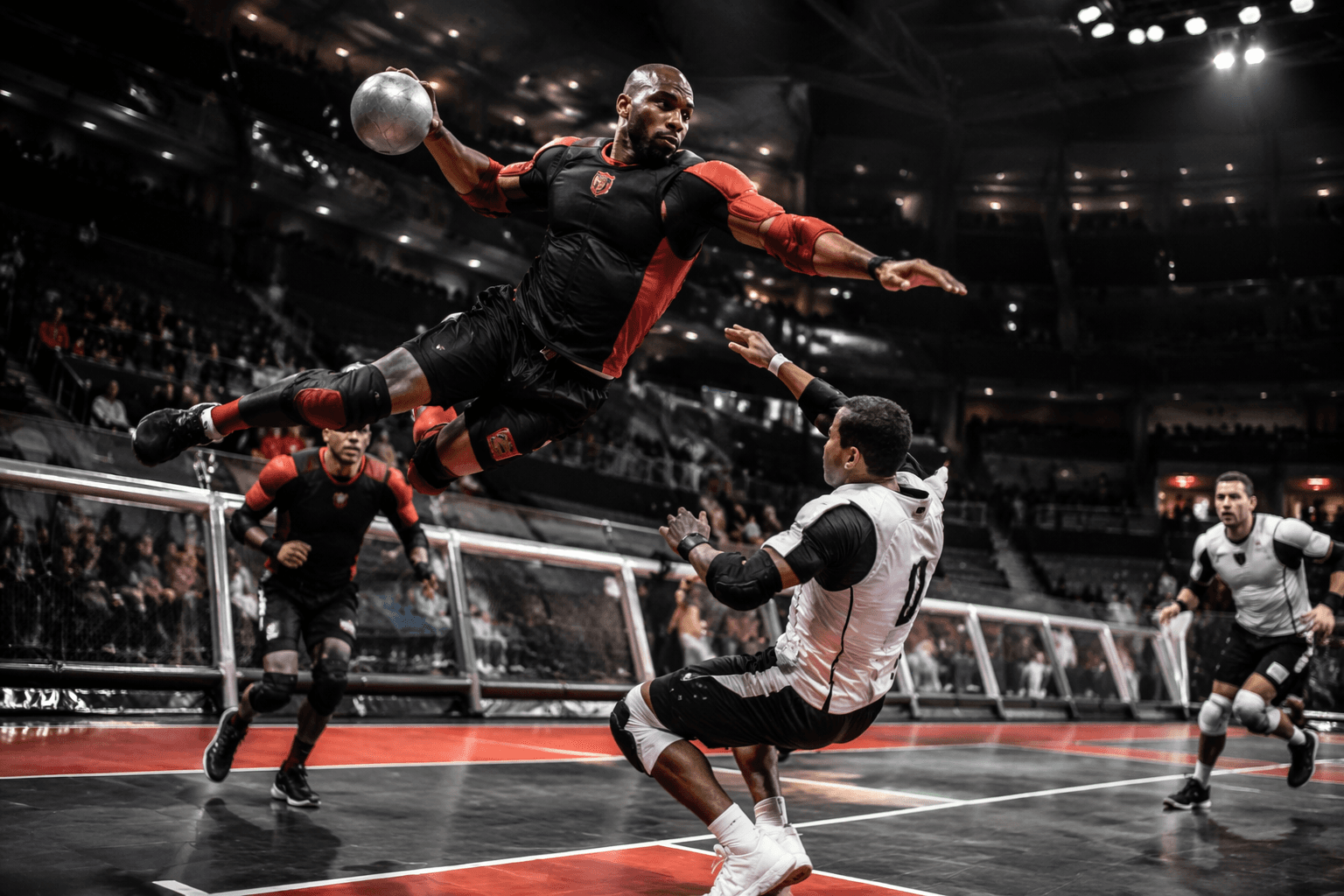
Indiana Native Nathaniel Harris Helps Lead SlamBall's Return
Hammond native Nathaniel Harris took a sister’s nudge, a Pacers trampoline tryout and a basketball path through IU-Northwest into SlamBall’s revival.

Nathaniel Harris gives SlamBall an Indiana accent. The Hammond native came up through Hammond High and IU-Northwest, played semi-pro basketball, then followed a sister’s nudge into a tryout for the Indiana Pacers trampoline team, a route that made the sport click in a different way.
Harris now serves as a handler for the Lava, a job that suits a player who spent years moving the ball in full-court basketball before learning to do the same thing on a spring-loaded floor. In SlamBall, the positions are stripped down but sharper than in the game Indiana fans know best: one handler, one stopper and two gunners. The responsibility is not just to create offense, but to think, react and reset on both ends before the next burst of action.
That background matters because SlamBall’s return has widened the kind of athlete it attracts. The league is back after a 15-year hiatus with eight teams, and Harris sits in the middle of that revival as proof that the sport rewards more than one athletic identity. Football players, basketball players and track athletes are all learning the same system at once, which is exactly what makes the league different from a traditional basketball setup. The game values players who can shift instantly between offense, defense and transition without the comfort of a normal dead-ball rhythm.
Harris says that turn helped him understand what SlamBall really sells. It is not only basketball skill translated to an unusual court. It is also the entertainment value of aerial play, the timing of rebounds and the willingness to attack space with every bounce. That is the logic behind the sport’s spring-loaded floor and four trampolines inside the arc, where full-contact play and legal goaltending on trampoline shots create the kind of explosive finishes that separate SlamBall from anything played on hardwood.
The scoring system pushes that style even further. Teams can score two-pointers, three-pointers, four-pointers from deeper range and three-point slam dunks, turning every possession into a calculation of speed, angle and body control. For Harris, the fit is obvious. Indiana raised him on basketball, but SlamBall gave him a new stage, one where the state’s trampoline roots and his own guard instincts meet in the same possession.
This article was produced by Prism’s automated news system from verified source data, official records, and press releases, then run through automated quality and moderation checks before publishing. The system is built and supervised by the people who set the standards it runs under. Read our full AI policy.
Did this article answer your question?