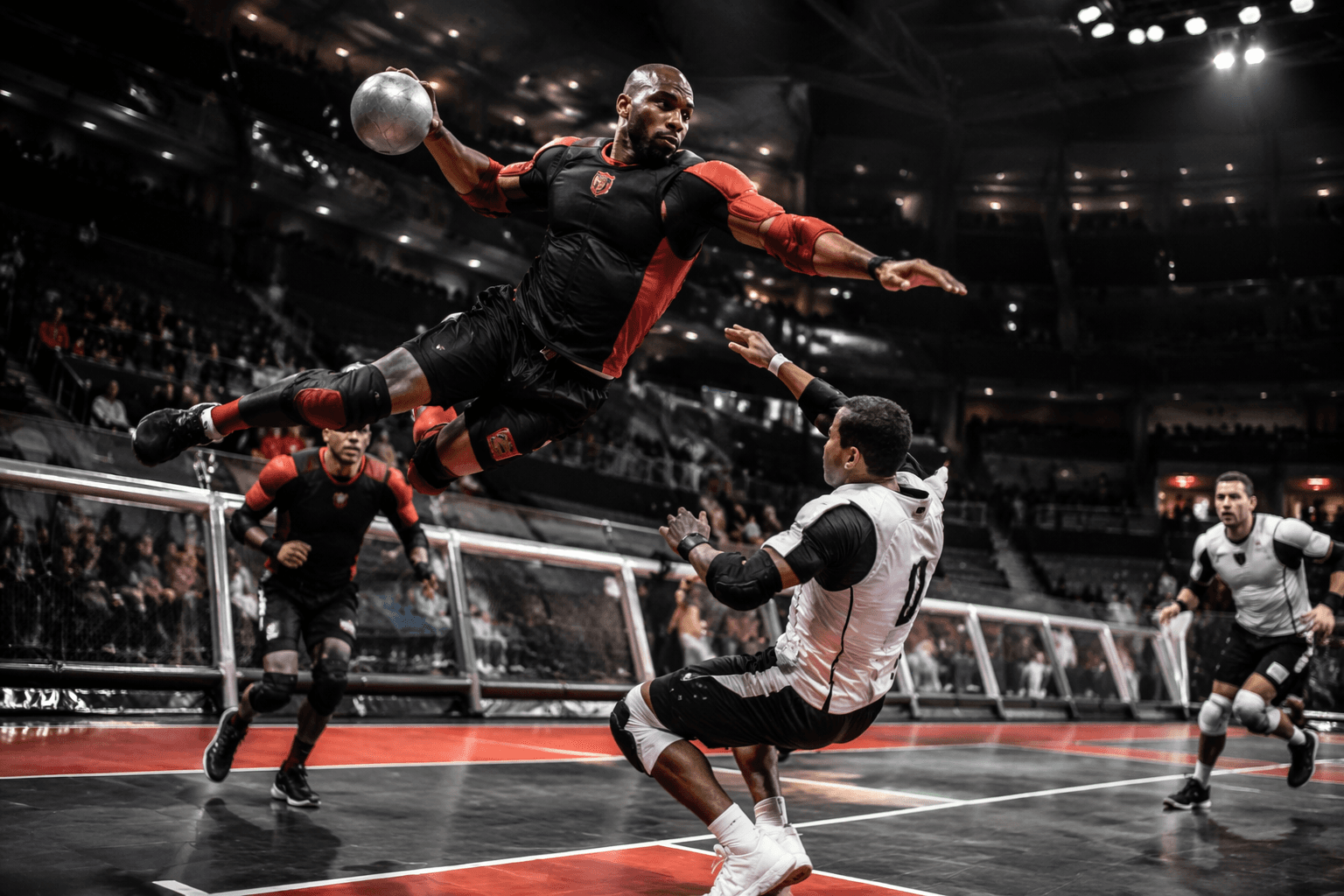
Mason Gordon Reboots SlamBall: China Training Turns Chaos to Skilled Spectacle
Mason Gordon rebuilt SlamBall from a raw, injury-prone spectacle into a coached sport by turning to structured training in China that teaches pure SlamBall skills.

A once-anarchic court of rim-rattling dunks and spring-loaded collisions is being taught how to land. Mason Gordon, creator of SlamBall, has pushed the sport away from ad hoc recruits and highlight-driven chaos toward a formalized athlete pipeline developed through training programs in China. That shift matters because it replaces improvisation with repeatable technique, improving safety and making the product easier to package for fans and broadcasters.
SlamBall’s rules remain a hybrid: basketball, football, and gymnastics meld on a springbed floor with four trampolines near each hoop. Players rotate among three defined roles - handler, gunners, and stopper - that demand distinct skills. Historically, Gordon admits earlier iterations were raw and sometimes violent, producing high-profile injuries that undercut credibility. The new approach focuses on fundamentals specific to the springbed game rather than importing basketball or football players and asking them to learn on the fly.
China programs supplied the curriculum and coaching framework that enabled the reboot. Coaches there built training progressions that scaffold aerial technique, contact timing, and landing mechanics; they established coaching staffs and drills tailored to the four-trampoline court. The emphasis on a graded progression aims to keep intensity while removing recklessness: athletes learn rebound timing on the trampolines, practiced ball-handling in traffic, and role-specific drills for gunners and stoppers. Stan Fletcher, long seen as a standout Slamball figure and now a coach and trainer, figures prominently in translating raw talent into teachable skills.
Performance analysis shows the payoff is twofold. Athletes emerging from the China pipeline arrive with repeatable timing and safer landings, producing cleaner highlights that still deliver the viral, social-media-friendly visuals that made SlamBall a cult sensation. The quality of play is less chaotic but more spectacular in a controlled way - big dunks executed with predictable outcomes rather than perilous gambles. That consistency is critical for in-arena product and televised packages where replay, commentary, and sponsorship activation require reliability.
Business implications are significant. Social clips and highlight reels already exist; Gordon’s challenge has been turning those clips into sustained attendance, media rights, and sponsorships. A coached athlete base makes SlamBall more investible by reducing the liability risk that scared off some partners in the past and by offering a coherent player-development story brands can support. Yet converting nostalgia into a paying, steady audience remains an uphill climb. The sport competes for attention in an attention-saturated media landscape and must prove it can deliver regular events with marketable stars.
Culturally, the China training pipeline signals a globalization of a niche American spectacle. It creates career pathways for athletes trained expressly for SlamBall and contributes to a new athletic vernacular - springbed timing, trampoline footwork, and gunner-to-stopper sequencing. For fans, the reboot promises the same high-flying thrills with fewer emergency-room storylines. For the sport’s future, the metric to watch is not just the next viral dunk but whether structured training yields consistent game nights, stable rosters, and the commercial deals that turn rebooted curiosity into a durable league.
This article was produced by Prism’s automated news system from verified source data, official records, and press releases, then run through automated quality and moderation checks before publishing. The system is built and supervised by the people who set the standards it runs under. Read our full AI policy.
Did this article answer your question?