Mason Gordon remains the creator behind SlamBall’s return to the spotlight
Mason Gordon’s 1999 napkin sketch still drives SlamBall’s rules, roster identity and high-flying chaos. The 2023 comeback put that vision on ESPN with eight teams in Las Vegas.

Mason Gordon is still the clearest thread tying SlamBall’s past to its present because he created the sport’s blueprint in 1999 and still serves as the league’s chief executive officer. He imagined a hybrid game that blended basketball, football, hockey and trampoline-powered aerial action, with players able to launch nearly twenty feet off the floor. That original design is not just background noise anymore. It is the reason SlamBall looks and plays the way it does, from collisions at the rim to rebounds off the glass and finishes that turn every possession into a possible highlight.
The league’s own history places the invention in 1999 and the first live version in Los Angeles, with Gordon and Mike Tollin credited as the original launch team. That matters because SlamBall has always needed a clearer author than most sports. Gordon gives it one. He also gives it a philosophy: this is a contact sport built around speed, bounce and air, not a novelty act built to survive on gimmicks alone.
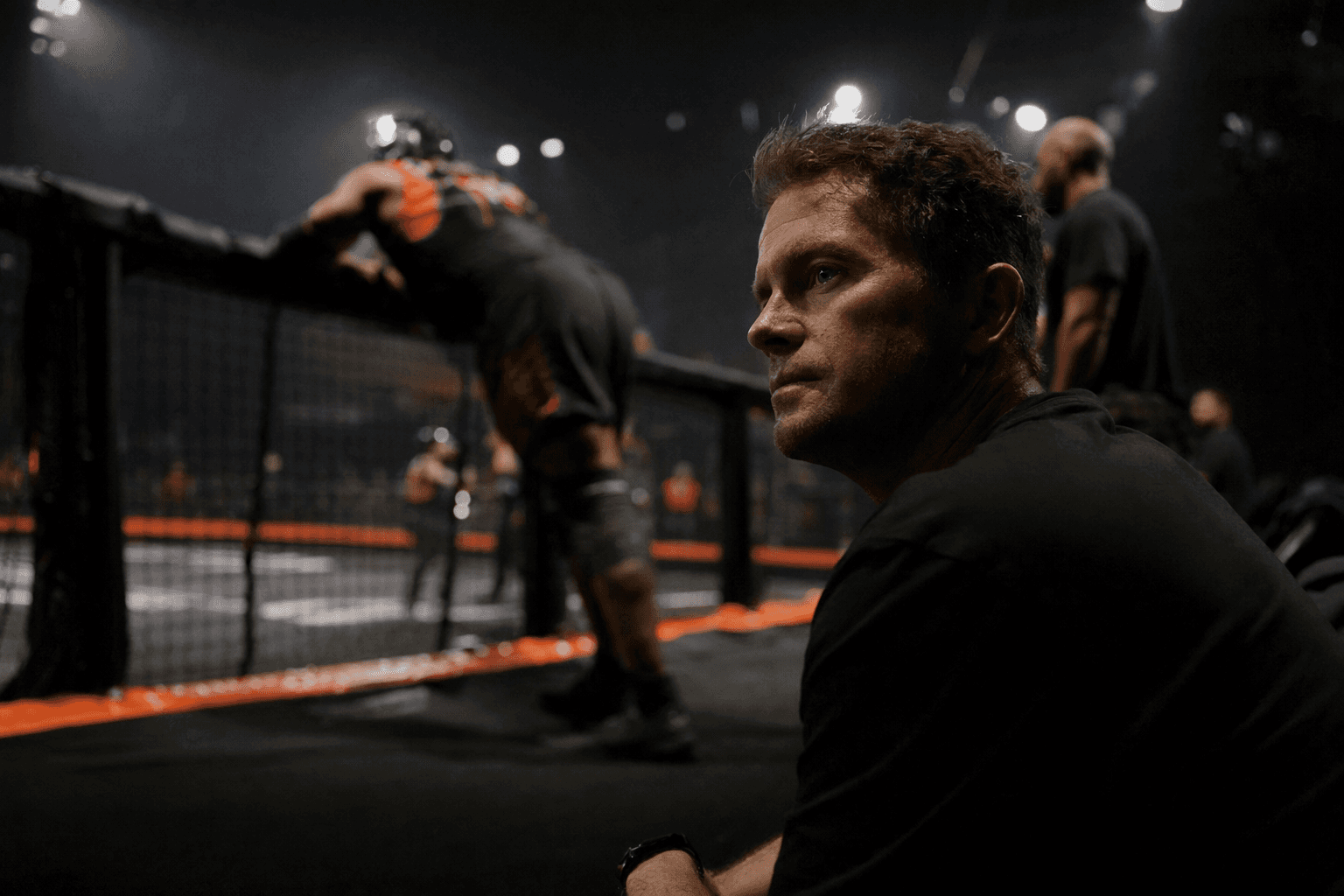
That identity was on display again when the league returned in 2023 after more than a 20-year absence. The relaunch ran from July 21 to Aug. 17, with every game staged at Cox Pavilion in Las Vegas and a championship week closing the run. ESPN carried the reboot under a two-year broadcast partnership, and the field included eight teams. Three legacy clubs, the Mob, Rumble and Slashers, came back alongside five additions, Buzzsaw, Gryphons, Lava, Ozone and Wrath. Michael Rubin and Blake Griffin helped finance the comeback, giving the sport a level of business muscle that matched its ambition.
But Gordon’s influence reaches beyond ownership and financing. He brought original warehouse players back as coaches and pushed the product toward a short-form, streaming-friendly format without stripping out the violence and verticality that made SlamBall distinct in the first place. In a 2011 ESPN profile, Gordon made the case that SlamBall was “a legitimate sport” and not a packaged entertainment product. He has also described it as “a legitimate sport that has its own rhythms, strategies, and concepts,” while insisting the players are “the very best in the world.” Those ideas still shape the floor: who fits, how teams defend the lane, and how the league sells speed as a competitive advantage.
The setting reinforces that message. UNLV describes Cox Pavilion as a multipurpose arena connected to the Thomas & Mack Center, and Gordon moved to Las Vegas in 2023 as part of the city’s sports surge, with Derek Stevens of Circa listed as a founding partner in the first SlamBall league. The comeback may use modern broadcast logic and newer team names, but the sport’s core remains Gordon’s original bet: that a real league could be built out of force, timing and altitude, and still feel new every time a player leaves the floor.
Know something we missed? Have a correction or additional information?
Submit a Tip