MaxAir Trampolines rose from garage startup to SlamBall supplier
A garage-built trampoline maker became SlamBall’s key enabler, proving that the league’s air time depends on engineering as much as athleticism.
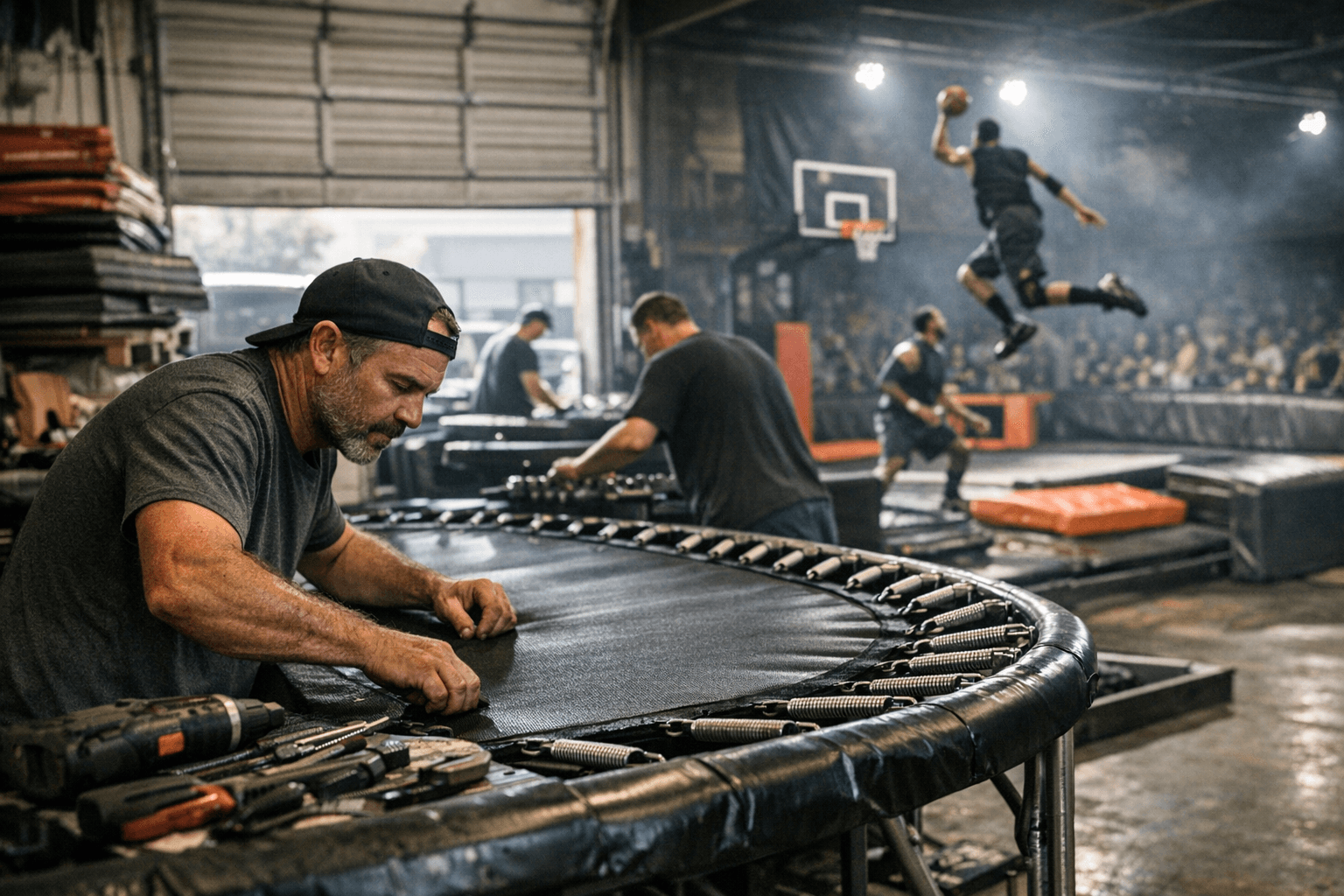
The hidden engine under SlamBall’s highlight reels
MaxAir Trampolines did not become part of SlamBall by accident. The company built its reputation on the unglamorous work of making rebounds predictable, durable, and safe, which is exactly what a sport built on collisions, vertical bursts, and controlled chaos demands. That is why the relationship matters so much: the league’s spectacle depends on equipment that can take repeated punishment without sacrificing performance.
SlamBall’s format makes the stakes clear. The game is played on a 96-foot by 64-foot court with springbeds built into each end, 10-foot rims, four players on the floor per team, seven-player active rosters, and four 5-minute quarters. It is a sport designed around lift and speed, but it only works if the trampoline surface responds the same way every time. In that sense, MaxAir is not just a supplier. It is part of the infrastructure that lets the game exist at all.
From Malaysia to Grand Rapids, and from curiosity to a company
The MaxAir story starts with Steven Chan, whose interest in trampolines was sparked as a young gymnast in Malaysia. He saw how much excitement one giant trampoline created when it was introduced at his training complex, and that reaction stuck with him. Years later, that early fascination became a business idea, and in 2010 he launched MaxAir in Grand Rapids, Michigan, out of a garage and with no guarantee the company would survive.
The first trampoline the team built reportedly took 400 hours. That number says a lot about the company’s origin story: MaxAir began as a craft operation, not a mass-production factory looking for a quick market. The early years were about learning how to build better, then building faster without losing quality, and only then thinking about how to reach customers far beyond Michigan.
That patient approach eventually paid off. By the time of the FOX 17 feature, MaxAir was shipping trampolines to every continent except Antarctica. The company had also placed its products in the homes of X Games and Olympic athletes, at trampoline parks such as Altitude Trampoline Park in Walker, and in training facilities that needed equipment sturdy enough to handle elite-level use. The business was scaling, but it was scaling because the product had proved itself in demanding environments.
Why SlamBall was the perfect proving ground
MaxAir’s biggest break, Chan said, came when the company became the official trampoline supplier of the SlamBall League. That partnership was more than a logo placement or a sponsorship line. SlamBall is built on a very specific set of forces, and the trampoline system has to support them all at once: explosive jump height, repeated impact, side-to-side contact, and enough consistency for players to trust every takeoff.
That is why high-performance string-bed trampolines matter so much here. In SlamBall, rebound is not a side feature. It is the engine of the sport, the thing that turns a hard sprint into a drive to the rim and a check into a launch. MaxAir’s engineering expertise fits that world because the league needs equipment that can deliver lift while keeping the action controlled, repeatable, and safe enough for players to attack the basket without hesitation.
The fit is also cultural. SlamBall itself was invented in 1999 by Mason Gordon, first played in Los Angeles, and later debuted on Spike TV in 2002-2003 before returning in 2023 after a long hiatus. It has always sold a mix of old-school contact and futuristic bounce. MaxAir’s trampolines sit in the middle of that identity, turning the league’s most recognizable visual effect into a product problem the company knows how to solve.
The craftsmanship behind scale, safety, and durability
MaxAir’s own history helps explain how it got there. Paul Hagan, the company’s co-founder, started gymnastics in 1975 at age 14 in Grand Rapids. He built his first trampoline in 1979 in his high school metals shop class, which is a detail that captures the company’s DNA better than any glossy marketing line could. This was a business born from hands-on experimentation, metalwork, and a willingness to keep refining what the market might eventually want.
In 2007, MaxAir says Steve Chan started working with Hagan, helping develop the 14-foot by 14-foot Super Quad in 2010 along with custom safety padding. That matters because the company’s rise was not only about bigger jumps, but also about safer, more controlled systems. In a sport or training environment where rebound is the product, safety padding and structural consistency are not optional extras. They are part of what makes the equipment usable for athletes, families, action-sports facilities, and training centers.
The 14-by-14 Super Quad marked a turning point in the trampoline world, according to MaxAir. Put together with the company’s later work for SlamBall, it shows a clear pattern: MaxAir was not simply selling trampolines, it was iterating on a specialized platform for high-performance use. That is the hidden story behind the brand’s growth. The company’s reputation came from solving hard design problems well enough that a league built around aerial contact could trust its product.
What MaxAir says about SlamBall’s future
The SlamBall partnership does more than validate MaxAir. It also helps explain why the league can keep building toward a broader footprint. A sport like this cannot scale on novelty alone. It needs dependable equipment, standardized performance, and a manufacturing partner capable of supplying venues, training sites, and athletes who expect the same response from every springbed.
That is where MaxAir’s broader market becomes important. A company that can build for elite athletes, family facilities, action-sports parks, and international training centers has the production discipline SlamBall requires. The league’s rebound-driven style is dramatic on camera, but behind that drama is a manufacturing standard that has to hold up in real life, game after game, jump after jump.
MaxAir’s rise from a garage startup in Grand Rapids to a global supplier shows how niche sports can reshape niche manufacturers, and vice versa. SlamBall gave the company a stage where its engineering could be seen, felt, and trusted. MaxAir gave SlamBall the equipment backbone needed to make vertical contact sports look effortless. Together, they show that in modern sports, the spectacle is only as strong as the infrastructure beneath it.
This article was produced by Prism’s automated news system from verified source data, official records, and press releases, then run through automated quality and moderation checks before publishing. The system is built and supervised by the people who set the standards it runs under. Read our full AI policy.
Did this article answer your question?