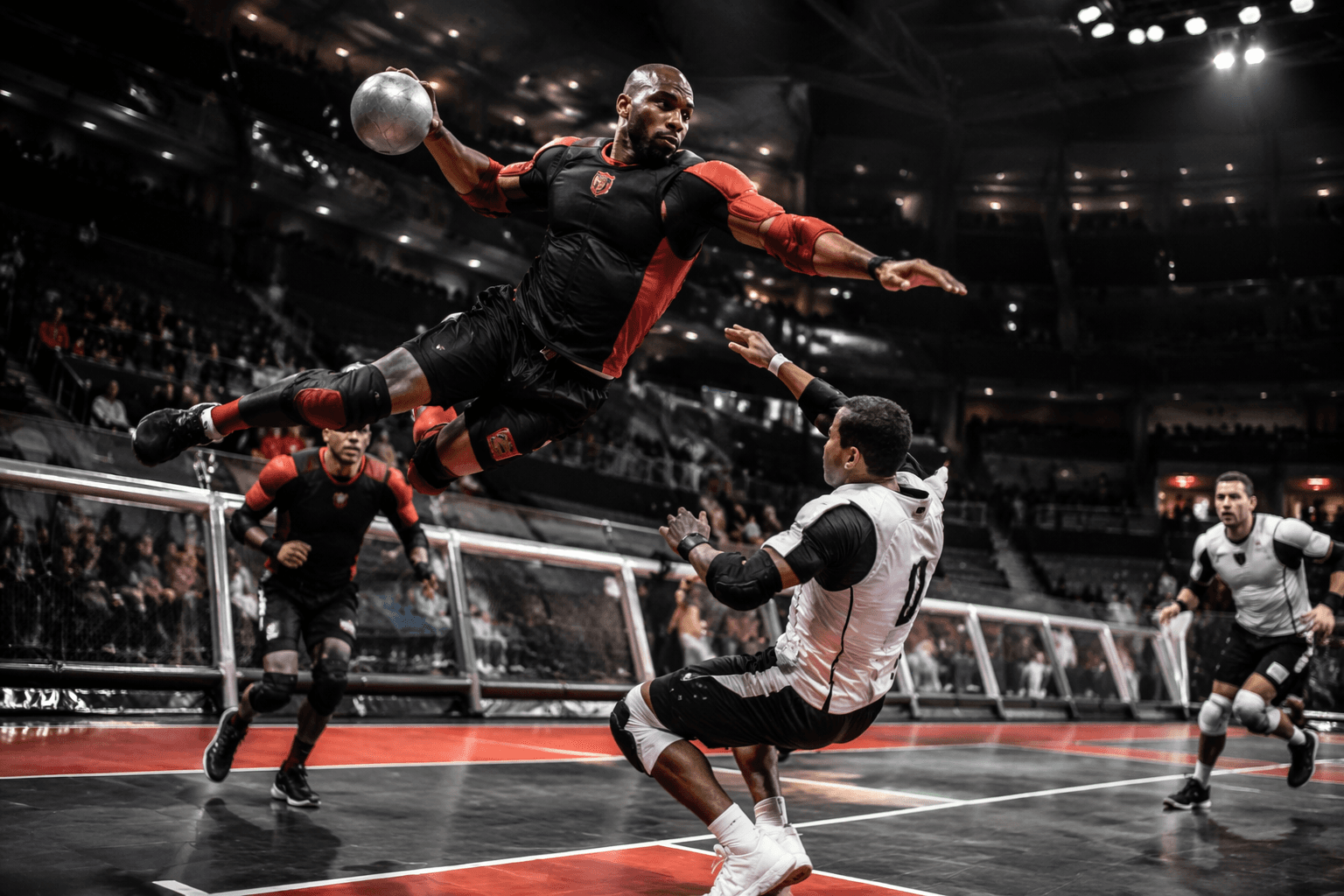
SlamBall rules reveal springbeds, four-point arc, and fast-paced chaos
SlamBall’s bed layout, four-point arc, and contact rules turn every possession into a vertical sprint. Once the island and the wall make sense, the chaos looks engineered.

The court is the sport
A SlamBall court is 96 feet long and 64 feet wide, and that tight footprint is the first clue that this is not basketball with a novelty prop bolted on. Each end of the floor holds three identical springbeds, while the fourth bed, the scoring bed, is slightly larger at 10 feet by 14 feet. Add the 8-foot plexiglass wall around the playing area, and the result is a game built to keep action alive, force angles, and punish any lapse in timing.
That layout changes everything. Players are not simply running sets on a flat floor, they are attacking vertical lanes, timing bounces, and controlling their bodies in the air. A missed read does not just waste a shot, it can turn into a rebound off the wall, a live-ball scramble, or a sudden transition the other way. The design explains why SlamBall feels fast even before the ball is thrown down.
Why spacing looks different here
The court geometry creates a style of spacing that has little in common with hardwood basketball. The springbeds create launch points, so defenders are not just guarding a dribbler or a shooter, they are guarding angles of ascent. Offense is often less about creating one clean perimeter look and more about finding the right moment to attack a bed, rise above the defense, and convert elevation into a scoring chance.
The current format also uses a 26.5-foot four-point arc, which changes shot value and stretches the floor in a way that rewards range as much as power. That extra point is not a gimmick; it is a pressure point. Defenders have to respect deep space while also tracking movement toward the beds, which means every possession has more depth than a standard half-court set. The sport is only partly about shooting. It is just as much about quick reads, vertical timing, and the ability to turn a bounce into a scoring opportunity.
How a possession really begins
The game is played in four 5-minute quarters, so the pace is already compressed before the action starts. Each half begins with a throw down, an inverse tip-off that requires the ball to reach its apex uninterrupted. That opening sequence sets the tone immediately: possession is earned through timing, not just possession of the ball.
There are four players on the court for each team, and each roster carries seven active players. Substitutions are hockey-style and can happen during play, which keeps the tempo high and the benches engaged. The island area between the springbeds is a no-contact zone, and improper contact there can trigger a face-off. That rule matters because it shapes how teams defend the middle of the floor. There is no free-for-all in the most dangerous part of the court, and that limitation is what keeps the game from dissolving into pure collision.
The timeout structure is just as compressed. Each team gets one timeout per game, and it can only be used in the fourth quarter. It lasts 45 seconds. In a sport this short and this fast, that is barely enough time to reset the board, which is exactly why strategy in SlamBall feels like a series of bursts instead of a long, grinding chess match.
Protection is part of the design
SlamBall’s mandatory gear is not an afterthought. Players wear elbow pads, knee pads, padded combat shirts, ankle-roll guards or ankle braces, and custom padded and fitted head gear at all times during official competition. The equipment is there because the sport asks athletes to launch, collide, land, and recover in a space where the next contact can come in the air or immediately after touchdown.
The league’s health and safety protocol goes further. It uses on-site certified athletic trainers, concussion evaluation procedures, daily health screenings, and a medical clearance requirement before a player can return to play or practice after a blow to the head. The seven-player roster is also backed by a four-player taxi squad, a reminder that injury planning is part of the competitive structure. In SlamBall, safety is not separate from the game. It is built into the architecture that allows the game to exist at all.
From warehouse experiment to broadcast property
SlamBall began in 1999, when Mason Gordon invented the sport in an L.A. warehouse. It first played in Los Angeles, then reached a national audience on Spike TV in 2002-2003. The league later returned to television through NBC Sports and CBS in 2008, proof that this was never just a one-off stunt. It has long carried the logic of a property with a real broadcast identity, one that can be packaged, relaunched, and explained through its own rules.
That context matters for the modern version of the league. The 2023 relaunch began July 21 at Cox Pavilion in Las Vegas, under an exclusive two-year ESPN broadcast partnership covering the 2023 and 2024 seasons. ESPN, ESPN2, and ESPN+ all carried the return, and the league opened with eight teams. Three legacy clubs, the Mob, Rumble, and Slashers, were joined by the Buzzsaw, Gryphons, Lava, Ozone, and Wrath.
The player pool reflected how the league recruits for its demands. SlamBall said it drafted 56 players with an average age of 26.9. Of those players, 68% came from basketball backgrounds, 16% from football, 9% from track and field, and 7% from multiple-sport backgrounds. Bryce Moragne went first overall, and Ken Carter, the coach whose story inspired Coach Carter, returned with the Rumble. That mix says a lot about the sport’s identity: basketball skill matters, but so do speed, force, and the ability to adjust to a surface that rewards explosiveness over comfort.
Why the rulebook is the real blueprint
Once the court, the island, the beds, and the clock are all understood, SlamBall stops looking like a novelty and starts looking like a system. Every inch of the floor matters because every inch affects how a player launches, lands, and survives the next collision. The rulebook is not just a list of restrictions. It is the blueprint for the sport’s pace, its contact, its spacing, and its highlight reel.
That is why SlamBall’s distinct style is so easy to recognize once you know what to watch for. The springbeds create the airtime, the wall keeps the chaos alive, the four-point arc stretches the defense, and the protective gear makes the violence playable. In SlamBall, the design is the drama.
This article was produced by Prism’s automated news system from verified source data, official records, and press releases, then run through automated quality and moderation checks before publishing. The system is built and supervised by the people who set the standards it runs under. Read our full AI policy.
Did this article answer your question?