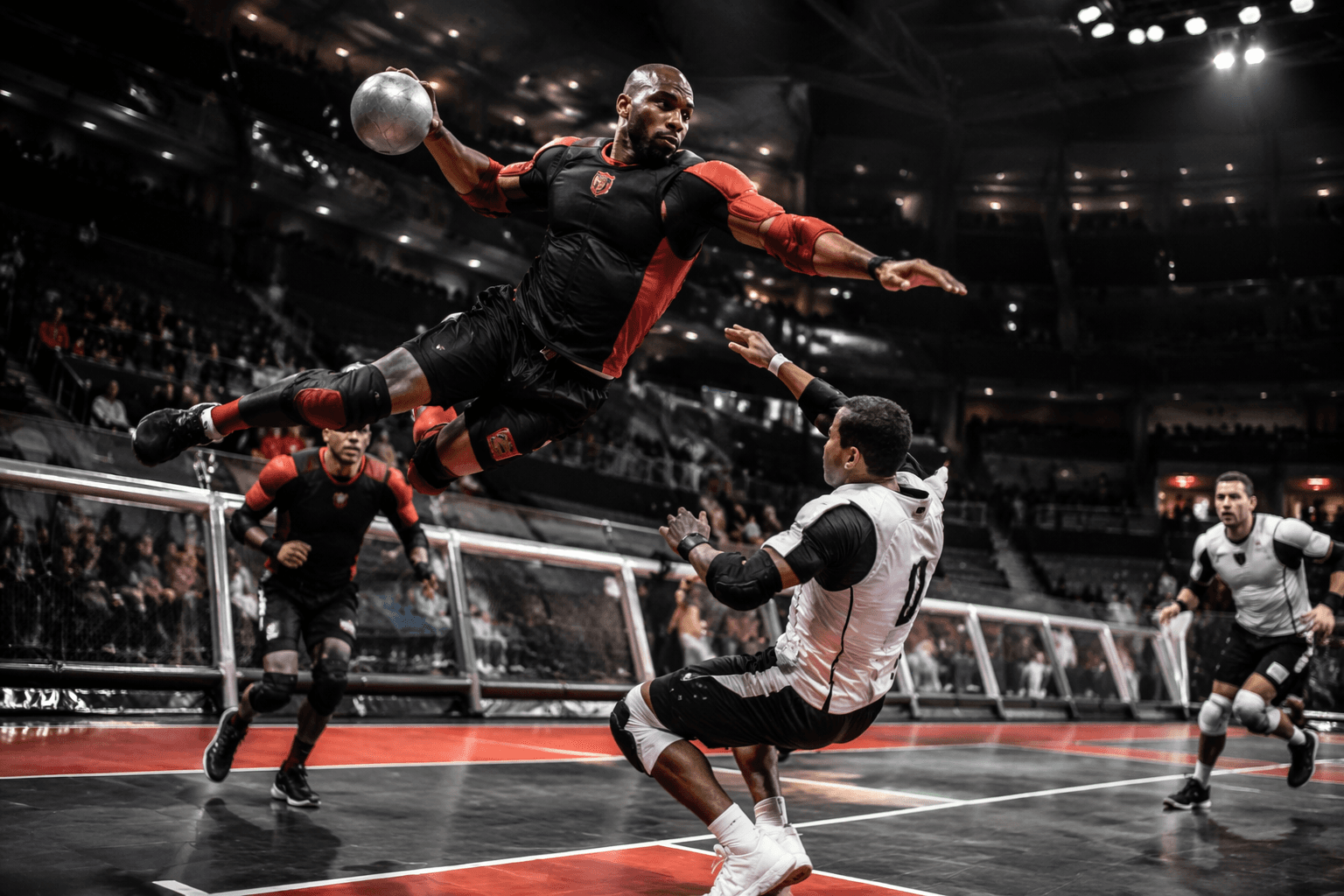
Tony Crosby II, shortest SlamBall player, brings elite dunking and leadership to Slashers
Tony Crosby II turns a 5-foot-6 frame into a SlamBall weapon, pairing a 52-inch vertical with captaincy and starter minutes for the Slashers.

The shortest player on the floor can still look like the biggest problem
Tony Crosby II is listed at 5-foot-6 and 175 pounds, but SlamBall has built him into something far more imposing than a size label suggests. The Slashers’ handler is not just surviving in a league of collision and elevation, he is turning his lift, timing, and flair into a competitive edge that makes him one of the sport’s most distinct personalities.
That tension between listed height and elite explosiveness is exactly what makes Crosby such a SlamBall fit. He was drafted in Round 4 of the 2023 SlamBall Draft, named captain of the Slashers, and then placed in a starter role alongside Bradley Laubacher, Alonzo Scott Jr., and Amir Smith. In a sport where possessions can flip in an instant, the league is betting that Crosby’s first step and finish at the rim can bend the game as much as any towering frame.
A dunker’s résumé built for SlamBall
Crosby’s appeal starts with the obvious number attached to him: a 52-inch vertical leap. That kind of spring is rare anywhere, and in SlamBall it becomes a structural advantage because the league rewards rapid space creation, air control, and fearless finishes above the rim. He was already the kind of athlete who could turn a half-opening into a highlight before he ever became a Slashers starter.
That reputation is not based on social-media flash alone. Crosby won the Quai 54 Dunk Contest in 2021, and Quai 54 bills itself as the world’s biggest streetball tournament with a high-flying dunk contest that draws elite dunkers. That background matters because it shows Crosby can perform in a setting where creativity, nerve, and execution are all under pressure. In SlamBall, those same traits translate directly into production.
His YouTube profile reinforces the same identity. Crosby describes himself as a former Division I high jumper and current professional dunker at only 5-foot-6, and says he has competed in dunk contests in France, Switzerland, Venezuela, and more. That international dunk circuit gives him a different kind of credibility in the league: he is not just a novelty-sized athlete, but a specialist who has spent years refining how to attack the rim from unusual angles.
The college track background explains the lift
Crosby’s SlamBall value makes even more sense when you trace it back to Grand Canyon University Athletics. His track-and-field resume shows a true jumping base, not just dunk-contest theatrics. He finished second at the WAC Outdoor Championships in the high jump with a 2.02-meter leap, finished fifth at the WAC Indoor Championships, and set a personal best of 7.00 meters in the long jump at the Steve Scott Invite, where he placed ninth overall.
That combination of high jump and long jump is important because it suggests more than bounce. It points to approach speed, body control, rhythm in the air, and landing mechanics, all traits that matter in a sport built around spring-loaded contact and sudden elevation. Crosby’s movement profile helps explain why he can operate in tight seams, rise quickly, and still finish cleanly when defenders think they have taken away the angle.
For SlamBall, that is a valuable athlete archetype. The league rewards players who can turn a small runway into a scoring opportunity, and Crosby’s track background gives him the biomechanics to do exactly that. He is not simply jumping high; he is doing it in a way that fits the timing and chaos of the sport.
Why the Slashers trust him as a leader
The Slashers’ usage tells the clearest story of all. SlamBall’s team page lists Crosby as a starter in the handler position, and the roster page places him in the first unit with Laubacher, Alonzo Scott Jr., and Amir Smith. At the same time, the squad page and player stats page show he is an active rostered player, which matters because his value is not symbolic. He is in the rotation, on the floor, and part of the core structure.
That trust extends beyond the lineup card. Despite being a fourth-round pick, Crosby was named captain of the Slashers. In a league that often gravitates toward larger bodies and force-first reputations, that is a meaningful vote of confidence. It suggests the staff sees him as a tone-setter, not merely a showman. The captaincy also fits the way he plays: fast, decisive, and willing to impose momentum with one explosive possession.
The Slashers’ roster construction makes his role even more striking. With handlers, gunners, and stoppers filling different lanes of responsibility, Crosby’s job is to create offense without losing the edge that keeps the team moving. In that system, his burst becomes a tactical weapon, not just a crowd-pleaser.
The 26-point night that turned the profile into proof
The strongest evidence that Crosby’s profile is real came in live action at Cox Pavilion in Las Vegas, Nevada. SlamBall described him as a “5-foot-6 mighty mite” after he scored a season-high 26 points, threw down six dunks, and led the Slashers to a 64-56 win over the Rumble. That performance matters because it showed the difference between a compelling bio and a player who actually changes outcomes.
Six dunks in one game is not window dressing. It is a statement about how often Crosby can turn pace into points and lift the Slashers in games that demand energy and urgency. The 64-56 result also underscores how quickly a high-flying finisher can swing the balance of a close contest. When Crosby is producing at that level, the Slashers are not just getting style points, they are getting a reliable engine for pressure offense.
The business and cultural value of that kind of player is obvious. SlamBall sells action, personalities, and identifiable physical contrasts, and Crosby delivers all three at once. He is short by league standards, but explosive enough to dominate highlight packages, experienced enough to earn a captaincy, and productive enough to anchor a starting role. That combination is exactly why he stands out in a sport that rewards athletes who can make the impossible look repeatable.
What Crosby means for SlamBall’s future
Crosby’s rise says something important about where SlamBall can go as a product. The league does not need every star to fit a traditional basketball prototype. It can build around athletes whose value comes from functional explosiveness, aerial confidence, and the ability to generate spectacle without sacrificing output. Crosby is proof that a 5-foot-6 player can be a matchup issue when the jump is elite and the timing is ruthless.
He also gives the Slashers a face that travels beyond the court. The dunk-contest pedigree, the international competition history, the track-and-field foundation, and the captaincy all create a player story that feels bigger than one roster slot. In a league that thrives on moments above the rim, Crosby has become one of the clearest examples of how size can be reframed when athleticism, leadership, and showmanship all point in the same direction.
For the Slashers, that makes him more than a starter. It makes him a signature piece, a player who can tilt a game with one takeoff and define a team’s identity with the confidence to keep attacking.
This article was produced by Prism’s automated news system from verified source data, official records, and press releases, then run through automated quality and moderation checks before publishing. The system is built and supervised by the people who set the standards it runs under. Read our full AI policy.
Did this article answer your question?