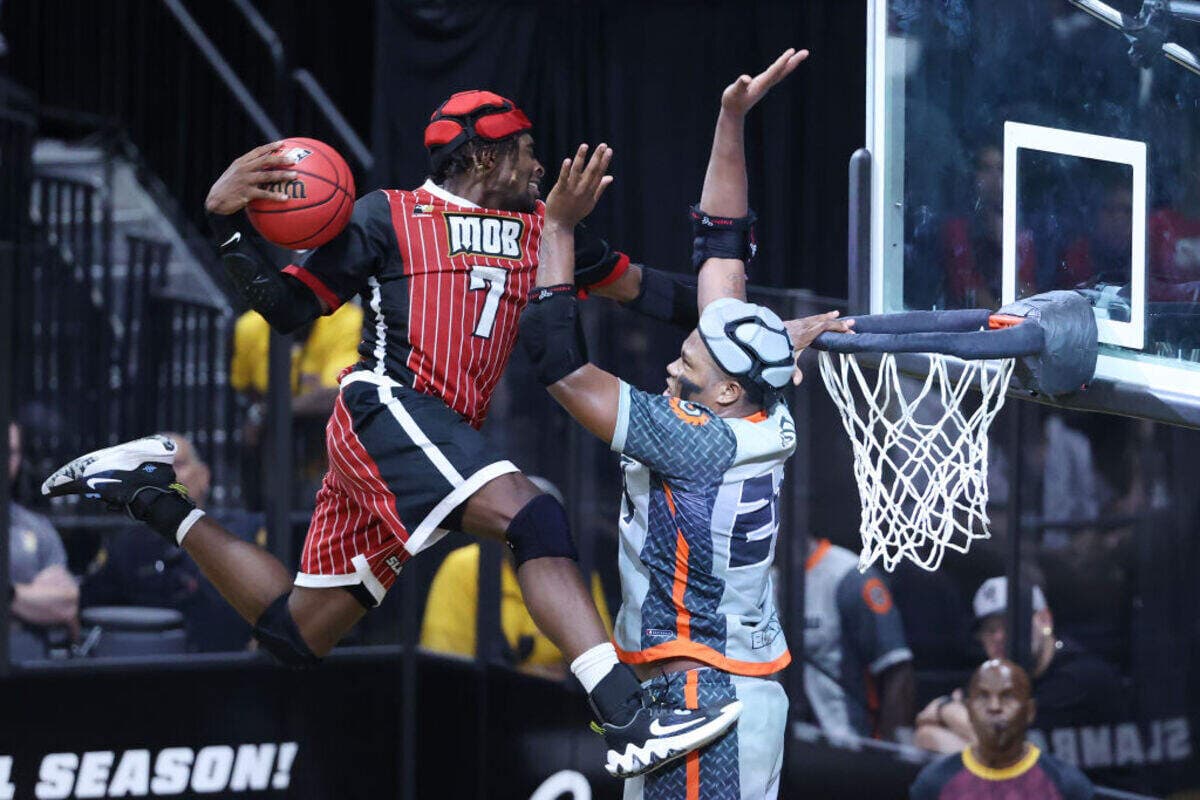
Paxton Henry's track jumping background boosts Lava's SlamBall upside
Paxton Henry brings a four-year jumping base to Lava’s handler spot, and his WAC peak hints at the air-born upside SlamBall rewards.

Paxton Henry is listed as #14 handler for Lava. He spent four years as a standout jumper at Grand Canyon University, with a track and field background built on takeoff, timing, and control in the air. SlamBall is one of the few leagues where those skills can translate directly into live possessions.
Why Henry fits Lava’s handler role
Henry is not being framed as a pure finisher or a novelty athlete; he is listed as a handler, which means Lava is trusting him with ball handling, spacing, and decision-making in a game that never gives you much time to settle in. In SlamBall, the floor changes the math. Bounces are different, angles are tighter, and a player who can process space while moving through the air has a real chance to create value.
That is where Henry’s track profile becomes more than background color. A four-year jumper brings explosion off the line, body control at the apex, and the ability to land and reset without losing balance. On a trampoline-enhanced court, those traits can turn into possessions won.
The track résumé explains the ceiling
Henry appears on Grand Canyon University Athletics' track and field roster. This is not just an athlete who dabbled in another sport. The background suggests sustained development rather than one flashy season or a one-off conversion project.
His best work came at the WAC Championships in his senior year. Championship settings compress decision-making, reward timing, and expose athletes who can rise when the rounds get shorter and the pressure gets sharper. Henry’s ability to peak there suggests more than raw lift.
TFRRS records place Henry in the WAC Indoor Track & Field Championships and on Grand Canyon men’s all performances and rankings pages. The background comes with conference results, roster status, and measurable competition history.
What a jumper can actually do in SlamBall
A lot of crossover talk in this league gets lazy fast. People hear “jumper” and immediately jump to dunk potential. That sells the sport short and misreads Henry’s value. The more interesting part is how a jumper’s mechanics map onto a handler’s job.
A track jumper already understands how to generate force quickly, how to keep the chest quiet while the legs fire, and how to stay efficient in the air. Those are useful tools when the handler has to gather a pass, read a defender, and make the next move before the possession collapses. SlamBall does not reward straight-line speed alone; it rewards athletes who can manipulate their bodies in compressed space.
For Lava, that creates a different kind of upside. Henry does not need to be a traditional basketball creator to matter. If he can carry the ball, survive contact, and turn his aerial base into cleaner routes to the rim or sharper reads in transition, he gives the team an option that standard basketball scouting might overlook.
Why this profile fits SlamBall’s recruiting logic
SlamBall keeps casting outside the usual basketball lane. The league is built for athletes whose best skills may not have found a full outlet elsewhere, and that is exactly where a four-year jumper can become a functional piece. The value is not just athleticism in the abstract. It is whether that athleticism can be attached to a role.
A player like Henry expands the range of what a lineup can look like because he brings a movement foundation that is unusual even by SlamBall standards. The league can afford to be creative when the environment itself is unconventional. A handler who can play above the floor changes how pressure is applied, how lanes open, and how quickly a possession can turn into a scoring chance.
Lava may be buying into the kind of game-state value that comes with championship track competition. A player who handled the demands of that setting has already shown he can prepare, peak, and execute in a high-leverage setting. In SlamBall, momentum can swing two or three times in a single sequence.
This article was produced by Prism’s automated news system from verified source data, official records, and press releases, then run through automated quality and moderation checks before publishing. The system is built and supervised by the people who set the standards it runs under. Read our full AI policy.
Did this article answer your question?