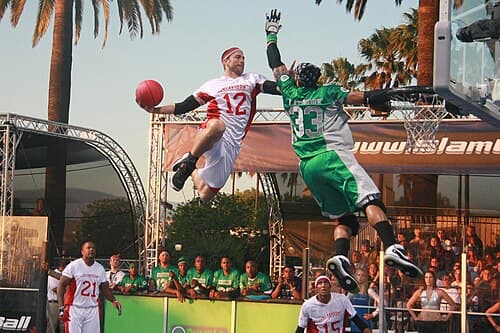
SlamBall Coaches Prioritize Verticality, Aerial Control, and Contact Conditioning
Three training pillars separate SlamBall's elite finishers from everyone else: verticality mechanics, aerial body control, and contact conditioning that converts midair chaos into scored possessions.
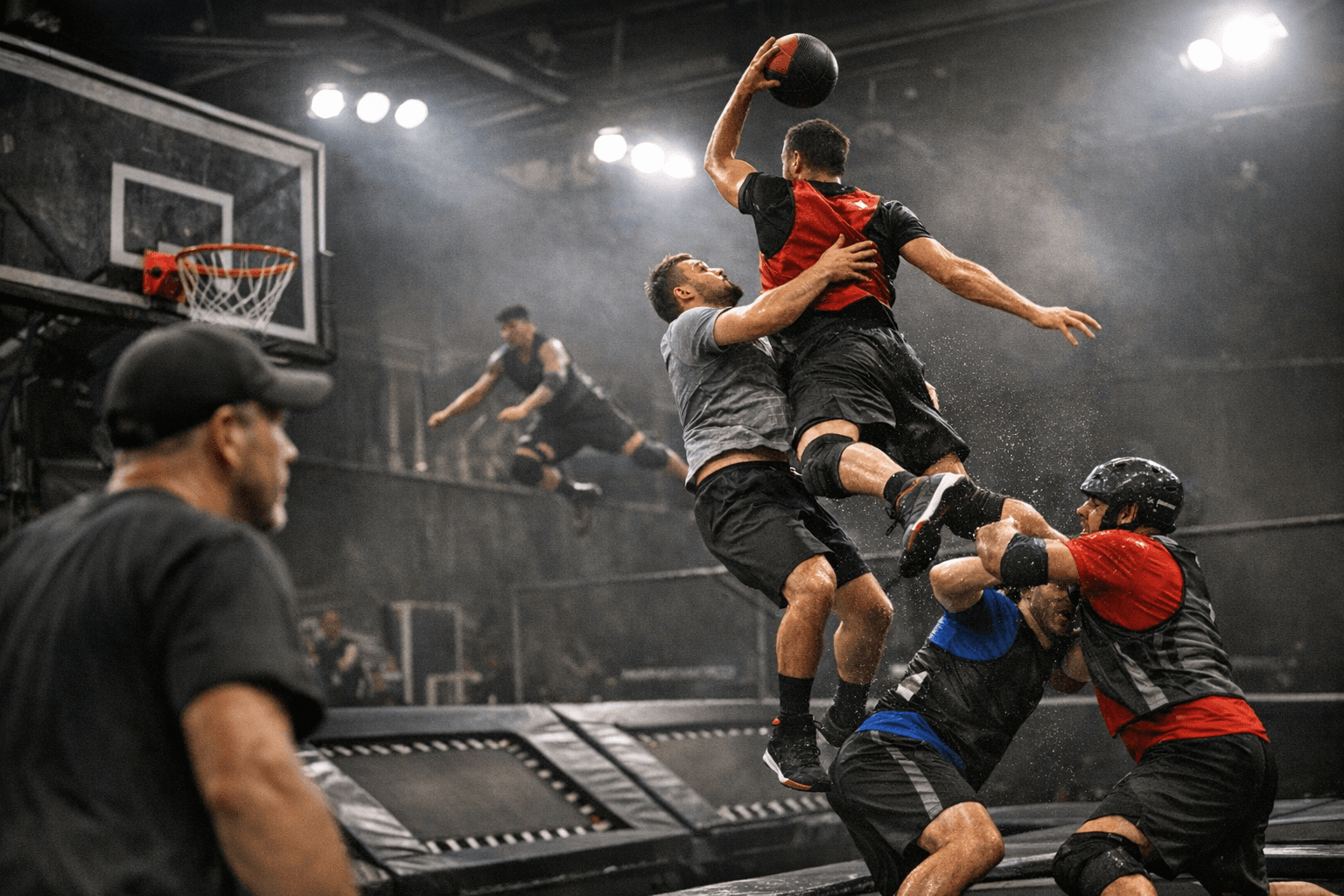
Picture the sequence that stops a scroll: an athlete hits the trampoline pad, loads in a fraction of a second, and launches skyward. At the apex, a defender's shoulder arrives. The finisher absorbs the hit, locates the rim, and hammers through for three points on the way down. Clean landing. Crowd gone. That play doesn't happen by accident, and it doesn't happen from raw athleticism alone. It is engineered across three specific training pillars that modern SlamBall coaching staffs have moved to the center of their programs: verticality mechanics, aerial body control, and contact conditioning. Reverse-engineer any great SlamBall highlight and you'll find all three operating together inside a window that lasts fewer than three seconds.
Why SlamBall Demands a Different Training Language
Traditional basketball never asks an athlete to internalize trampoline rebound timing, complete a finishing motion while inverted, or absorb a legal shoulder hit at six feet of air. SlamBall asks for all three, and the sport's format compresses those demands mercilessly. Four five-minute quarters, a 20-second shot clock, and live hockey-style substitutions create a possession structure that rewards reliable aerial finishers over everything else. Legal goaltending on trampoline shots and waist-to-shoulder contact rules add collision vectors that exist nowhere else in organized basketball. The result is a sport whose physical preparation requirements sit at the intersection of gymnastics, football, and plyometric training, and coaching staffs that treat it like standard basketball are leaving highlight-grade plays, and points, on the floor.
Pillar 1: Verticality Mechanics
The foundation is measurable before it is trainable. Coaches should establish baseline vertical output using two protocols: the countermovement jump (CMJ), which captures elastic energy contribution and reactive strength, and a scaled box-jump test with height calibrated to athlete size. From that baseline, training targets three mechanical components in sequence: loaded step patterns, single-leg eccentric control, and the forced arm-swing sequence that bridges gym results to in-game lift.
The arm-swing drill is the most transferable piece. Athletes bring both arms fully behind the hips before driving them upward in a coordinated arc timed to the jump. The cue progression drawn from Darius Clark, whose world-record vertical was built on repeatable mechanical simplicity, reduces it to three words: lower, plant, jump. Toe-finish emphasis, meaning full triple-extension through the ankle at takeoff, converts the arm-swing energy into maximum vertical displacement. Together, these cues are simple enough to hold under fatigue, which matters when an athlete is hitting the trampoline for the fourth time in a 20-second possession.
Volume structure across the week should separate motor patterning from maximal output. Submaximal box jumps build the pattern; one maximal attempt per microcycle preserves central nervous system readiness without degrading recovery across a condensed schedule.
Pillar 2: Aerial Body Control
Getting high enough is table stakes. Controlling what happens at the top of that arc is where possessions are won. Orienting the body, locating the rim, and manipulating the ball in under half a second requires spatial awareness that can only be developed through gymnastics-informed progressions, not vertical work alone.
Drill sequences begin on low-height trampolines and progress to full SlamBall pad surfaces that match competition bounce characteristics. This matters more than it sounds: the league's move toward standardized trampoline response means athletes can internalize rebound timing and body position rather than compensating for surface variation between venues, making the training more predictive of in-game output. Spotter-assisted inverted positions teach spatial orientation under unfamiliar body angles early, before athletes are responsible for managing that awareness independently under contact. Quick-release landing progressions build proprioception so the floor registers without the athlete searching for it. Targeted core bracing sequences reduce rotational overshoot during contested slams, which is the mechanical root cause of most near-miss finishes when a defender arrives at the apex simultaneously.
The sequencing is not negotiable. Rushing athletes to full-height aerial work before proprioceptive foundations are established produces injury exposure and mechanical habits that are far harder to correct once competition pressure is added.
Pillar 3: Contact Conditioning and Safe Finishing
SlamBall's contact rules create a specific physical preparation problem. Waist-to-shoulder contact is permitted, legal goaltending on trampoline shots sends defenders into the same aerial coordinates as finishers, and the collision geometry this produces has no analog in traditional basketball conditioning. Strength and conditioning plans must therefore address neck and upper-back reinforcement, deceleration drills from aerial heights, and shoulder integrity work calibrated to keep finishing mechanics intact through legal contact.
The scripting of contact exposures is where most programs either invest or fall short. Small-group scrimmages should be designed so that athletes complete slam attempts while absorbing controlled shoulder and torso hits, with intensity scaling gradually under coach supervision. The 0-to-3-second window an aerial possession occupies is short enough that untrained athletes will sacrifice finishing mechanics to protect themselves the moment contact arrives. Conditioning the body to complete the motion reflexively, even when hit, is what converts physical preparation into three points on the scoreboard. Every contact rep should replicate that window as precisely as possible.
Testing, Scouting, and Converting Training to Game Output
Combine testing for SlamBall needs to look different than traditional basketball evaluations. The testing stack should pair CMJ and box-jump vertical metrics with aerial control assessments, specifically trampoline landing accuracy scored against a target zone and midair pass completion to fixed targets, plus contact resilience evaluations that measure whether an athlete finishes a slam attempt under load. These categories map directly to the sport's scoring structure, where three- and four-point slams drive both scoreboard outcomes and broadcast value simultaneously.
In-practice tracking metrics give front offices concrete KPIs: loose-ball recoveries, contested stop percentages, and successful rim-through slams in live scrimmage. Small improvements in these numbers compound across four compressed quarters. Standardizing trampoline and rebound measurements across practice facilities ensures those KPIs are portable across venues rather than artifacts of a single gym's bounce profile.
Weekly Drill Menu
- Verticality block:*
- Session A: CMJ baseline check + forced arm-swing drill (3 sets, 5 reps, maximal intent); log height against prior week
- Session B: Loaded step patterns + submaximal box jumps (4 sets, 8 reps at 70% effort) for motor patterning
- Session C: Single-leg eccentric control work + one maximal box-jump attempt per athlete for CNS loading; record and compare
- Aerial control block:*
- Session A: Low-height trampoline orientation with spotter (10-minute block); focus on spatial cues, not height
- Session B: Quick-release landing progressions + core bracing sequences (15-minute block); target landing within a 12-inch circle on 8 of 10 attempts
- Session C: Full-height pad work with spotter, ball-finish integrated at apex; evaluate rotational overshoot
- Contact conditioning block:*
- Session A: Controlled shoulder-contact scrimmage at 50% intensity while completing slam attempts
- Session B: Deceleration drills from aerial heights + neck and upper-back reinforcement circuits
- Session C: Live small-group contact scrimmage at 75-85% intensity with live substitution rotations
Measurable Benchmarks Checklist
- Rebound-to-takeoff consistency: under 0.3-second ground contact variance across 10 consecutive trampoline jumps
- Midair body control: land inside a 12-inch target circle on 8 of 10 trampoline attempts
- Contact tolerance: complete a legal slam finish on 7 of 10 attempts while absorbing a controlled shoulder hit
- Vertical progression: track CMJ and box-jump scores every four-week microcycle to confirm adaptation trends
- In-game conversion: monitor rim-through slam percentage and contested stop rate as primary game-value KPIs
The coaching staffs building all three pillars together, with repeatable cues, standardized measurements, and scripted contact exposures, are the ones producing the athletes who land on highlight reels and on the right side of the final score. In a sport defined by what happens in three seconds of air, the preparation that happens on the ground is everything.
This article was produced by Prism’s automated news system from verified source data, official records, and press releases, then run through automated quality and moderation checks before publishing. The system is built and supervised by the people who set the standards it runs under. Read our full AI policy.
Know something we missed? Have a correction or additional information?
Submit a Tip