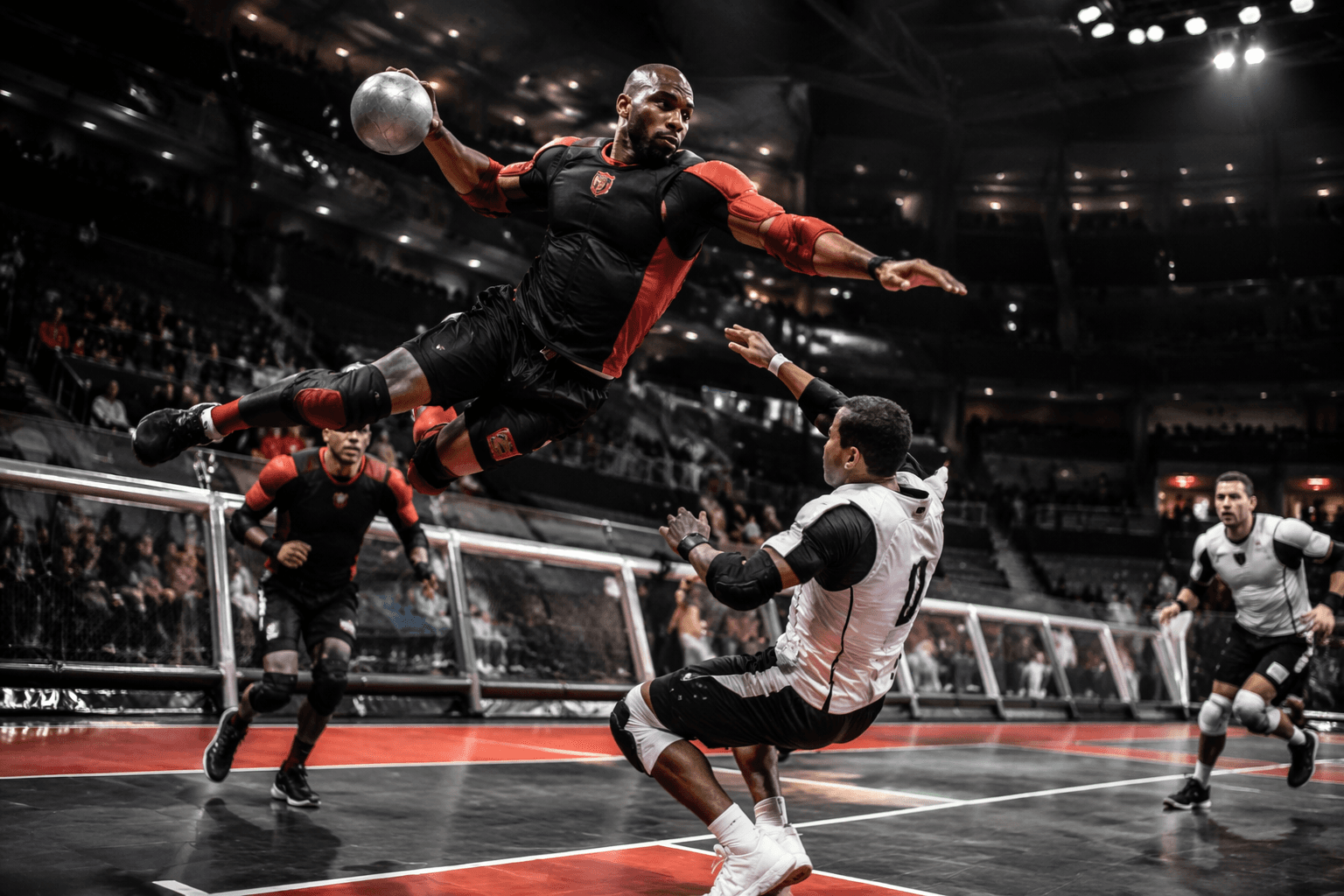
SlamBall Demands Explosiveness, Toughness, and Aerial Skill From Its Athletes
SlamBall athletes need three things most sports never combine: trampoline-powered explosiveness, full-contact toughness, and aerial body control precise enough to finish a dunk mid-collision.
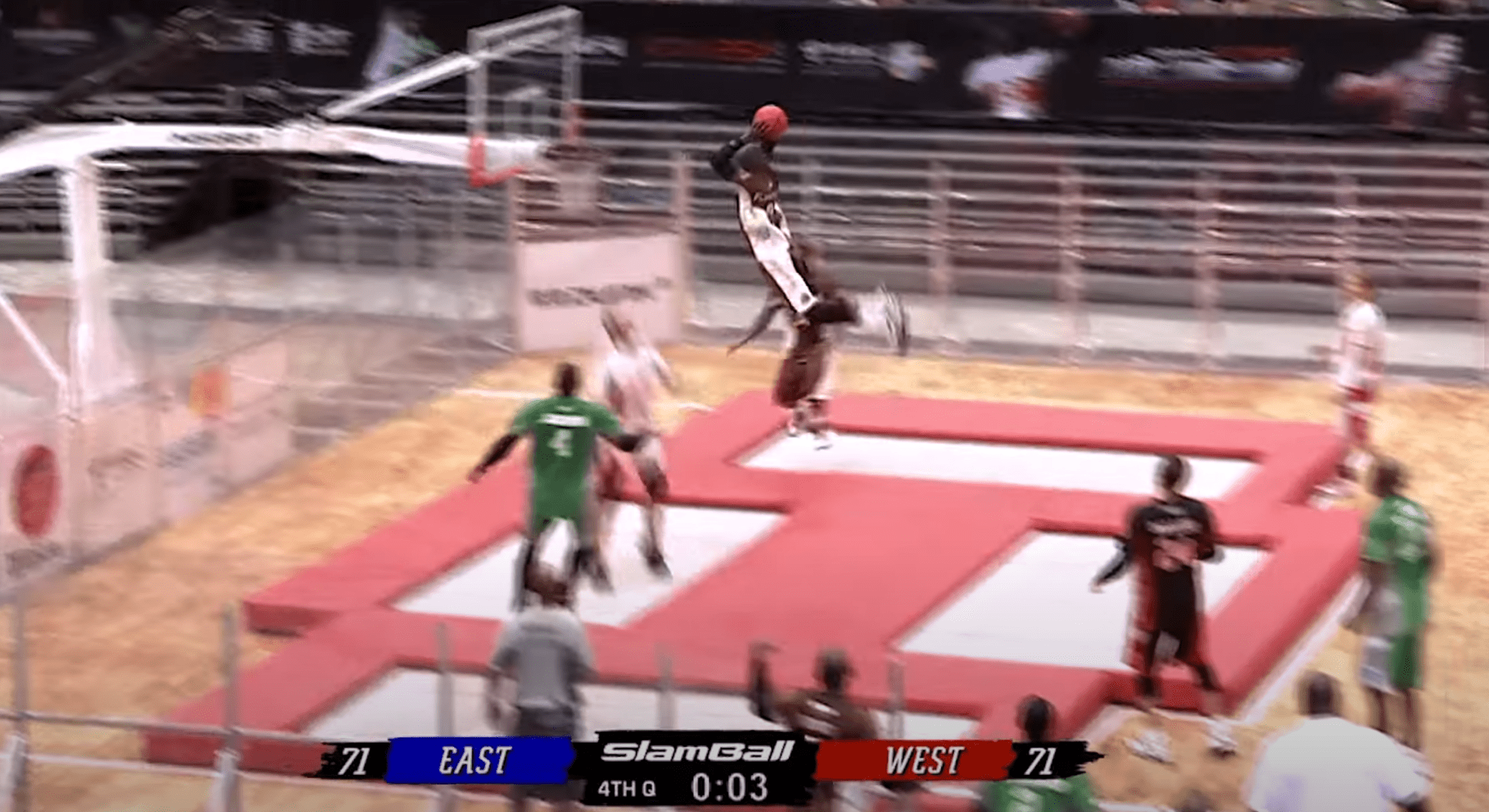
There's a moment in SlamBall that no other sport can manufacture: an athlete launches off a trampoline, rises to rim level, absorbs a legal full-body hit, and still manages to redirect the ball cleanly through the hoop. That sequence, compressed into two or three seconds, captures everything the sport demands from the people who play it. Three physical qualities have to converge at once: explosive vertical power, the durability to take and dish contact in the air, and enough aerial body awareness to finish or recover no matter what happens on the way down.
Vertical Explosiveness: The Foundation
Every possession in SlamBall routes through the trampolines embedded in the court, which means the ability to generate and absorb vertical force isn't a bonus attribute, it's the price of entry. Athletes who can't convert trampoline energy into controlled height quickly become liabilities on both ends of the floor. On offense, height determines finishing angles and separation from defenders; on defense, it determines whether a block attempt actually threatens the shooter or just provides entertainment from below.
What makes this more complex than standard basketball athleticism is the repetitive, reactive nature of trampoline jumping. An athlete isn't just leaping once per play; they're timing approaches, managing momentum off moving surfaces, and doing all of it while tracking opponents and the ball simultaneously. That skill set sits somewhere between gymnastics and power sports, which is precisely why SlamBall has always attracted athletes from multiple disciplines rather than converting basketball players wholesale.
Contact Durability: Playing Through the Air
Full-contact play is legal under the modern SlamBall ruleset, and that single rule changes the entire physical calculus of the sport. In traditional basketball, contact in the act of shooting draws a foul. In SlamBall, a defender can challenge a ball-carrier who is already airborne, which means athletes are routinely absorbing collisions at heights and angles that most sports pad, penalize, or outright prohibit.
This places a premium on a specific kind of toughness: not just the willingness to absorb contact, but the physical conditioning to do it repeatedly across a game without losing aerial control afterward. A player who flinches mid-jump, or who tightens up anticipating a hit, becomes unpredictable in the air. The most effective SlamBall athletes develop what might be called contact composure, the ability to register a collision as information rather than disruption, adjust body position in real time, and still execute the play.
The collision element also reshapes defensive strategy in ways that don't exist in any other major court sport. Defenders aren't limited to positioning and timing; they can physically contest an airborne offensive player within the ruleset. That turns every trampoline approach into a calculation: does the ball-carrier have the durability and spatial awareness to absorb what's coming, or does the defender gain an advantage by forcing contact before the jump reaches its peak?
Aerial Body Control: The Separator
Of the three physical pillars, coordinated aerial body control is the hardest to develop and the most visible to watch. Height and toughness create the conditions for spectacular play; body control is what actually produces it. An athlete who launches cleanly, absorbs contact at the peak of their jump, and still threads a dunk through the rim is demonstrating real-time proprioception, an internal sense of where every limb is positioned without being able to see it directly.
The stylistic dimension of SlamBall dunks isn't incidental. Because the trampolines generate significantly more height than a standard basketball jump, athletes have more time in the air, which creates both the opportunity and the obligation to control that time well. A clean, deliberate finish reads as skill. A scrambled, survival-mode finish after unexpected contact reads as athleticism. The best SlamBall players are capable of both, often on the same possession.
Recovery is the less celebrated half of this skill. When contact disrupts a player's trajectory mid-air, the difference between a dangerous fall and a controlled landing comes down entirely to body awareness. SlamBall's athletes need to be able to read their own momentum in real time and make micro-adjustments that redirect force into something manageable. That's not a skill that transfers automatically from basketball or football; it tends to come from backgrounds that include gymnastics, diving, or other disciplines where spatial orientation while airborne is explicitly trained.
Why the Combination Is Rare
Sports tend to specialize. Football builds contact durability but doesn't require aerial finesse. Gymnastics demands body control and explosive power but removes the collision element entirely. Basketball develops vertical athleticism and court vision but protects players in the act of shooting. SlamBall is one of the only competitive sports that sits at the intersection of all three demands simultaneously, and it does so in a live-game environment where the stakes are real and the margin for error is small.
That combination is what makes SlamBall athletes genuinely unusual as a category. The physical profile that produces an elite SlamBall player doesn't map cleanly onto any existing talent pipeline. It requires vertical power that rivals what NFL receivers and NBA guards develop, contact tolerance closer to what hockey and football players are conditioned for, and aerial orientation skills that most court sports never explicitly develop at all.
The sport's growth as a spectator product depends directly on how many athletes can actually meet all three demands at a high level. When they do, the result is the kind of play that no other sport can produce, a ball-carrier rising off a trampoline, taking a hit at the apex of their jump, and finishing through the rim with enough control to make it look almost routine. Almost.
This article was produced by Prism’s automated news system from verified source data, official records, and press releases, then run through automated quality and moderation checks before publishing. The system is built and supervised by the people who set the standards it runs under. Read our full AI policy.
Did this article answer your question?